Strategic Capabilities of SM-3 Block IIA Interceptors (June 30, 2016)

In two previous posts, I made estimated projections forward in time of the number of U.S. Navy ballistic missile defense (BMD) capable ships and the number of SM-3 BMD interceptors.[1]  These projections reached two main conclusions: (1) The number of BMD capable ships would reach the upper seventies (77) by 2040; and (2) The number of SM-3 Block IIA interceptors (including possible more advanced version of the missile) would be in the hundreds, possibly 500-600 or more, by the mid-to-late 2030s.

Several developments since those posts were written illustrate the uncertain nature of such projections.  In February 2016, it was revealed that the Navy had decided to upgrade three additional Flight IIA Aegis destroyers to the full advanced BMD capability (under the previous plan these three ships would have had no SM-3 BMD capability).[2]  In addition, it is still unclear how long the five Aegis BMD cruisers will remain in service, although this makes no difference to the longer term projections..

(more…)

Update on Future Ground-Based Midcourse (GMD) Flight Tests (April 20, 2016)

An updated description of planned GMD flight tests (last update was my post of April 12, 2015) as best I can reconstruct them.  Between now and mid-2021, it appears that MDA plans five intercept and one non-intercept test of the GMD system.

FY 2017:

FTG-15 (1Q FY 2017).  This is scheduled to be the first intercept test since FTG-06b in June 2014.  It will be the first GMD intercept test against an ICBM-range target (range greater than 5,500 km).  The target will include countermeasures.  FTG-15 will  also will be the first flight and intercept test of the new production CE-II Block-I version of the Exo-Atmospheric Kill Vehicle (EKV) and the first flight test of the upgraded C2 booster.   According to Admiral Syring, in this test “…we’re getting now out to the long-range and closing velocities that certainly would be applicable from a North Korean or Iran type of scenario.” [1]

FTG-15

FTG-15 (Image source: MDA)

(more…)

Updated List of Claims about GMD Effectiveness (April 14, 2016)

This is an updated list (previous version was June 16, 2015) of claims by U.S. government officials about the effectiveness of the U.S. Ground-Based Midcourse (GMD) national missile defense system.  It adds four additional claims (#33, #34, #35 and #36).

(1) September 1, 2000: “… I simply cannot conclude, with the information I have today, that we have enough confidence in the technology and the operational effectiveness of the entire NMD system to move forward to deployment. Therefore, I have decided not to authorize deployment of a national missile defense at this time.”  President Bill Clinton, at Georgetown University, September 1, 2000.

(2) March 18, 2003:  “Effectiveness is in the 90% range.[1]   Edward Aldridge, Undersecretary of Defense for Acquisition, Technology and Logistics.

(more…)

A Three-Stage Two-Stage GBI Interceptor (February 2, 2016)

One thing that was surprising (to me, at least) about Missile Defense Agency (MDA) Director Admiral James Syring’s January 19 2016 presentation at the Center for Strategic and International Studies was his description of the MDA’s planned two-stage version of the Ground-Based Interceptor (GBI).[1]

The MDA has long had plans to eventually incorporate a two-stage version of the three-stage GBI currently deployed in Alaska and California into its Ground Based Midcourse GMD) national missile defense system.

The idea of using a two-stage version of the GBI first came to public attention in 2006 when the George W. Bush Administration announced plans to deploy two-stage GBIs in Europe to provide an extra layer of defense of U.S. territory against Iranian ICBMs.  Although an agreement was reached in 2008 to deploy ten of the two-stage GBIs on Polish territory, in 2009 President Obama cancelled these plans in order to proceed with his European Phased Adaptive Approach (EPAA).  However, the possibility of deploying two-stage GBIs – this time on U.S. territory — was retained was retained as part of the GMD “hedge” strategy.[2]

(more…)

How Many SM-3 Block IIA Missiles? (January 25, 2016)

In a previous post, I projected the number of Aegis BMD ships, and in particular the number of ships with the “advanced” BMD capability, though 2045. I did this primarily because I was interested in the question of how many SM-3 Block IIA interceptors, which have a potentially significant capability to intercept intercontinental-range missiles, are likely to be deployed.  In this post, I turn to the question of projecting how many Aegis SM-3 block IIA interceptors the United States might eventually deploy on its ships and at its Aegis Ashore sites.

(1) Projection based on past and planned procurements.

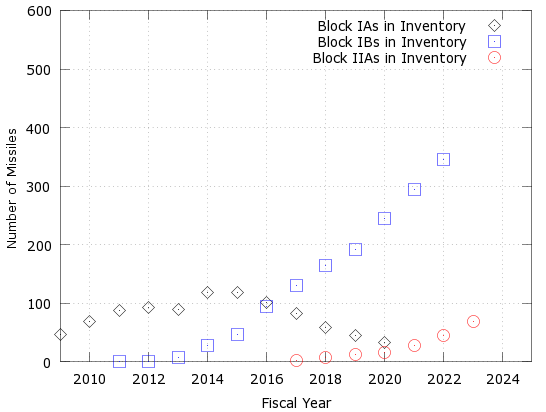
Figure 1 shows the number of SM-3 Block IA, Block IB and Block IIA missiles in inventory based on past procurements and planned future procurements.

AegisMissileProjection020716

Figure 1.  Number of SM-3 interceptors in inventory.  Diamonds are Block I/IAs, squares are Block IBs, and circles are Block IIAs.  Numbers do not include missiles expended in tests or retired because of reaching the end of their service lives.

(more…)

How Many Aegis BMD Ships in 2040? (December 13, 2015)

For another project, I was interested in how many SM-3 Block IIA interceptors and ships capable of launching them the United States would have in the future.  This post is the result of attempting to estimate how many Aegis BMD ships the United States would have by about 2040.  In the next post, I’ll look at the numbers of interceptors.


How Many Aegis BMD Ships Today?

The U.S. Navy currently has 22 Aegis cruisers and 62 Aegis destroyers.  Five of the cruisers (CGs 61, 67, 70, 72 and 73) have a BMD capability.  Of the destroyers, all of the Flight I and Flight II ships (28 ships, DDG 51 through DDG 78) have a BMD capability.  None of the 34 Flight IIA destroyers (though DDG 112) have yet been given a BMD capability.  Thus the United States currently has 33 BMD capable ships.  These numbers are reflected in Figure 1 below.

AegisShips2015Figure 1. Planned (the chart was made in 2013) deployments of BMD capable ships as of 2015. Chart from:  https://www.navalengineers.org/ProceedingsDocs/ASNEDay2014/Day1/AEGIS_CS2.pdf.

(more…)

Updated BMD Overview and GMD Presentations (May 27, 2015)

This post updates my post of  June 26, 2013, in which I collected together a number of the publicly available MDA Overview  and GMD System type briefings by MDA or other military/government officials (if you have one I missed, please send it to me).  Thanks to Laura Grego at the Union of Concerned Scientists for obtaining the Todorov slides and most recent Syring briefing (one by FOIA, the other just by asking MDA).

MDA Deputy Director Brigadier General Kenneth Todorov, April 2015: Todorov-CSIS-April72015

MDA Program Executive for Advanced Technology Richard Matlock: SMDC2014–Matlock-Adv-Tech

MDA Director Vice Admiral J. D. Syring, August 13, 2014: Slides: SyringAugust2014SMDC-Slides  Transcript: SyringAugust2014SMDCtranscript

MDA Director Vice Admiral J. D. Syring, August 2013: SyringAugust2013SMDC

MDA Program Executive for Advanced Technology Richard Matlock, August 2013: 2013-08-15-Matlock-AdvancedTechnology

MDA Director Vice Admiral James Syring, February 2013: BMD-Update-Syring-February2013

MDA Deputy Director Rear Admiral Randall M. Hendrickson, August 14, 2012: BMD-Update-Hendrickson-August 2012

“U.S. Ballistic Missile Defense,” Moscow, May 2012: US-BMD-Moscow-May2012

MDA Director Lt. General Patrick O’Reilly, March 2012: BMD-Update-O’Reilly-March 2012

MDA Director Lt. General Patrick O’Reilly, August 2011: BMD-Overview-O’Reilly-August2011

MDA Director Lt. General Patrick O’Reilly, September 2009: BMD-Overview-O’Reilly-September2009

MDA Director Lt. General Patrick O’Reilly, May 2009: BMD-Update-O’Reilly-May 2009

MDA Director Lt. General Trey Obering, May 2008: OberingMay2008NDIA

MDA Executive Director Dr. Patricia Sanders, June 2007: BMD-Overview-Sanders-June2007

MDA Director Lt. General Trey Obering, March 2007: BMD-Overview-Obering-March 2007

MDA Deputy Director Brigadier General Patrick O’Reilly, January 2007: BMD-Overview-O’Reilly- January 2007

Estimating the Composition of the 44 Deployed GBIs in 2017 (May 5, 2015)

Under current plans, the total number of deployed Ground-based Interceptors (GBIs) of the U.S. Ground-Based Midcourse Defense (GMD) system will reach a total of 44 by the end of 2017.  Three different types (and likely several sub-types) of Exo-Atmospheric Kill Vehicles (EKVs) will be deployed on these GBIs.  These are the original Capability Enhancement-1 (CE-I) version, deployed between 2004 and 2007, the follow-on CE-II version deployed between 2008 and 2015, and the new CE-II Block 1, which will be deployed starting in 2017.  The differences between these types of EKVs are described in my post of April 26, 2015.

In this post I try to estimate the composition of the deployed GBI force when the 44th GBI is deployed in 2017.

It seems clear that ten of the deployed GBIs will be the new CE-II Block 1 version. This assumes that the first flight and intercept test of a CE-II Block 1, currently scheduled for the third quarter of calendar year 2016, is successful. The MDA currently plans to deliver eleven CE-II Block 1s by the end of 2017, one of which will be expended in the intercept test  — FTG-15.

According to the Department of Defense’s Inspector General, through 2015, the U.S. has bought a total of 33 CE-I and 24 CE-II EKVs, for a total of 57.[1]  This numbers appears to be the final totals for each of these EKV versions, because by 2016 production will have switched over to the CE-II Block 1.  Under current test plans, by the end of 2017, seven CE-Is and six CE-IIs EKVs will have been expended in test flights.[2]  These tests will reduce the number of remaining EKVs to at most 27 CE-I and 18 CE-IIs.

According to the 2015 prepared statement of MDA Director Admiral Syring for Congressional committees, “Four previously fielded CE-II GBIs will be used for flight and Stockpile Reliability testing.”  Removing these four GBIs  leaves 16 deployable CE-II GBIs, since two of the CE-IIs (CTV-02+ and FTG-11) to be withdrawn for testing were already subtracted out of our count in the previous paragraph.

A total of 16 deployed CE-IIs is consistent with Admiral Syring’s statement in his 2015 prepared testimony that eight new CE-IIs would be deployed in 2015 and that eight currently fielded CE-IIs would be upgraded in FY 2016.

With sixteen CE-IIs deployed, the breakdown at the end of 2017 would be:

10 CE-II Block-1s

16 CE-IIs

18 CE-Is

Thus at that point less than half of the deployed GBIs would be CE-Is.

An alternate method of attempting to count the number of deployed CE-II GBIs is included at the end of this post.


Continuing out past 2017:

The further out one goes in time, the more speculative attempts to estimate the EKV stockpile become. However, several general points can be made:

(1) MDA budgetary materials suggest that few if any new GBIs will be deployed using funding from its RDT&E account from 2017 to 2020.[3]  All the currently deployed GBIs as well as those planned for deployment through 2017 have been bought through the MDA’s RDT&E account.  GBIs usually require several years from initial procurement to deployment, and there are no indications in the RDT&E budget materials of plans to procure additional GBIs for deployment in the near future.

Specifically, in the Ground Based Interceptor Manufacturing budget element for FY 2016, MDA cites only three projects:

— Completing the planned deliveries of CE-II equipped GBIs.

— Continuing the manufacturing of the eleven CE-II Block 1 GBIs planned for deployment (and use in a test) by the end of 2017.

— Beginning acquisition of two new GBI boosters.  These are likely the two boosters that will be used in the flight and intercept tests of the new Redesigned Kill Vehicle (RKV) planned for FY 2018 and FY 2019.

(2) Beginning in FY 2018, MDA will begin procuring two GBIs per year under its Procurement account.  These GBIs are needed to provide additional GBIs to support flight testing, stockpile reliability, and spares requirements associated with the increase from 30 to 44 deployed GBIs.  Under previously announced plans, a total of ten GBIs will be bought over five years for these purposes.  Initially, these GBIs will likely be equipped with CE-II Block 1 EKVs and be deployed to free up older deployed GBIs for testing.  Thus by about 2019-2020, the numbers of deployed CE-1s will likely to begin declining in favor of CE-II Block 1s.  It is possible that starting in 2020, these GBIs will start to be equipped with RKVs — if not, then it seems that both CE-II Block 1 EKVs and RKVs would have to be in production at the same time.

(3) Under current plans, MDA plans to begin deploying RKV-equipped GBIs in 2020.  There has been no public indication of how rapidly such new GBIs might be deployed.  One possible factor might be that the EKV-equipped GBIs are said to have a twenty-year lifetime, and the last CE-I equipped-GBIs were deployed in 2007.  Replacing all of the deployed CE-Is by 2027 would only require an RKV deployment rate of somewhat over two per year.  Of course, if it was decided to establish an East Coast interceptor site, the rate of RVK production would have to increase very significantly.

An alternate attempt estimate of the number of CE-II GBIs at the end of 2017:

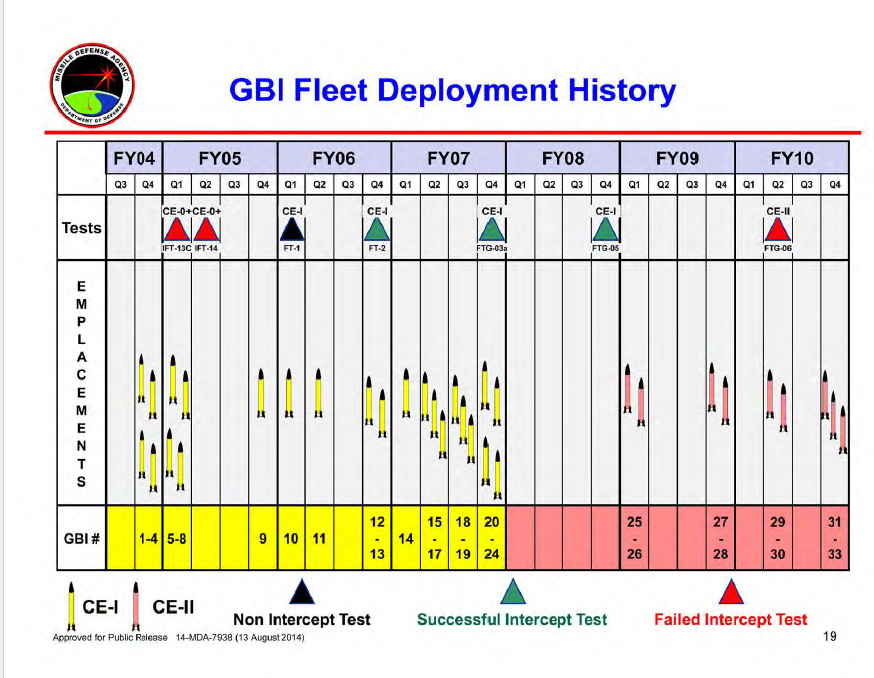
Another way to try to estimate the number of deployed CE-IIs is by the numbers assigned to individual GBIs in MDA budget documents.  These numbers are the same as those used in the slide entitled “GBI Fleet Deployment History,” in Admiral Syring’s 2015 SMDC Conference presentation, as shown below (click on image for larger version).  As Admiral Syring’s slide shows, the first twenty four deployed GBIs were CE-1s that were deployed before the end of September 2007.  These GBIs were designated GBI 1 through GB 24.  The slide makes clear that at that time only GBIs intended for deployment are included in this numbering scheme.
GBIDeployments

Deployment of GBIs resumed with the first CE-II GBI — GBI 25 – in October 2008.  The first six CE-II GBIs – GBI 25 through GBI 30 – were deployed into empty silos, bringing the total number of deployed GBIs to the objective total of thirty.  Admiral Syring’s slide shows three additional CE-II GBIs (GBI 31 to GBI 33) were deployed by the end of FY 2010.  These three GBIs replaced existing deployed CE-I GBIs.  Thus at the end of FY 2010, there would have been twenty one deployed CE-I GBIs and nine deployed CE-II GBIs.

In addition to the nine deployed CE-IIs, by the end of 2010 there appear to be two or three CE-II EKVs that were outside of this numbering scheme.  These are the EKVs used in intercept test FTG-06, which took place in January 2010, and one or both of the EKVs intended for intercept test FTG-09, which was a salvo test (two interceptors against one target) scheduled for FY 2011.  Following the failure of FTG-06, FTG-09 was cancelled in order to conduct FTG-06a, which also failed.

Following the failure of FTG-06a, deliveries of CE-II EKVs were suspended.  MDA budget documents show that the first of the suspended deliveries was GBI 34.  Thus at the time of this suspension, there would have been nine deployed CE-II GBIs (GBI 25 – GBI 33) and two CE-IIs expended in intercept tests.  However, the GAO has stated that, at the time of the suspension, twelve CE-II GBIs had been delivered and ten of these had been deployed.  The reason for this discrepancy is unclear (to me).  One possible, although speculative, resolution to this discrepancy would be that the both of the interceptors for the planned FTG-09 salvo test were CE-II GBIs (as opposed to what is now planned as the first salvo test, FTG-11 in FY 2017, which will use one CE-I and one CE-II).  Both of these CE-II GBIs would be outside the GBI numbering scheme, and the EKV not expended in FTG-06a could have been subsequently deployed, bringing the total number of deployed CE-II GBIs up to ten.

In 2013 and 2014, two CE-II EKVs were expended in the flight test CTV-01 and the intercept test FTG-06b.  According to MDA budget documents, both of these CE-II EKVs were pulled from the ones that had already been deployed, bringing the number of deployed CE-IIs down to seven or eight.

Following the successful intercept test FTG-06b in 2014, MDA once again began accepting deliveries of CE-II-equipped GBIs.  According to MDA budget documents, the next batch of eleven CE-II GBIs (GBI 34 to GBI 44) will be delivered before the end of FY 2016, bringing the total to eighteen or nineteen deployed.  Taking into account the four deployed CE-II GBIs that in 2015 MDA Director Syring said would be withdrawn from deployment, the total number of deployed CE-II GBIs would then be fourteen of fifteen.

This counting scheme only totals twenty three CE-II EKVs.  Given that the DoD Inspector General reports total of twenty four CE-IIs were delivered, and the conclusion above that sixteen CE-IIs will be deployed by 2017, it appears likely that there is one more CE-II GBI that is for some reason outside the GBI numbering system. (In addition, there is no reference to GBIs 45, 46 and 47 in the MDA budget documents.)

Production and delivery of GBIs will subsequently continue with eleven CE-II Block 1 GBIs (GBIs 48-58).  This Block 1 numbering of GBIs appears to differ from the previous GBI numbering scheme in that it includes GBIs both for deployment and testing, and in particular it includes the GBI for the FTG-15 intercept test, scheduled for 2016. This would leave ten CE-II Block 1s for deployment by the end of 2017.

[1] Inspector General, U.S. Department of Defense, “Exoatmospheric Kill Vehicle Quality Assurance and Reliability Assessment – Part A,” DODIG-2014-111, September 8, 2014, p. 7. Available at: http://www.dodig.mil/pubs/documents/DODIG-2014-111.pdf.

[2] For the CE-Is, these are FT-1 (2005), FTG-2 (2006), FTG-3a (2007), FTG-5 (2008), BVT-1 (2010), FTG-07 (2013), and FTG-11 (2017). For the CE-IIs, These are FTG-6 (2010), FTG-6a (2010), CTV-01 (2013), FTG-06b (2014), CTV-02+ (2015) and FTG-11 (2017).

[3] By budgetary materials, I primarily mean the annual MDA RDT&E Budget Justification Books available on the Department of Defense’s Comptroller’s website. For example, the FY 2016 materials are at: http://comptroller.defense.gov/Portals/45/Documents/defbudget/fy2016/budget_justification/pdfs/03_RDT_and_E/MDA_RDTE_MasterJustificationBook_Missile_Defense_Agency_PB_2016_1.pdf.

The Track Gate Anomaly: Does it also Affect CE-I Kill Vehicles? (August 15, 2014, revised 8/18/2014)

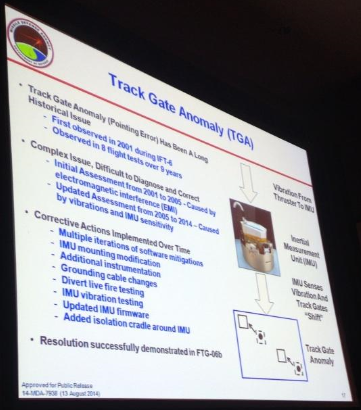
On Wednesday August 13, at the Space and Missile Defense Symposium, MDA Director Vice Admiral James Syring was one of the featured speakers. As Admiral Syring started to go through his slides, Aviation Week reporter Amy Butler began to photograph the slides. Even though the the slides were clearly marked “Approved for Public Release,” meeting organizers quickly stopped her, saying photographing of the slides was not permitted. However, before she was stopped she managed to photograph twelve of the slides and subsequently posted them on twitter (she tweets as @ABAviationweek). You can read her account about the slides and her (sucessful) attempt to ask Admiral Syring a question here:

The twelve slides that were posted are actually more detailed and interesting then those in your typical MDA briefing. Hopefully they will all soon be publicly available.

The slide that struck me as the most interesting was one titled “Track Gate Anomaly (TGA)” shown below:

TrackGateAnomaly

(more…)

Could SM-3 Interceptors be Deployed Rather than Additional GBIs? And is the SM-3 Block–IIB Making a Comeback? (Probably Not.) A tale of battling transcripts. (July 10, 2013)

At his July 9 daily press briefing, Pentagon Press Secretary George Little stated that the Department of Defense was considering deploying Navy SM-3 interceptors in addition to or instead of the 14 additional Ground Based-Midcourse (GMD) Ground-based Interceptors (GBIs) that are currently planned for deployment in Alaska by 2017.  Here what he said, from a transcript posted on the DoD’s website:

LITTLE:  There are no plans to change our expansion to 44 Ground Based Interceptors.  And as I understand it, we’re looking at deploying a different kind of system, the SM3 (inaudible) system as part of the additional Ground Based Interceptors. 

This is pretty big news, it seems to me.  But it gets even more interesting.

Here’s the same statement by Little, as transcribed by CQ Transcriptions:[1]

LITTLE:  There are no plans to change our expansion to 44 Ground Based Interceptors.  And as I understand it, we’re looking at deploying a different kind of system, the SM3 BII (ph) system as part of the additional Ground Based Interceptors. 

In this version, he not only says they are considering deploying SM-3s, but he specifically says they are considering deploying the Block IIB variant of the SM-3 interceptor!   

(For those of you not up on SM-3 versions, the SM-3 Block IIB was the very high speed version of the SM-3 that the DoD announced the cancellation of at its March 15, 2013 press conference announcing the deployment of the 14 additional GBIs.  This cancellation was significant because, at least up to that time, the Block IIB version has been the primary focus of Russian complaints about US missile defense plans.)

So is the SM-3 Block IIB making a comeback?  Or is the “inaudible” on the DoD website’s transcript simply a way of correcting a misspeaking?  The follow up queston suggests that the statement may simple be an error.

QUESTION:  I don’t want to correct you, but the issue is a new warhead on the — that’s got to be proven out.  The thing you just mentioned I think was canceled… 

      (CROSSTALK) 

LITTLE:  OK.  Well, we’re — we’re taking a look at another system, I think, and — for the GBIs. 

Nonetheless, this is the first offical statement (I think) indicating tht SM-3s, of whatever type, might be deployed as substitutes for GBIs.


[1] “George Little, Defense Department Press Secretary, Holds Defense Department Regular News Briefing, CQ Transcriptions, July 9, 2013.