Want Something to Remember GMD Test FTG-07 By? You Can Get it Here. (July 8, 2013)


FTG07Patch

Did you know the Missile Defense Agency has a store?  I didn’t until a few minutes ago.  But here it is: http://missile.bigcartel.com/

I have no idea if this is in any way an official site (from the URL, maybe not).  But where else can you get your MDA mission shirts and patches?

For example, you can get your patch (pictured above) for last Friday’s FTG-07 test of the Ground-Based Midcourse Defense (GMD) system.  Unfortunately, they only come in packs of 50 for $400.  (However, they probably will not sell out any time soon)

On the other hand, you can get a patch from the somewhat more successful FTI-01 test of last year for only $1 (pictured below).

FTI01Patch

Updated Table of Ground-Based Midcourse (GMD) intercept tests. (July 7, 2013)

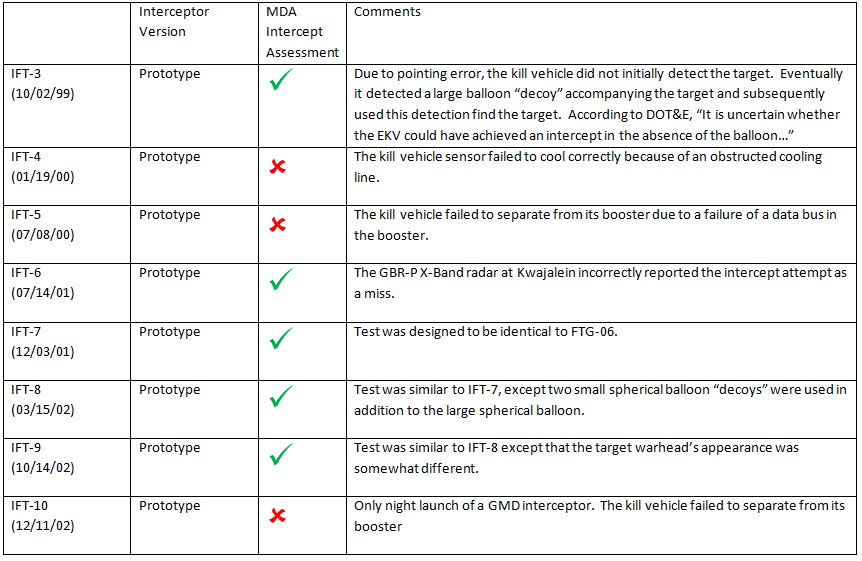
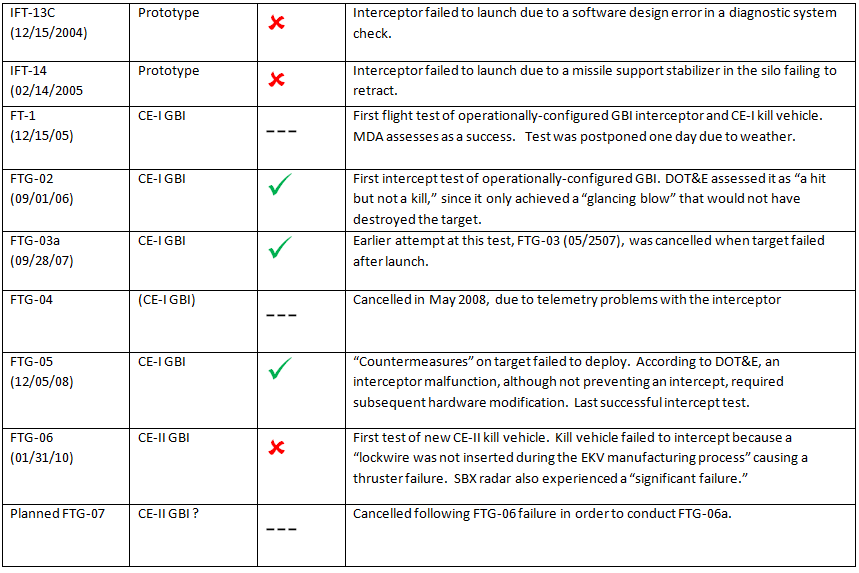
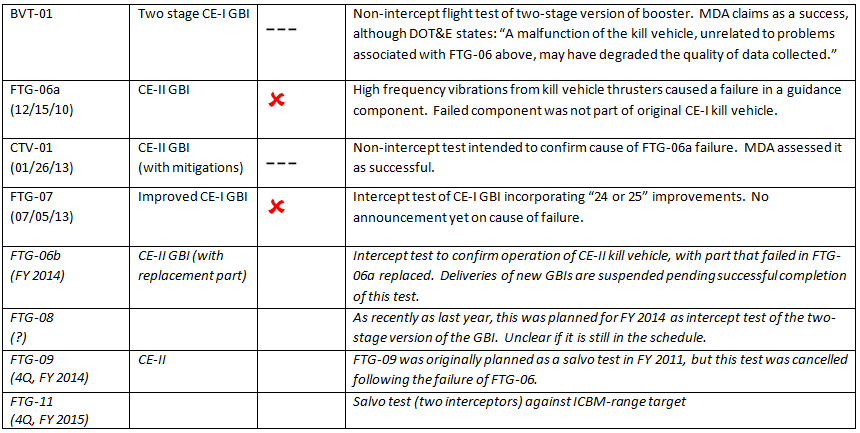
Updated Table of Ground-Based Midcourse (GMD) intercept tests.  Several non-intercept tests that used actual kill vehicles and several recently cancelled tests are also included.  Unfortunately, I had to split it into three pieces. Click on each section of the table for larger versions.

(Update, July 8: Major technological advance: I have figured out how to post the table as a single table.  Click here for the single table version – you will probably have to click on one more box to get the table)

GMDTestTable1

 GMDTestTable2

GMDTestTable3

Ballistic Missile Defense: Ground-Midcourse Intercept Test Fails (July 5, 2013)

The first intercept test of the GMD national missile defense system since December 2010 has failed to achieve an intercept.  The test was designated FTG-07, reviving the designation of an earlier cancelled intercept test (see the end of this post).  The last successful intercept test of the GMD system was FTG-05, conducted on December 5, 2008.

The primary stated purpose of FTG-07 was to test the many changes that have been made to the GBI interceptor since it was deployed.  Ten of the thirty deployed interceptors are a new version of the GBI using the new CE-II version of the kill vehicle.  However, these ten interceptors are not considered operational, because the CE-II version of the GBI failed in both of its intercept tests.

The other twenty deployed GBIs are older interceptors using the original CE-I version of the kill vehicle.  It was a refurbished version of the CE-I GBI that was tested today.

Although the three previous intercept tests (in 2006, 2007, and 2008) of this CE-I version of the GBI have all been described by the MDA as successful, many problems with these interceptors have been discovered.  According the GAO, as of 2011:  “all GMD flight tests have revealed issues that led to either a hardware or software change to the ground-based interceptors.”[1]  Accordingly, in 2007, MDA began a program to refurbish the older, already deployed CE-I GBIs.  [The deployment of 24 CE-I interceptors was completed in FY 2007.  Four of them were subsequently replaced by CE-II interceptors.]  This refurbishment program, which the GAO has estimated will cost between $14 and $24 million per interceptor, is still ongoing.[2]  According to MDA Director Vice Admiral James Syring, FTG-07 would test out 24 or 25 “improvements” to the CE-I GBI.[3]

In addition, this test has been described as using a “complex” target.  It is unclear exactly what this means, but it may indicate that that this was the fourth attempt to intercept a target using “countermeasures.”  (In the previous three attempts, the decoys failed to deploy in one test, and the interceptor failed in the other two).

Bottom Line: Although we need to wait for details, this test failure may pose a particular problem for GMD advocates.  In recent years, when asked about whether or not the GMD system could be relied on to be effective, the standard MDA reply has been that although the two most recent intercept tests had failed, these were of the new CE-II GBIs, and the older GBIs could still be relied on.

For example, here is part of Admiral Syring’s response to a question during his most recent Congressional testimony:[4]

ADM. SYRING:  “Let me take that, and then maybe, sir, I’ll cede some time to Dr. Gilmore.  The systems we have today work.  And I’ll keep — I’ll keep it that simple.  The older systems, which we call the CE1 interceptors, have been successfully flight tested three out of three times.

The problem that we’ve had recently with the newer interceptor — and those failures both occurring in 2010 — and that’s the flight test that I — that I spoke about in terms of the January fix was flown in a nonintercept flight and then we’ll fly later this year in an intercept flight to validate the performance of the new kill vehicle.”

The failure of FTG-07 could put a serious dent in that argument.


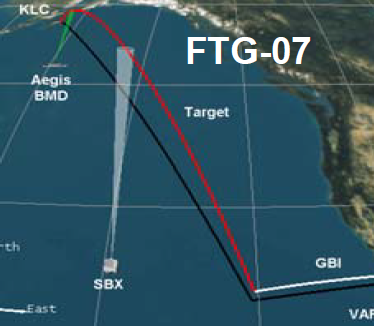
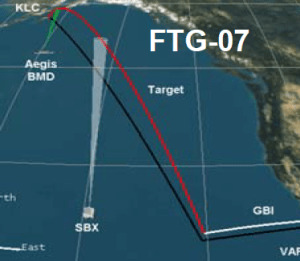
Historical Note:  The original FTG-07 (see figure below) was planned as a two-stage GBI intercept test against an IRBM target, and as of June 2009, it was scheduled for 4Q of FY 2010.  The target launch was to be from Kodiak, rather than Kwajalein.  However, after the failure of FTG-06, this test was cancelled in order to conduct FTG-06a.[5] 
 

 FTG07

Figure 1.  FTG-07 as originally planned but since cancelled.


[1] Government Accountability Office, “Missile Defense: Opportunity Exists to Strengthen Acquisitions by Reducing Concurrency,” April 2012, pp. 18-19.

[2] GAO, Missile Defense: Opportunity Exists to Strengthen Acquisitions by Reducing Concurrency,” April 2012, pp. 78.

[3] “We’ve incorporated over 20 — I want to say 24 or 25 improvements to the current CE-1 fleet that I’ll demonstrate in flight within the next month, and that — those improvements and those continued — the continued improvements of the current fleet is part of my R&D request as well.” Vice Admiral James Syring, House Armed Services Committee, May 8, 2013.

[4] Strategic Forces Subcommittee, Senate Armed Services Committee, May 9, 2012.

[5] GAO-11-372, p. 27.

Free E-book on Norway and Space Security (February 12, 2013)

Author Bård Wormdal’s book “The Satellite War,” about Norway’s military-related outer space activities is now available for free at http://www.amazon.com.  I’ve only just started to read it.    You can download it at: http://www.amazon.com/The-Satellite-War-ebook/dp/B009J1D1N4.  The last two chapters discuss the Globus-II (formerly HAVE STARE) radar at Vardo.  Wormdal’s message to me today said the book would be free “this week,” so if you are interested you might want to download it soon.

Ballistic Missile Defense: Estimating the Range of an Aegis Radar against a Missile Warhead Target (October 23, 2012)

Estimating the Range of an Aegis Radar against a Missile Warhead Target

By George Lewis and Theodore Postol

In our post of September 21 (https://mostlymissiledefense.com/2012/09/21/ballistic-missile-defense-radar-range-calculations-for-the-antpy-2-x-band-and-nas-proposed-gbx-radars-september-21-2012/), we estimated the range of an AN/TPY-2 X-band radar against a warhead target.  For a target radar cross-section of 0.01 m2 and with a radar dwell time of 0.1 seconds, we obtained a detection range (assuming S/N = 20) of 870 km and a discrimination range (assuming S/N =100) of 580 km.  In this post, we make similar estimates for the Aegis SPY-1 radar, and get significantly shorter ranges of 550 and 370 km, respectively.  These numbers seem likely to substantially overestimate an Aegis radar’s actual operation range.

(more…)

Illustration of Radar Imaging of Satellite (May 20, 2012)

Recently published test range images provide an interesting illustration of U.S. capabilities to image satellites.

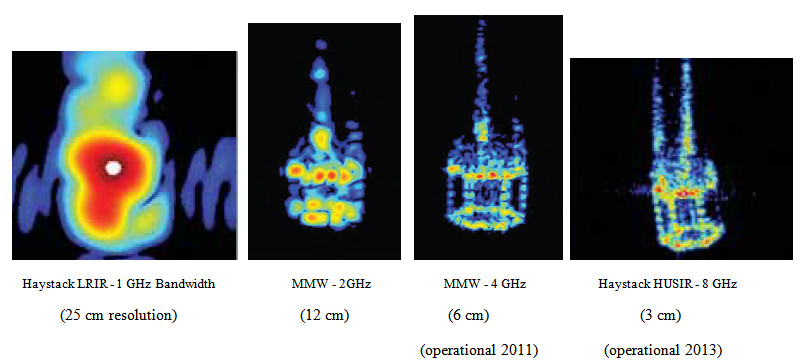
By combining range and Doppler measurements, wide-bandwidth radars can produce photograph-like images of satellites.  The range resolution of a radar is limited to about c/2β, where c is the speed of light and β is the radar’s bandwidth, although for radar processing reasons this limit is not always achieved.  For example, for β = 1 GHz, such as is used by the X-Band Haystack Long-Range Imaging Radar (LRIR)  (and the U.S. X-Band missile defense radars), this formula gives a range resolution of 15 cm, although the Haystack LRIR reportedly only achieves a resolution of 25 cm.  A small cross-range resolution can then achieved by observing a target as it rotates relative to the radar.  This rotational motion can be either due to the satellite’s own spin or simply due its orbital motion relative to the radar.   Typically a rotation of a few degrees is required to get a cross-range resolution equal to the range resolution. 

All U.S. radar images of real satellites are officially classified (although two apparently from HAVE STARE have been published on the internet).

However, the recently published 2011 Lincoln Laboratory Annual Report contains two images of a satellite model at a test range, corresponding to the resolutions of the Millimeter Wave (MMW) radar at Kwajalein before and after its upgrade from 2 GHz bandwidth (12 cm resolution) to 4 GHz Bandwidth (6 cm resolution).  The previous year’s Annual Report contained similar images for the Haystack LRIR at 1 GHz (25 cm resolution) and after its planned upgrade to 8 GHz (~ 3 cm resolution).  I have combined these to give a progression of improving resolution:


Here is a picture of the model used for the Haystack measurements (from the 1010 Annual Report):


 It is not clear that the same model is used for both the Haystack , as its relative dimensons appear different in the two sets of images (although this could be a viewing angle effect).  Nevertheless it provides an intersting illustration of the rapidly improving U.S. capabilities in this area  (although the last two images don’t look very different to me).