MDA Reports Successful Aegis SM-3 Block IB Intercept Test (October 4, 2013)

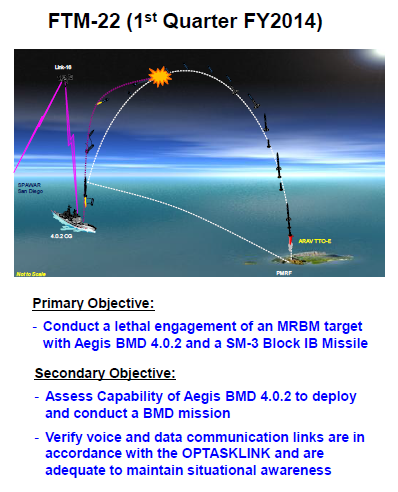
The MDA has announced that yesterday  it conducted a successful intercept test of an SM-3 Block IB interceptor against a seperating medium-range target.  This test, designated FTM-22 , would be the fifth successful intercept test of the SM-3 Block IB after the first intercept test failed.  The MDA has previously stated that successfully completing FTM-22 would allow full rate production of the Block IB interceptor to begin.

The image below (from MDA) was made before test.

FTM-22

Updated Table of Aegis Intercept Tests (September 20, 2013)

Here is an updated table of Aegis BMD intercept tests (see note below the table for how to view a much more readable version of the table).

Target Key: S = short-range, M = medium-range, IR = intermediate range, U = unitary (non-separating), Sp = separating

Click on the rectangular icon at the right (next to the plus and minus magnifiers) to get a much more readable version.

Successful Salvo Test of SM-3 Block IB Announced. (September 19, 2013)

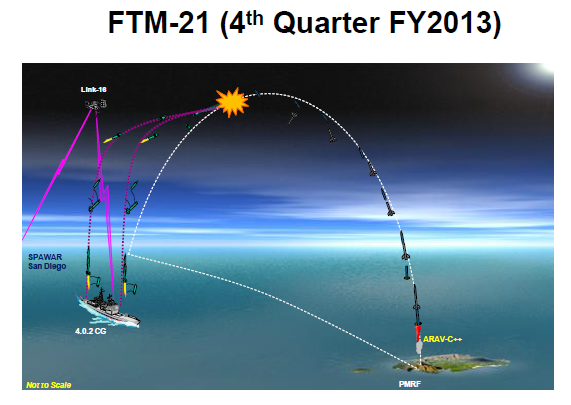
The Missile Defense Agency (MDA) yesterday announced that it had successfully conducted an intercept test of the Aegis SM-3 Block IB interceptor.  In the test, labeled FTM-21, two SM-3 Block IB interceptors  were salvo launched  (that is, sequentially launched against a single target) from the Aegis cruiser Lake Erie, equipped with the Aegis 4.0.2 system, at a short-range ballistic missile target with a separating warhead.  The first of the two interceptors reportedly hit and destroyed the target warhead.

FTM-21

Figure 1.  Illustration of FTM-21 (made prior to the test).  Image source: MDA

This was the first salvo test using two SM-3 interceptors.  In MDA’s previous intercept test, FTO-01 held on September 10, 2013, an SM-3 Block IA and a THAAD interceptor were salvo fired at a medium-range target.  In both tests, the first interceptor reportedly hit the target, leaving nothing for the second missile to intercept.

According to the MDA, in FTM-21 “…the target complex was the most difficult engaged to date.”  The target complex likely consists of at least the target warhead, the rocket booster, and debris associated with the warhead deployment.  Whether any Aegis target complex has included other objects deliberately released (such as decoys) has not been publicly revealed.

This was the fourth successful intercept attempt of the Block IB interceptor, following an initial failed intercept attempt on September 1, 2011.  The next Aegis test, FTM-22, is scheduled for later this year.  If this test, of an SM-3 Block IB interceptor against a medium-range target, is successful, full rate production of the SM-3 Block IB could begin.

Aegis BMD and Related Briefings (September 12, 2013)

As described in my post of September 10, I am now compiling collections of official briefings on missile defense topics in “Missile Defense Compilations” section of the blog.  This post includes briefings on Aegis Ballistic Missile Defense (BMD) and related topics:

Rear Admiral Jim Syring (Program Executive Office, Integrated Warfare Systems, “Navy IAMD Capabilities,” July 12, 2012 (IAMD = Integrated Air and Missile Defense): 2012-7-SyringNavyAegis

Captain Brian Shipman (Aegis BMD Chief of Staff), “Aegis BMD Overview,” January 23, 2012: 2012-1Aegis_BMD_Overview_MAC_CAPT Shipman 23 AEGIS-Jan 12_ 2012-Shipman

Ms. Laura DeSimone (Deputy Program Executive, Aegis BMD), “Aegis BMD; The Way Ahead,” December 6, 2011: 2011-12AegisDeSimoneDec2011

Rear Admiral Joe Horn (Aegis BMD, MDA), “Aegis BMD Overview,” July 21, 2011:2011-7-Horn-SmallBusiness

Mr. Scott Perry (MDA), “Aegis BMD Update,” July 14, 2011: 2011-7-Aegis-Perry

Captain Mike Anderson (Aegis BMD Technical Director, MDA), “C4I Evolution,” February 11, 2011: 2011-2-Anderson

Rear Admiral Joe Horn (Aegis BMD Program Executive), “Aegis BMD Overview,” July 13, 2010: 2010-7-AegisBMDOverview-RDMLHorn

Vice Admiral J.T. Blake (Deputy Chief of Naval Operations for Integration of Requirements and Resources), “Integrated Air and Missile Defense,” July 13, 2010: 2010-07-IAMD-Blake

Rear Admiral Alan B. Hicks (Aegis BMD Program Director), “Aegis Ballistic Missile Defense Overview,” August 3, 2009: 2009-8-AegisHicks

Rear Admiral Alan B. Hicks (Aegis BMD Program Director), “Aegis Ballistic Missile Defense Overview,” June 18, 2008: 2008-6-AegisNDIA_Hicks

MDA, “Aegis BMD – Status, Integration, and Interoperability,” May 6, 2008: 2008-5-AegisBMD-StatusIntergrationandInteroperability

Rear Admiral Alan B. Hicks (Aegis BMD Program Director), “Aegis Ballistic Missile Defense Overview,” November 28, 2007: 2007-11AegisHicks

MDA, “Aegis Ballistic Missile Defense,” September 28, 2006: 2006-6-Aegis06282006

Rear Admiral A. Brad Hicks, “Aegis Ballistic Missile Defense (BMD) System, December 19, 2005:  Link to briefing. 

MDA Announces Successful Test FTO-01 (September 11, 2013)

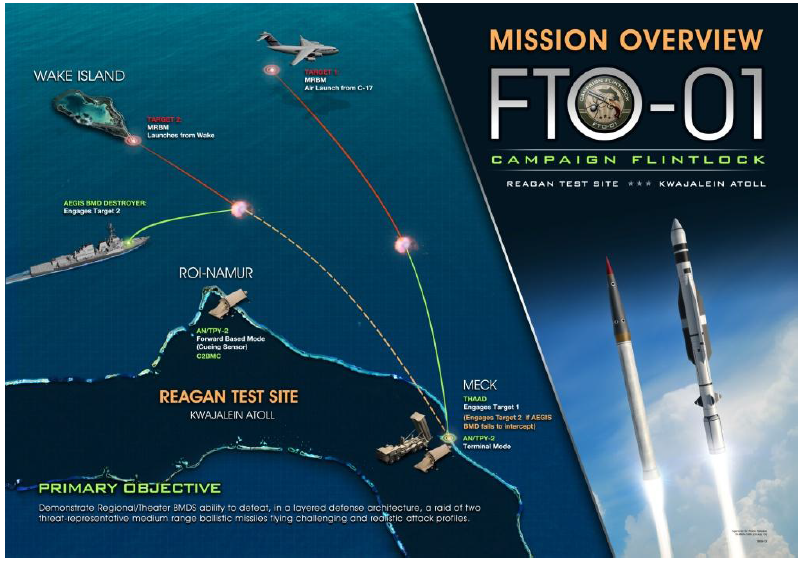
Yesterday the MDA announced the successful completion of test FTO-01.  As illustrated in Figure 1 below (made before the test), in this test, conducted on and near Kwajalein Atoll,  two medium-range ballistic missile targets were intercepted, one by an Aegis SM-3 Block 1A interceptor launched from an Aegis  cruiser and the other by a land-based THAAD interceptor.   In both intercepts, cuing from a TPY-2 X-band radar operating in its forward-based mode was used.  The MDA News Release described the test as an “operational” test that demonstrated a “layered defense architecture.”  The “layered defense architecture” here refers to the launch of a second THAAD interceptor that would have attempted to intercept the target hit by the SM-3 if the SM-3 had failed to destroy the target.  Since the SM-3 hit its target, this second THAAD interceptor did not attempt an intercept, although it likely collected some interesting data on the intercept scene.  

FTO-01-1

Figure 1.  The plan for test FTO-01.  From slide 17 of an August 14, 2013 briefing by MDA Director Vice Admiral James Syring, available at: https://mostlymissiledefense.com/2013/09/10/mda-overview-briefings-september-10-2013/.

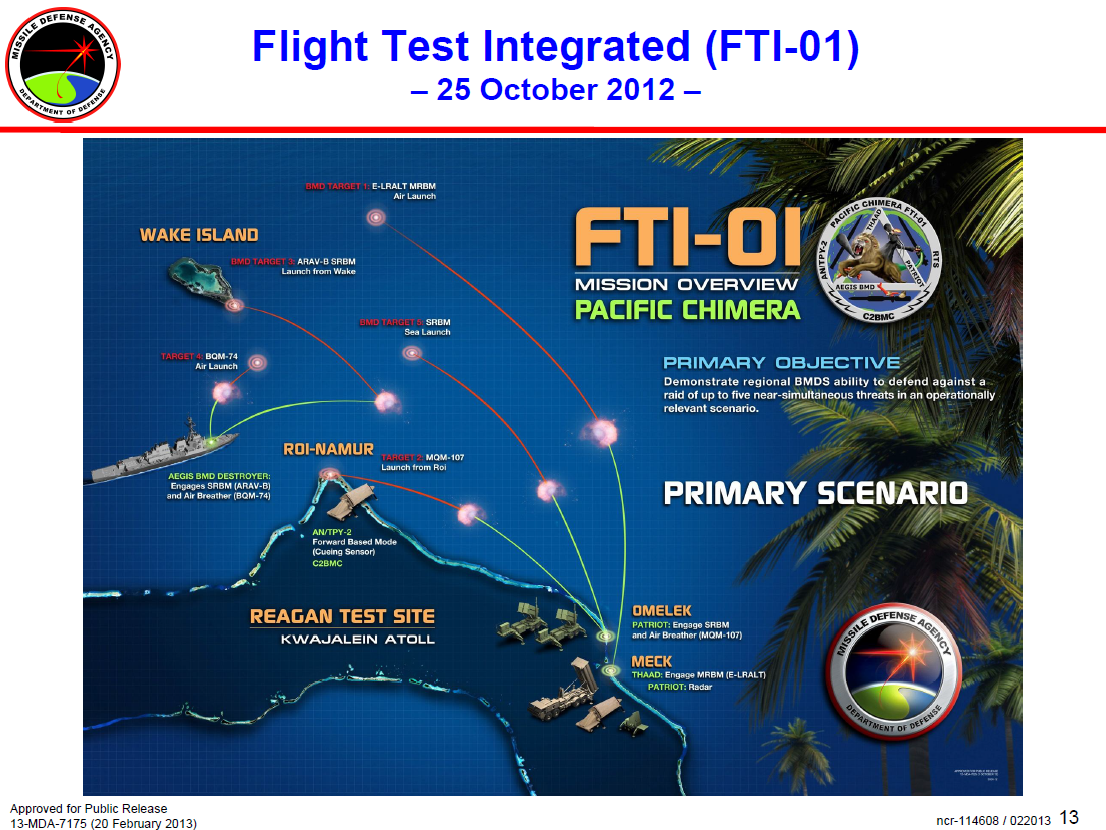
It is interesting to compare this test to the previous, arguably even more complex, combined test, FTI-01, held in October 2012.  This test is shown in Figure 2 below (from after the test).  In this test, five interceptors (two SM-3 Block IA, one THAAD, and two Patriot) attempted to intercept five ballistic missile or aircraft targets in one-on-one engagements (all apparently occurring within a short period of time.)

 FTI-01-1

Figure 2.  Geometry of test FTI-01.  From briefing by MDA Director Vice Admiral James Syring, February 22, 2013.  Available at: https://mostlymissiledefense.com/2013/09/10/mda-overview-briefings-september-10-2013/.

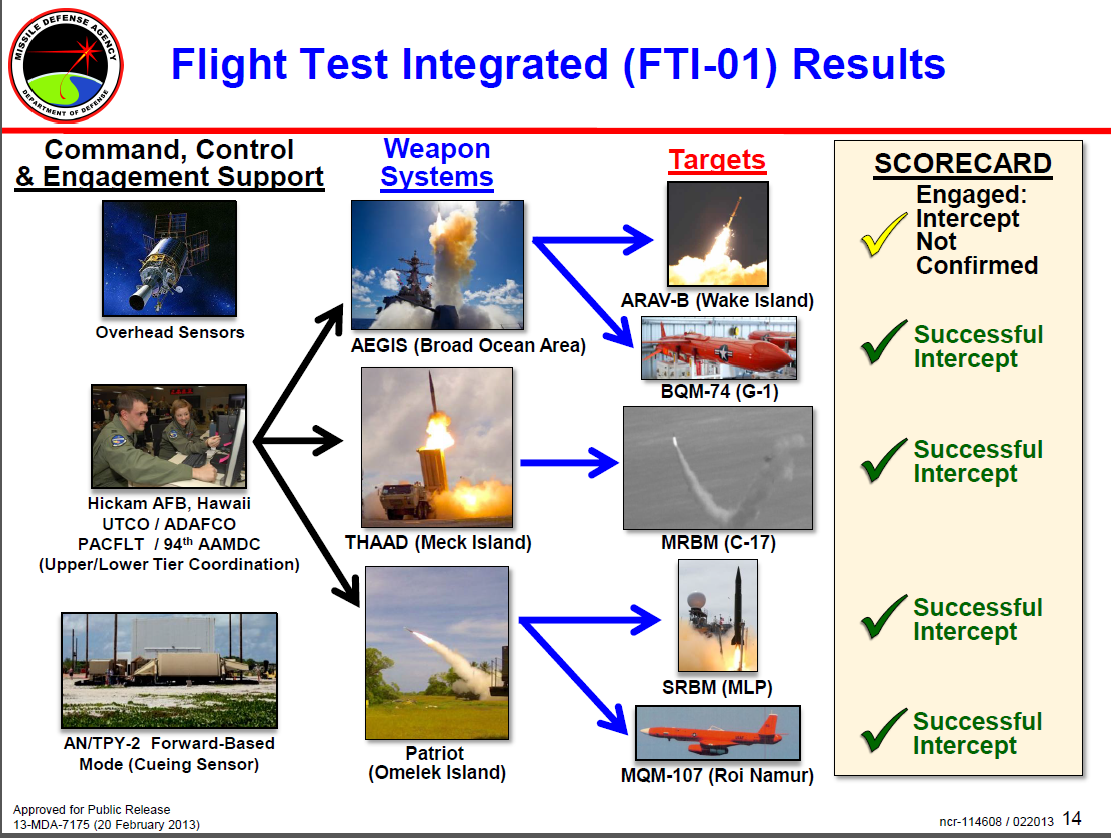
Unlike yesterday’s test, which was called an operational test, FTI-01 was described as a combined developmental-operational test (precisely why it was not a fully operational test is unclear to me).  The results of FTI-01 are shown in Figure 3 below.

 FTI-01-2

Figure 3.  Results of FTI-01 (October 2012).  From briefing by MDA Director Vice Admiral James Syring, February 22, 2013.  Available at: https://mostlymissiledefense.com/2013/09/10/mda-overview-briefings-september-10-2013/.

As shown in Figure 3, four of the five intercept attempts in FTI-01 succeeded (in the fifth, although shown on the slide as “not confirmed,” the intercept attempt failed).  The failed intercept in this test was the attempted intercept of a short-range ballistic missile by an Aegis SM-3 Block IA interceptor (as far as I know, the cause of this failure has not yet been publicly revealed – the MDA fact sheet on testing  (updated yesterday) still lists the failure as “pending investigation”).  It would have been interesting if this test had involved a THAAD backing up an SM-3 as was done for the first time in yesterday’s test – in the case  of TFI-01 the THAAD missile would have had a target to attempt to intercept.


MDA Overview Briefings (September 10, 2013)

In my post of June 26, 2013, I collected together a number of the publicly available “MDA Overview” type briefings.  It seems to me that it is worth doing such collections somewhat more systematically.  So I have created a new Category called “Missile Defense Compilations” (the “Category” listings are on the right side of the home page, after “Recent Posts” and “Archives”).  Today’s post is the first for this new category and is an expanded version of the June 16 collection of MDA Overview Briefings.  In this category I will also link to posts such as my one about Claims About GMD Effectiveness,  testing record compilations, and additional collections of briefings (Aegis BMD will be next).

Here are the MDA Overview type briefings, which will be updated as I come across additional briefings (if you have one I missed, please send it to me):

 MDA Director Vice Admiral J. D. Syring, August 2013: SyringAugust2013SMDC

MDA Program Executive for Advanced Technology Richard Matlock, August 2013: 2013-08-15-Matlock-AdvancedTechnology

MDA Director Vice Admiral James Syring, February 2013: BMD-Update-Syring-February2013

MDA Deputy Director Rear Admiral Randall M. Hendrickson, August 14, 2012: BMD-Update-Hendrickson-August 2012

“U.S. Ballistic Missile Defense,” Moscow, May 2012: US-BMD-Moscow-May2012

MDA Director Lt. General Patrick O’Reilly, March 2012: BMD-Update-O’Reilly-March 2012

MDA Director Lt. General Patrick O’Reilly, August 2011: BMD-Overview-O’Reilly-August2011

MDA Director Lt. General Patrick O’Reilly, September 2009: BMD-Overview-O’Reilly-September2009

MDA Director Lt. General Patrick O’Reilly, May 2009: BMD-Update-O’Reilly-May 2009

MDA Director Lt. General Trey Obering, May 2008: OberingMay2008NDIA

MDA Executive Director Dr. Patricia Sanders, June 2007: BMD-Overview-Sanders-June2007

MDA Director Lt. General Trey Obering, March 2007: BMD-Overview-Obering-March 2007

MDA Deputy Director Brigadier General Patrick O’Reilly, January 2007: BMD-Overview-O’Reilly- January 2007

Are Boost Phase Defenses Making a Comeback at MDA? (August 21, 2013)

Recent Missile Defense Agency (MDA) presentations at the August 2013 Space and Missile Defense Symposium suggest that boost phase defenses may be making something of a comeback at the MDA.   This is somewhat surprising (to me), since in the last few years MDA has cancelled its two main boost program, the Kinetic Energy Interceptor in 2009 and the Airborne Laser in 2011.

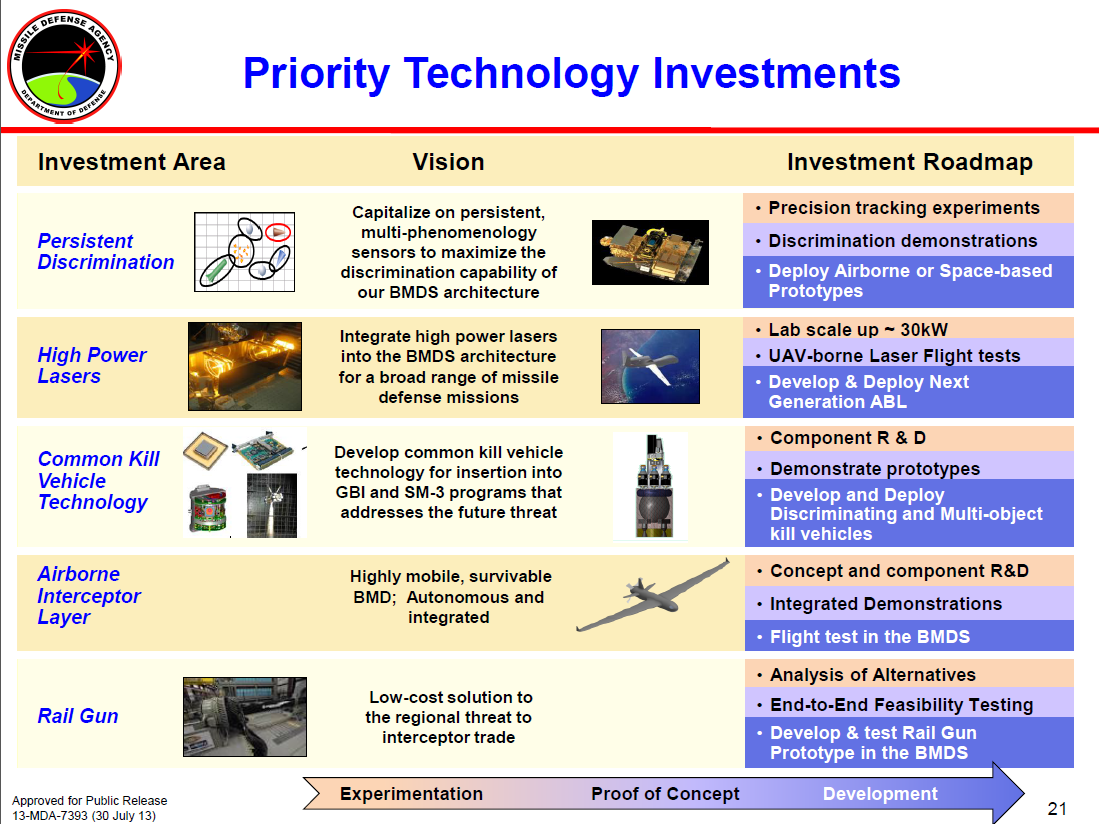
However, a slide, shown below (click on it for a larger image), from MDA Director Vice Admiral J.D. Syring’s August 14 presentation showed an “Airborne Interceptor Layer” that was intended to provide “Highly mobile, survivable BMD; Autonomous and Integrated” as one of five MDA “Priority Technology Investments.”[1]  Another priority investment area was high power lasers, with one objective being the development and deployment a new Airborne Laser.

boost1


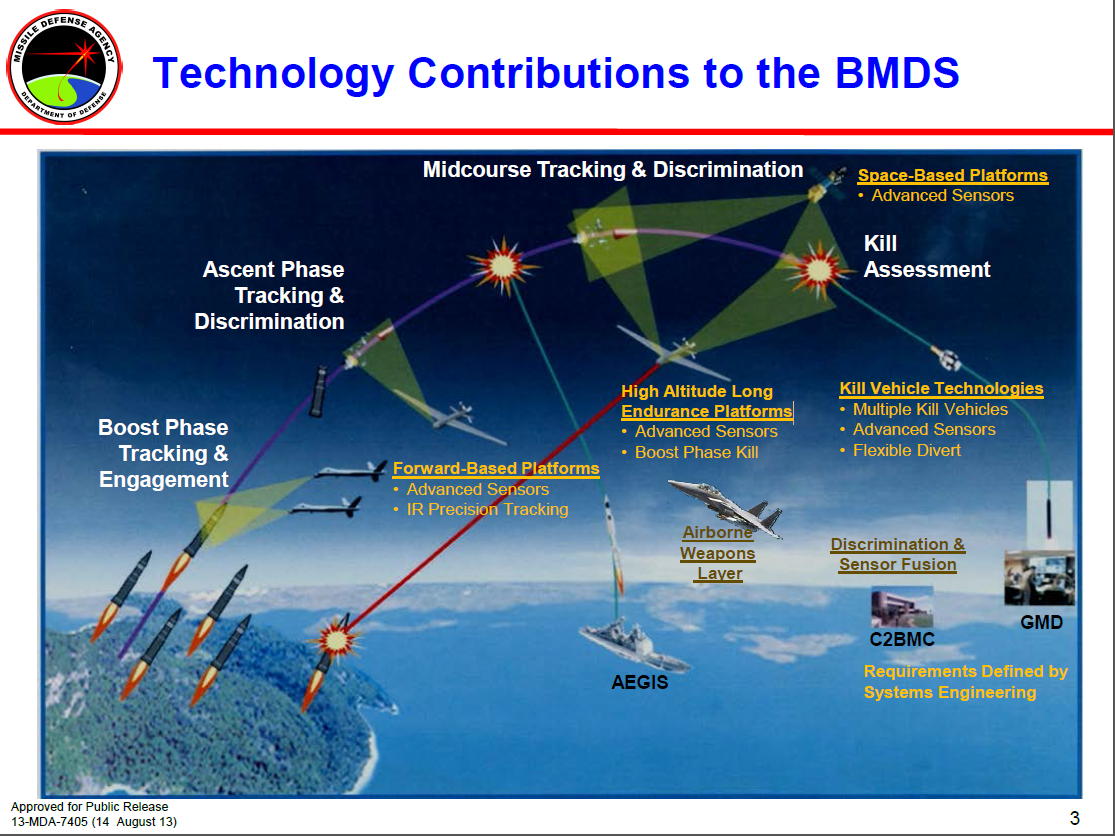
Another slide, shown below, from the presentation of  Richard Matlock, MDA’s Program Executive for Advanced Technology, shows both a “Boost Phase Kill” from a “High Altitude Long Endurance Platform” (apparently using a laser), and an “Airborne Weapons Layer,” deployed on a fighter aircraft.

boost2


[1]Slide 21 of VADM J. D. Syring, “Ballistic Missile Defense Overview,” 16th Annual Space and Missile Defense Symposium, August 14, 2013.

More on Early Warning Radar to Qatar (August 8, 2013)

In my post of August 7 about the U.S. sale of a large phased-array FPS-132 early warning radar to Qatar, I omitted the detail that the announcement stated that the radar was a Block 5 version of the FPS-132.  I omitted the “Block 5” designation because I has never seen this before and had no idea what it meant.  However, a 36(b)(1) Arms Sale Notification released today provides some additional information.

Specifically, the Notification says:

“The AN/FPS-132 Block 5 supports Missile Defense, Space Situational Awareness, and Missile Warning areas.  The Block 5 system employs 3 electronically steered phased array radar faces to survey 360 degree azimuth.  The Block 5 system is capable of reporting airborne tracks to a maximum range of up to 2,000 km and to a minimum radar cross section (RCS) of 1 m2.”

So:

(1) It is a three-faced array (like the one at Fylingdales).  So its coverage is not solely focused on Iran , but will include the entire region.

(2) The description of it having a maximum range of 2,000 km and a minimum target RCS capability of 1 square meter:

                (a) Vastly understates the radar’s capabilities.  See my post of August 7 for a discussion of the range capabilities of at least the U.S. FPS-132s.

                OR

                (b) Indicates that the radar is a much smaller version  of the U.S. version of the FPS-132 (unlikely)

                OR

                (c) indicates that software restrictions are being installed in the radar to limit its capabilities.

If I had to guess, I’d guess it’s (a).

The 360° nature of the radar would make it even more attractive for space surveillance, assuming (as I am) that the U.S. will have access to its data.  It’s hard to see what the south looking face(s) of the radar would do other than look for space objects.   


Update on TPY-2 Radars. (August 8, 2013)

According to a recent report, the Army may have to “borrow” a TPY-2 X-band radar from a Terminal High-Altitude Area Defense (THAAD) battery for use in future missile defense tests.[1] 

This seems like a good occasion to take another look at where the United States is in building and deploying these radars.  In particular, a more detailed look at the current status of and potential future requirements for these radars indicates that substantially more than the currently planned twelve radars may be needed to meet requirements.

 TPY2-FTI01

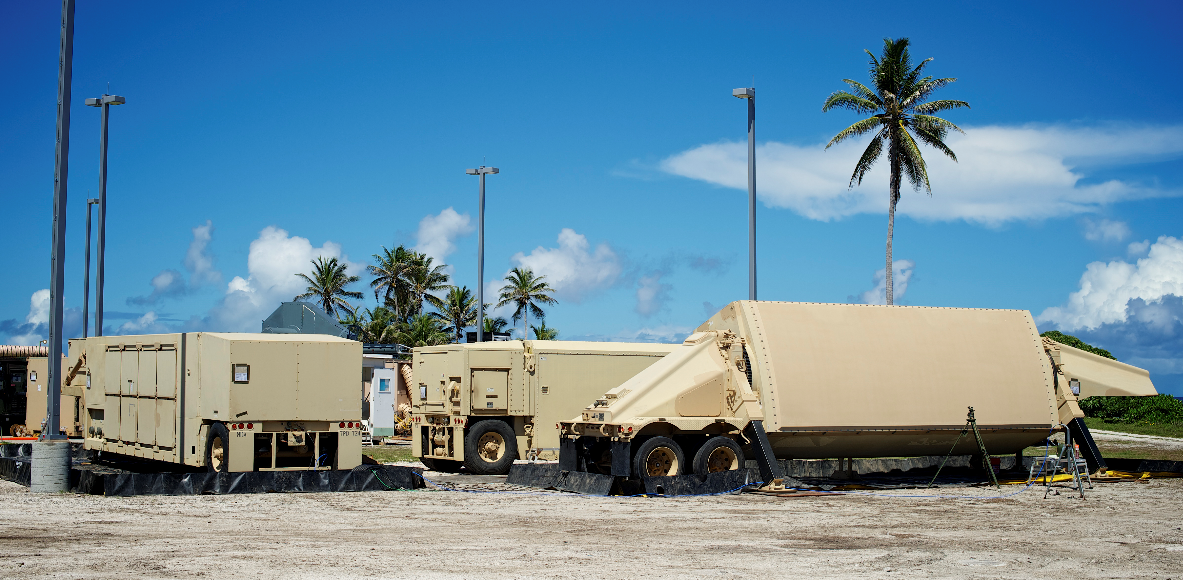
A TPY-2 radar and associated equpment at Kwajalein for the FTI-01 test (image source: http://www.mda.mil).

The TPY-2 radar is an air-transportable radar X-band radar (X-band refers to its operating frequency of about 10 GHz) that can be configured either as a forward-based radar (FBX) for detecting, tracking, and discriminating ballistic missile targets or as a fire control radar for a THAAD  theater missile defense battery.   A TPY-2 radar can be switched between the either configuration in no more than about eight hours.  As a forward deployed radar, a TPY-2 can be used simultaneously both as part of a regional defense system and, in some cases, as an element of the U.S. Ground-Based Midcourse (GMD) national missile defense system.

Prior to 2012, plans called for a total of 14 TPY-2 radars, nine of which were intended for THAAD batteries.  The FY 2013 MDA budget, released in February 2012, reduced the number of planned TPY-2s to eleven (corresponding to a decrease in the planned number of THAAD batteries from nine to six).  In 2013, Congress provided funding for a twelfth TPY-2. 

The U.S. Army has so far accepted delivery of eight TPY-2s.  A TPY-2 takes about 30 months to build under normal circumstances.  In March 2013, it was reported that TPY-2s numbers nine and ten were about halfway completed, and that construction of number eleven was just beginning.  TPY-2 #12 is not yet formally under contract.

Thus, in approximate order of deployment, the current status of the existing and currently planned TPY-2 radars is:

(1) Recently used for testing.  This is the oldest of the TPY-2s.

(2) FBX – Northern Japan

(3) FBX — Israel

(4) FBX — Turkey

(5) THAAD battery – now at Guam

(6) THAAD battery – now at Fort Bliss, TX

(7) FBX – Qatar

(8) THAAD battery #3 (in training) – Fort Bliss

(9) (~mid-2014) THAAD battery #4

(10) (~mid-2014) THAAD battery #5

(11) (~late-2015) THAAD battery #6

(12) (2016, not yet under construction) FBX #6

At present, then, all eight already-completed TPY-2 radars are committed, four as FBXs, three as THAAD radars, and one for use in testing.  At the very least a TPY-2 operating as an FBX will be needed for the FTO-01 integrated system test planned for later in 2013 (another TPY-2 will be used as THAAD fire control radar during this test). 

However, in February 2013 the U.S. announced that a second FBX would be deployed to Japan in the near future.  This commitment was reiterated at the March 15, 2013 Department of Defense Press Conference announcing plans to deploy fourteen additional GBI national missile defense interceptors in silos in Alaska.  Since it appears unlikely that the ninth TPY-2 will be available before mid-2014, once this second radar is deployed to Japan, it thus may become necessary for testing purpose to “borrow” one of the TPY-2s assigned to a THAAD battery.

In the somewhat longer term, it appears that more, and possibly many more, TPY-2s will be needed to meet DoD requirements. Missile Defense Agency (MDA) Director Admiral James Syring recently stated that he was working to find funding for  a seventh and possibly eighth THAAD battery (each of which would require a TPY-2).[2]  At least several additional TPY-2s also seem likely to be deployed as forward-based radars.  In September 2012, the Wall Street Journal reported that in addition to the second FBX to be deployed to Japan, the United States was evaluating potential sites, such as the Philippines, for a third FBX deployment to eastern Asia (see my post of September 27, 2012).  Given the limitations of the Aegis Ashore radars planned for Romania (by 2015) and Poland (by 2018), additional TPY-2s will also likely be needed for deployment in Europe.  The September 2012 National Academy of Science (NAS) Report stated that the MDA has proposed deploying a TPY-2 at both Aegis Ashore sites (although possibly this could be accomplished by deploying a THAAD battery to either or both sites).[3] 

In addition, four TPY-2s have been sold to Qatar and the United Arab Emirates (two each) as part of THAAD batteries.  Production of these radars may not yet begun, as the twelfth U.S. TPY-2 was funded by Congress earlier this year in part to prevent a temporary shutdown of the TPY-2 production line in FY 2014.  

Finally, the September 2012 NAS Report proposed the deployment of five new X-band radars for precision tracking and discrimination.  Each of these proposed radars would be built using two TPY-2 antennas stacked one on top of the other.  Five such stacked TPY-2 radars would thus consume production resources equivalent to ten TPY-2 radars.  A February 2013 MDA report stated that such a stacked TPY-2 radar would take 30 months to develop and produce “assuming that two existing radars were made available for testing and integration.”[4]  If two already existing radars were not made available (which seems unlikely given the short supply of such radars), at least 63 months would be required to build such a stacked TPY-2 radar, “based on current radar production times.”  The report estimated that a stacked TPY-2 would cost “at least $500 million.” While building such a network of stacked TPY-2 radars would clearly have a huge impact on TPY-2 production, they do not currently appear to currently be MDA’s preferred option for adding new radar capabilities, at least based on the MDA’s February 2013 report’s conclusion (presented without any supporting analysis) that “alternative concepts would provide a more robust capability for less cost.”

——————-

[1]Jen Judson, “Army Could Borrow THAAD AN/TPY-2 Radar for Future Missile Tests,” Inside Defense SITREP, July 22, 2013.

[2]Hearing of the Defense Subcommittee of the Senate Appropriations Committee, July 17, 2013.

[3] NAS Report, Page 273, Table E-42, note c.

[4] Missile Defense Agency, “Stacked AN/TPY-2 Array Concept Report to Congress,” February 2013.
U.S. to Sell Large Early Warning Radar to Qatar (August 7, 2013) (corrected February 10, 2014)

On July 29, the U.S. Defense Security Cooperation Agency notified Congress of a potential sale of an FPS-132 early warning radar to Qatar.  This sale of an early warning radar had been announced previously (see my post of November 7, 2012), but the type of radar was not specified at that time.  

 The cost of the radar and associated equipment, training and support was estimated to be $1.1 billion.

FylingdalesUEWR

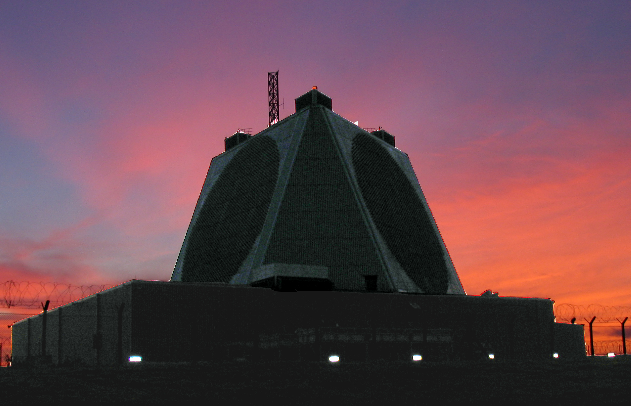
The FPS-132 UEWR radar at Fylingdales in Britain.  (Image source: http://www.mda.mil)

 The FPS-132 designation is used for Pave Paws or BMEWS early warning radars that have been upgraded to the Upgraded Early Warning Radar (UEWR) configuration that now forms the core radar infrastructure of the U.S. Ground-based Midcourse Defense (GMD) national missile defense system.  The GMD system currently incorporates three FPS-32s, the Pave Paws radar at Beale Air Force Base in California and the BMEWS radars in Fylingdales,  Britain and Thule, Greenland.   Current plans call for the two remaining Pave Paws radars, at Clear, Alaska and on Cape Cod, to be upgraded to the UEWR configuration by 2017 or later.

The three Pave Paws and two BMEWS radars, all manufactured by Raytheon, are nearly identical except for the somewhat greater size and power the BMEWS radars.  Each phased-array face of a Pave Paws radars has a diameter of 22.1 m compared to 25.6 m for a BMEWS’ radar face.   Each face of a Pave Paws is comprised of 1792 active transmit/receive (T/R) modules, giving an average power per face of about 150 kW.  Each face of a BMEWS includes 2,560 active T/R modules giving an average power of about 255 kW.   Except for the radar at Fylingdales, each of these radars has two faces, each of which covers 120° in azimuth, giving a total azimuthal coverage of 240°.  The Fylingdales radar has three faces, providing 360° coverage.   For descriptions of the Pave Paws and BMEWS radars, see my post of April 12, 2012.

These radars operate between 420-450 MHz, in the UHF radar band.  Because of their limited bandwidth (at most 30 MHZ, probably no more than 10 MHz), the range resolution of these radars is too poor (roughly 25 meters or more) to give them any significant discrimination capability.  However, they can simultaneously track large numbers of targets at large ranges.  MDA’s UEWR fact sheet states that an FPS-132 “detects objects out to 3,000 miles.” In fact, the actual ranges of these radars are likely to be significantly larger.  The original Pave Paws specifications state that it was capable of achieving a S/N = 17.7 dB (= 58.9) against a 10 m2 target (on boresite) at a range of 3,000 nautical miles ( = 5,550 km) with a single 16 ms pulse (the longest pulse it can produce).[1]   (However, because of the curvature of the Earth, ballistic missile targets are unlikely to be observed at ranges much greater than 4,000-4,500 km.) This corresponds to a range of 2,300 km against a 0.1 m2 target with a S/N = 13 dB (=20). The range of the larger BMEWS radars would be about 25% greater.  

The announcement of the sale of the radar to Qatar gives no details of the radar’s configuration, such as the number of antenna faces or how it compares in terms of size and power to the existing U.S. Pave Paws or BMEWS radars.  However, it seems likely that the radar is similar to the large phased-array early warning radar that Raytheon recently completed building for Taiwan (which in photographs such as the one here looks very much like a Pave Paws or BMEWS radar) and which is usually described as having two faces and costing about $1.3 billion (after significant cost overruns).

Qatar has also recently ordered two TPY-2 X-band radars (as part of two THAAD missile defense systems).    In the context of an integrated missile defense system, the FPS-132 UEWR would provide early warning and broad-area surveillance against ballistic missile targets for Qatar (and likely other countries), relieving the TPY-2 radars of this mission so as to enable them to focus on their roles as THAAD fire control and discrimination radars.

In U.S. use, all five of the Pave Paws and BMEWS radars also participate in the U.S. Space Surveillance Network (SSN).   While Qatar probably has little use for space surveillance, data from this radar (if made available) might be quite useful to the U.S. SSN, since it has no large radar in this part of the world.


[1] National Research Council, Radiation Intensity of the PAVE PAWS Radar System, 1979, Table 1.