The American Association for the Advancement of Science’s Center for Science, Technology and Security Policy (CSTSP) held an event on “Ballistic Missile Defense: Technical, Strategic and Arms Control Challenges,” on June 6, 2013 in Washington, DC. The speakers were Philip Coyle of the Center for Arms Control and Nonproliferation, George Lewis of the Judith Reppy Institute for Peace and Conflict Studies (and the author of this blog), and Bruce MacDonald of the Federation of American Scientists and Johns Hopkins University/SAIS. The speaker’s PowerPoint presentations are now available at the CSTSP website at: http://www.aaas.org/cstsp/programs/nuclear-security.shtml (under “Selected Events”).
All posts by mostlymissiledefense
Presentations on “Ballistic Missile Defense: Technical, Strategic and Arms Control Challenges” (June 19, 2013)
Posted by mostlymissiledefense on June 19, 2013
https://mostlymissiledefense.com/2013/06/19/presentations-on-ballistic-missile-defense-technical-strategic-and-arms-control-challenges-june-19-2013/
A Comparison of Potential GMD X-Band Radars (June 11, 2013)
One of the most significant deficiencies of the current Ground-Based Midcourse Defense (GMD) national missile defense system is its lack of radars that can even attempt to gather data for discrimination purposes. The core ground-based sensors of the GMD system are four (eventually six) upgraded early warning radars (UEWRs), as shown on the map below (click on it for a larger image). However, because of their low operating frequencies and correspondingly small bandwidths, these radars have essentially no discrimination capabilities.
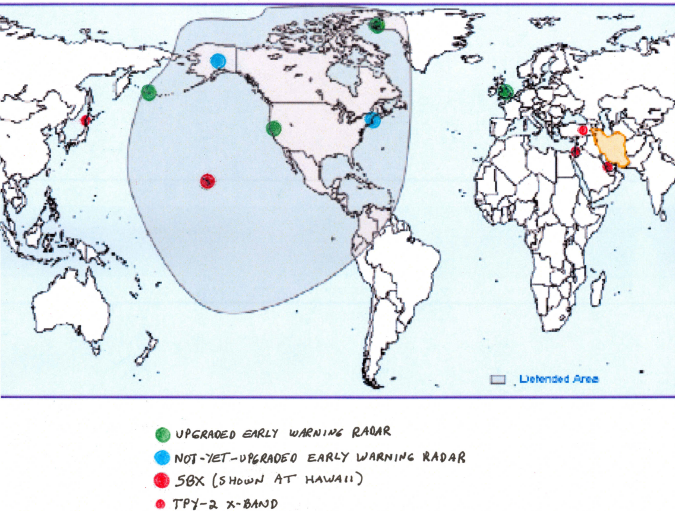
Figure 1. Current GMD radars. The base map is from the 2012 Ballistic Missile Defense Review, showing theoretical coverage of the GMD system against Iran. Aegis radars are not shown (the TPY-2s in Israel and Qatar are not formally part of the GMD system).
These UEWRs are supplemented by forward-deployed TPY-2 and Aegis radars and by a single large Sea-Based X-Band (SBX) radar. However these radars have significant limitations. The forward-based radars have only limited ranges against warhead targets and are primarily useful for tracking missile targets in the early phases of their flights. The SBX, while a large and powerful radar, was built primarily for test purposes and lacks the reliability and hardening of an operational system and has only a limited electronic scan field of view. Last year the SBX’s operating budget was drastically slashed and it was placed in a limited operations and testing status. Moreover, there is only one SBX, and thus it cannot cover the entire country.
In the last year, there has been a series of calls for building and deploying new X-band radars intended to provide discrimination support to the GMD system. The September 2012 National Academy of Sciences Report called for five new “stacked” TPY-2 radars, each using two TPY-2 antennas stacked one on top of the other, to be built and deployed alongside existing upgraded early warning radars. A February 2013 Missile Defense Agency Report to Congress, on the other hand, argued that other radar concepts, “such as a single phased array radar or X-band dish radars” could provide greater capability at a lower cost than the NAS’s proposed stacked TPY-2 radars.[1] In May 2013 Congressional testimony, Lt. General Richard Formica (Commander of the U.S. Army Space and Missile Defense Command/Army Forces Strategic Command and Commander of the Joint Functional Component Command for Integrated Missile Defense) stated that an X-band radar would “certainly” be part of any east coast GMD deployment.[2] In early June 2013, former MDA Director Trey Obering called for upgrading the X-band Ground-Based Radar Prototype (GBR-P) currently located on Kwajalein Atoll and moving it to the U.S. East Coast.[3]
Table 1 below compares various actual, proposed or hypothetical X-band radars. With the exception of the last radar, these radars are all members of the Raytheon’s “family”of X-band phased array radars that utilize essentially the same basic transmit/receive module technology, which facilitates comparisons between them. These are the current TPY-2 forward-based and THAAD radars, the stacked TPY-2 proposed in the NAS Report, the current SBX, the never-built GBR proposed by the Clinton Administration, the current GPR-P, and three possible upgrades to the GBR-P, and a hypothetical new radar with a detection range similar to the SBX but with a larger electronic field of view. The last radar in the table is an existing X-band dish radar.
The Raytheon X-band “family” can be divided into two main branches. One branch consists of the current TPY-2 radars. These radars are used both as the fire control radar for the THAAD theater ballistic missile defense system and as forward-based radars (currently in Japan, Israel, Turkey and Qatar as shown on the map above). These radars are designed to be air-transportable and are thus relatively small (9.2 m2 antenna area). They are intended to be able to carry out a wide range of radar missions, including surveillance, tracking, discrimination and fire control. The NAS proposed “stacked” TPY-2 radars would use two TPY-2 antennas, one on top of the other.
The other branch consists of radars with much larger antennas. The 3+3 national missile defense plan developed by the Clinton Administration envisioned deploying up to nine very large (antenna area = 384 m2) X-band Ground-Based Radars (GBRs) alongside existing early warning radars and at other locations (such as Hawaii). However, none of these GBRs were ever built as the George W. Bush Administration instead chose to build only the single, somewhat smaller SBX. A significantly smaller prototype GBR (the GBR-P) radar was built as Kwajalein and used in the early intercept tests of the GMD system. Under the Bush Administration’s now-cancelled European missile the GBR-P would have been moved to the Czech Republic, where it would have been known as the European Midcourse Radar. Instead, it remains in caretaker status at Kwajalein. A drawback of the larger X-band radars is that they use a much larger module spacing than the TPY-2 radars, resulting in very electronic limited scan angles (11-12 degrees, compared to about 60 degrees for the TPY-2s). For target separations greater than this, these radars would need to mechanically rotate and/or tilt, a relatively very slow process compared to electronic beam positioning. These larger radars are specialized for precision tracking and discrimination.
Since the radars in the table all (except for the last one) use the same basic Raytheon transmit/receive (T/R) modules, we can directly compare them. All else being equal, the power delivered in a single beam dwell will be proportional to the product of the radar’s average power, antenna area, and gain (which will be proportional to the antenna area). The relative P-A-G for each radar is shown in column five of Table 1 with the SBX taken as the baseline. The maximum tracking range will then be proportional to the fourth root of the P-A-G, and this relative range in shown in column six, again with the SBX as the baseline.
Of course, the P-A-G can be viewed in terms other than just range. If, for example, radar A has a P-A-G ten times greater than radar B it could, at the same range, track ten times as many targets, or obtain a S/N ratio ten times larger on a target for improved discrimination or tracking accuracy, or detect a target with a radar cross section ten times smaller than radar B.
As noted above, except for the TPY-2 and stacked TPY-2 (and the dish radar), all these radars have relatively large module spacings, which limits their maximum electronic scan due to the creation of grating lobes (additional main beams). The maximum scan angle in column seven of Table 1 for the larger X-band radars is based on a maximum radar frequency of 10 GHz (for example a 1 GHz bandwidth radar centered at 9.5 GHz in wide band mode). If the frequency is lower or only narrowband operation is considered, the scan angles will be slightly larger (for example at 9.5 GHz the GBR-P would be ±12 °).
The GBR-P was designed to be upgradable. Three different upgrades to the GBR-P are considered in Table 1:
GBR-P Upgrade #1: The older T/R modules in the GBR-P (assumed to be first generation, with average power of 1.2 W) are replaced with current T/R modules (assumed to be third-generation, same as in the TPY-2, with an average power of 3.2 W).
GBR-P Upgrade #2: The outer edges of the current GBR-P antenna face are not populated with modules. This upgrade fills the entire face (increasing the antenna area from 105 m2 to 123 m2) with current T/R modules.
GBR-P Upgrade #3: Another upgrade option that has been proposed would fill the entire GBR-P antenna face, but with the module spacing cut in half, thus increasing the number of modules by a factor of four compared to upgrade #2.[4] This change also doubles the extent of the radar’s electronic scan. While this would give a range nearly equal to that of the SBX, it would be a very extensive (and likely very expensive) upgrade.
The next to last radar in the table (60° SBX Equivalent) is purely hypothetical radar that uses the same module spacing as in the TPY-2 radars (and thus has a full ±60° horizontal electronic scan), but with an antenna size scaled up to give a detection range equal to the SBX. The large number of modules (over 200,000) required for such a radar would probably rule out such an approach, as this is equal to the total number of modules in all eight of the TPY-2s the United States has built so far.
As noted above, a February 2013 MDA report stated that X-band dish (non-phased arrays) radars could provide a more robust and inexpensive capability than the NAS’s proposed Stacked TPY-2 radars for the GMD system. The last radar in the table is the Have Stare X-band dish radar which was at one time deployed at Vandenberg Air Force base in California. It was subsequently moved to Vardo, Norway, where, renamed the GLOBUS II, it operates as part of the U.S. Space Surveillance Network.[5] The “emergency response” NMD system proposed by the Air Force in the mid-1990s would have used the Have Stare as its primary precision tracking and discrimination radar. Since its antenna is mechanically-steered, the number of targets such a radar can handle simultaneously will be quite limited compared to compare to the other radars in the table.
Here’s the table (click on it for a larger image):
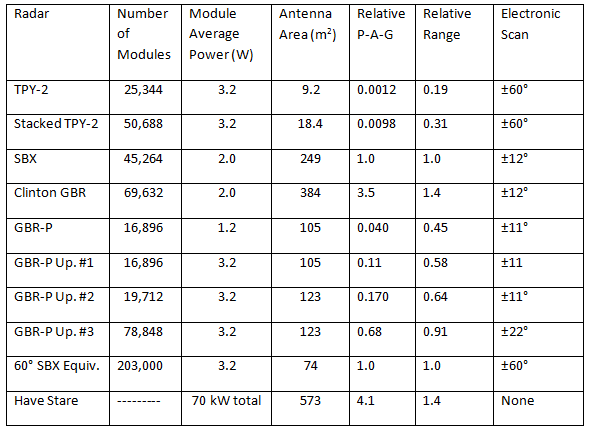
Table 1. Comparison of X-Band Radars
[1] Missile Defense Agency, “Stacked AN/TPY-2 Array Concept, Report to Congress, February 13, 2013. See Jordana Mishory, “DoD Advises Against ‘Stacked’ An/TPY-2 Radars to Boost Missile Defense,” Inside Missile Defense, May 1, 2013.
[2] General Formica: “Back to my point on sensoring and assessment and discrimination capability, an X-band radar, frankly, anywhere east would greatly benefit the threat that I and we in the agency see coming. And certainly that would be part of it.” Hearing of the Strategic Forces Subcommittee of the Senate Armed Services Committee, May 9, 2013.
[3] Trey Obering and Rebeccah Heinrichs, “Fund East Coast Missile Defense Now, Says Former Missile Defense Director, June 4, 2013. Available at: http://breakingdefense.com/2013/06/04/fund-east-coast-missile-defense-now-says-former-missile-defense-director/
[4] Military Electronics Briefing, “BMD X-Band Radars & BMD C4I,” Teal Group Corporation, July, 2007.
[5] The average power in the table for the HAVE STARE assumes it has the same maximum duty cycle (35%) as the larger Haystack X-band dish radar.
Posted by mostlymissiledefense on June 11, 2013
https://mostlymissiledefense.com/2013/06/11/a-comparison-of-potential-gmd-x-band-radars-june-11-2013/
Has the GMD National Missile Defense System Ever Been Intercept Tested at Night? (June 3, 2013)
An interesting question regarding testing of the Ground-Based Midcourse (GMD) national missile defense system is whether or not the system gas ever been intercept tested at night. That is, has the GMD system ever attempted to intercept a target that was not directly illuminated by the Sun? As the table below shows, the answer is yes, but not successfully.

The GBI interceptor launch (from Kwajalein) during the only GMD test in which the interceptor was launched at night, IFT-10, conducted on December 11, 2002. (http://www.mda.mil/global/images/system/gmd/ift103.jpg)
The table shows the launch locations and times (extracted from MDA press releases and news reports) for the fifteen intercept tests of both prototype and operationally-configured GMD ground-Based Interceptors (GBIs). Data for intercepts claimed as successful are in black and data in red is for failed intercept attempts. As the table shows, the latest interceptor launch time for a successful intercept is 3:19 pm local time (IFT-7). Taking into account the relative time and location of the target and interceptor launches, it is clear that all the successful intercept attempts took place with the target directly illuminated by the Sun.
There is one intercept attempt that clearly took place at night (IFT-10), in which the interceptor was launched at about 8:45 pm local time and in a direction generally heading away from the Sun. However, the intercept attempt failed when the kill vehicle failed to separate from the final booster stage.
Two other intercept attempts were conducted in which the interceptor launch would have occurred shortly before local sunset, IFT-13c and IFT-14. However, in both these cases, the interceptor failed to launch. Without knowing where the intercepts were planned to take place (and I haven’t tried to find out),one cannot be certain if the targets would have been sunlit, but give the targets’ launch locations (Kodiak) and typical intercept altitudes (250 km) in earlier tests, it seem likely they would have been.
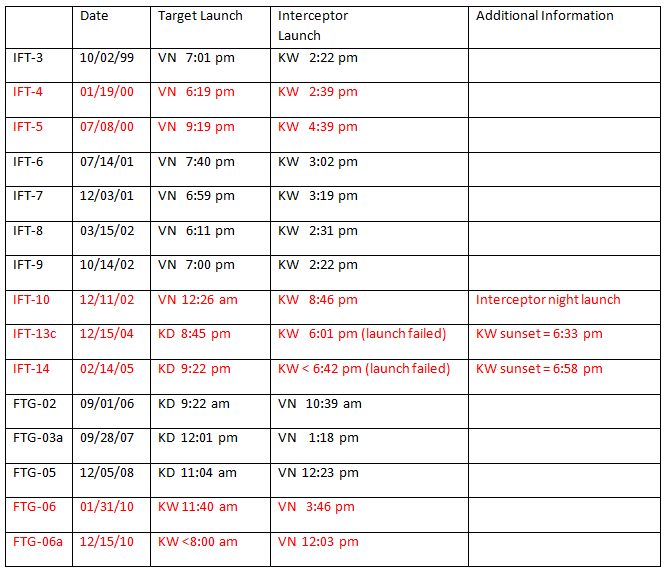
(Click on Table for more readable version)
Location Key: VN = Vandenberg Air Force Base, California
KD = Kodiak, Alaska
KW = Kwajalein Atoll.
All times are local (either standard or daylight savings, whichever is in effect).
Kodiak is four hours behind east coast time.
Kwajalein does not use daylight saving time and is 17 hours ahead of EST and 16 ahead of EDT.
Posted by mostlymissiledefense on June 3, 2013
https://mostlymissiledefense.com/2013/06/03/has-the-gmd-national-missile-defense-system-ever-been-intercept-tested-at-night-june-3-2013/
Updated List of Claims about GMD Effectiveness (May 20, 2013) (Updated July 10)
Claims by U.S. government officials about the effectiveness of the U.S. Ground-Based Midcourse (GMD) national missile defense system. This iteration adds seven additional claims (some old, some new). In order to facilitate future updates, they are now in chronological rather than reverse chronological order.
(1) September 1, 2000: “… I simply cannot conclude, with the information I have today, that we have enough confidence in the technology and the operational effectiveness of the entire NMD system to move forward to deployment. Therefore, I have decided not to authorize deployment of a national missile defense at this time.” President Bill Clinton, at Georgetown University, September 1, 2000.
(2) March 18, 2003: “Effectiveness is in the 90% range.”[1] Edward Aldridge, Undersecretary of Defense for Acquisition, Technology and Logistics.
Posted by mostlymissiledefense on May 20, 2013
https://mostlymissiledefense.com/2013/05/20/updated-list-of-claims-about-gmd-effectiveness-may-20-2013/
East Coast Interceptor Site: Some Observation’s from this Week’s Congressional Hearings (May 11, 2013)
A possible east coast site for interceptors for the current U.S. Ground-Based Midcourse Defense (GMD) national missile defense system was the subject of multiple questions at Thursday’s (May 9, 2013) hearing of the Strategic Forces Subcommittee of the Senate Armed Services Committee. Administration and military officials emphasized that the east coast of the United States was already protected by the current GMD system. They also said that if a decision to deploy such an east coast interceptor site was made, it would take five to seven years to build and would also involve the deployment of a new X-band radar in the eastern United States.
Senator Mark Udall began by asking Lt. General Richard Formica (Commander of U.S. Army Space and Missile Defense Command and of the Joint Functional Component Command for Integrated Missile Defense, of the U.S. Strategic Command): “Secretary of Defense Hagel, Admiral Winnefeld and General Jacoby have all said recently that the current ground- based midcourse defense system defends all of the U.S., including the East Coast, against missile threats from both North Korea and Iran. In your capacity as commander within Strategic Command, you represent the warfighter perspective on our missile defense capabilities and requirements. Do you have confidence in our current GMD system to defend all of the United States, including the East Coast, against current and near-term ballistic missile threats from both North Korea and Iran?”
General Formica replied: “Yes, Mr. Chairman. Thank you for the question. We do have confidence in the ability of the ballistic missile defense system to defend the United States against a limited attack from both North Korea and Iran today and in the near future. “
Madelyn Creedon, Assistant Defense Secretary for Global Strategic Affairs, added (referring to the additional fourteen interceptors in Alaska that the Administration announced in March): “The East Coast is well-protected as the result of — well, it was protected before the additional — and this additional fourteen provides additional protection both for anything from North Korea as well as anything from Iran should that threat develop.”
In response to a question from Senator Deb Fischer, General Formica stated (referring to the required Environmental Impact Statement) that “depending on the assumptions and how fast the EIS goes, five to seven years” would be needed to deploy an east coast interceptor site, with eighteen to twenty four months of this time needed for the Environmental Impact Statement. He also estimated that about 500 military and civilian personnel would be required to operate the site.
(A day earlier, in a House Armed Services Committee hearing, Representative Doug Lamborn urged Missile Defense Agency Director Vice Admiral James Syring to recommend that President Obama waive the requirement for an environmental impact statement in order to speed up the possible deployment of the east coast site. Admiral Syring seemed to be unaware that this was possible (and I don’t know if it is either)).
General Formica also indicated that such a deployment would involve a new X-band radar in the eastern United States:
Senator Fischer: “OK. And would such a site benefit from the deployment of an X-band radar on the East Coast?”
General Formica: “Yes, ma’am. Back to my point on sensoring and assessment and discrimination capability, an X-band radar, frankly, anywhere east would greatly benefit the threat that I and we in the agency see coming. And certainly that would be part of it.”
Posted by mostlymissiledefense on May 11, 2013
https://mostlymissiledefense.com/2013/05/11/east-coast-interceptor-site-some-observations-from-this-weeks-congressional-hearings-may-11-2013/
Aegis Ballistic Missile Defense (BMD) System Versions (May 7, 2013)
This post briefly describes the various versions of the Aegis Ballistic Missile Defense (BMD) Weapon System. See the post of May 2 for a description of the different versions of the Aegis BMD interceptor missiles.
Aegis BMD 3.0E: The first deployed Aegis BMD capability was the Aegis Long-Range Surveillance and Tracking (LRS&T) capability using the Aegis BMD 3.0E software. Thus upgrade allowed forward-based Aegis ships to track long-range ballistic missiles and relay this information back for possible use by the U.S. Ground-based Midcourse (GMD) national missile defense system. Several Aegis BMD 3.0E destroyers were forward-deployed in the Pacific as part of the initial GMD Limited Operations Capability in September 2004.
Posted by mostlymissiledefense on May 7, 2013
https://mostlymissiledefense.com/2013/05/07/aegis-ballistic-missile-defense-bmd-system-versions-may-7-2013/
Aegis Ballistic Missile Defense Interceptors (SM-3, SM-2 Block IV, and SM-6) (May 2, 2012)
The SM-3 is the U.S Navy’s current exo-atmospheric (above-the-atmosphere) ballistic missile defense interceptor. It is based on the airframe of the SM-2 Block IV extended-range air defense interceptor, including its two solid-fuel rocket stages. However the SM-3 replaces this missile’s explosive warhead and radar seeker with an additional solid-fuel third-stage motor and an infrared-homing, hit-to-kill kill vehicle.
SM-3 Block 0 was an initial version built only for testing. It was similar to the subsequent Block I version but had specific features added for testing, such as pressure gauges in fuel tanks and rocket motors and an “independent flight termination system.”[1] The Block 0 was used in the first five intercept tests (FM-2 through FM-6).
Posted by mostlymissiledefense on May 2, 2013
https://mostlymissiledefense.com/2013/05/02/aegis-ballistic-missile-defense-interceptors-sm-3-sm-2-block-iv-and-sm-6-may-2-2012/
Table of Future Aegis Intercept (mostly) Tests (April 30, 2013) (Updated May 16, 2013)
Projected future intercept tests for Aegis SM-3 (with a few significant non-intercept tests). Dates and descriptions are highly subject to change. Most data from FY 2014 (April 2013) budget documentation.
Key for targets: S = short-range (<1,000 km), M = medium range (1,000-3,000 km), IR = intermediate-range (3,000-5,500 km), U = Unitary (warhead does not separate), Sp = separating warhead. For Aegis BMD version, all or some 4.0.1 are now likely 4.0.2, CU = Capability Upgrade. ? = don’t know/not sure.
Click on the table from a more readable version.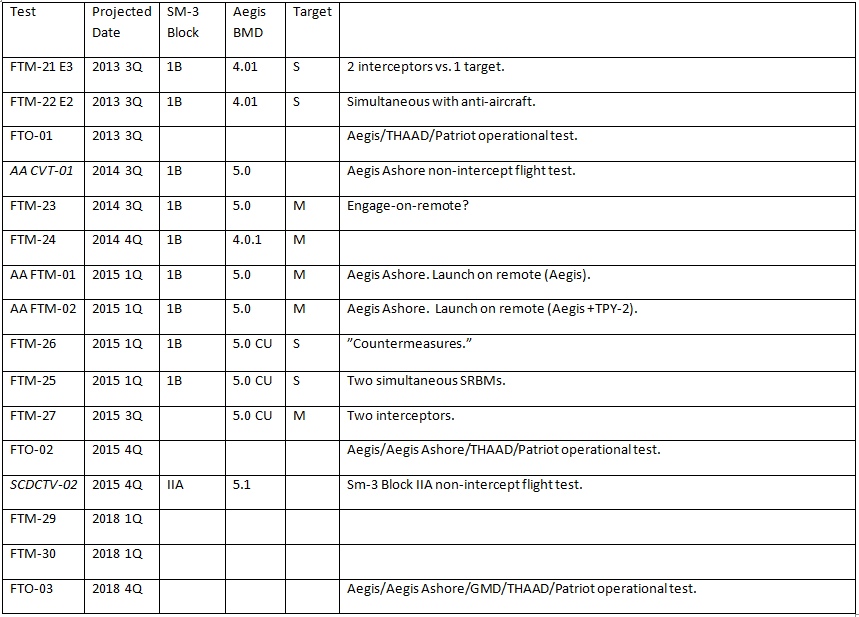
Posted by mostlymissiledefense on April 30, 2013
https://mostlymissiledefense.com/2013/04/30/table-of-future-aegis-intercept-mostly-tests-april-30-2013/
Table of Aegis SM-3 Intercept Tests (April 27, 2013) (Updated May 16, 2013)
Below is table of Aegis SM-3 intercept tests since testing resumed in 2002. Subsequent posts will discuss the Aegis system configurations and individual tests in more detail. Click on either half of the table for a more readable version.
Key for targets: S = short-range (<1,000 km), M = medium range (1,000-3,000 km), IR = intermediate-range (3,000-5,500 km), U = Unitary (warhead does not separate from rocket booster), Sp = separating warhead. For ships, (J) = Japanese destroyer (versions of Aegis BMD weapon may be somewhat different from equivalent US versions listed). ? = don’t know/not sure.


Posted by mostlymissiledefense on April 27, 2013
https://mostlymissiledefense.com/2013/04/27/table-of-aegis-sm-3-intercept-tests-april-27-2013/
GMD Testing Update (April 17, 2013)
The recently released FY 2014 Missile Defense Agency (MDA) budget justification documentation provides some new details on the MDA’s plans for future tests of the Ground-Based Midcourse Defense (GMD) national missile defense system. In particular, it raises the possibility of carrying out a second non-intercept flight test (CTV-02) before resuming intercept testing using the new CE-II version of the interceptor’s kill vehicle.
As discussed in my previous post on GMD testing, following the failure of the FTG-06a intercept test in December 2010, MDA removed the ten deployed Ground-Based Interceptors (GBIs) equipped with the CE-II version of the kill vehicle from operational status and suspended deliveries of new GBIs. Deliveries of new GBIs and repairs to the deployed CE-II equipped GBIs were to begin following successful completion of a return-to-intercept (RTI) flight testing program. The RTI program was to consist of a non-intercept flight test (CTV-01) which if successful would be flowed by an intercept test (FTG-06b).
The non-intercept test CTV-1 was conducted on January 26, 2013 and was described, based on preliminary information, as successful. The FY-2014 budget justification states that “Initial results indicate very robust performance of the CE-II kill vehicle.”[1]
However, the budget justification also states that: “In implementing a less concurrent technical approach for the CE-II program, we plan to execute a CTV-02 non-intercept flight test in second quarter 2014 followed by FTG-09 CE-II intercept test in fourth quarter 2014.”[2] On the other hand, the budget materials also indicated that if the success of CTV-01 was assessed to “conclusive,” then instead “we will eliminate CTV-02 in FY 2014 and instead fly the next CE-II intercept flight test (FTG-06b) in 1st quarter FY 2014, and plan to then conduct a second GBI intercept test in late FY 2014.
Note that the CTV-01 test in January was with a CE-II kill vehicle that still contained the part believed to be defective but used mitigations for the problems resulting from the part. Presumably, CTV-02, if it takes place, would use a kill vehicle with the new replacement part (as FTG-06b was planned to do).
At the Pentagon’s March 15 press conference, it was announced that an intercept test using an older CE-I kill vehicle would be conducted this summer. The budget documents state add that this test will be conducted in “in third quarter 2013 to validate reliability improvements made to the CE-I fleet over the last several years. [3] As discussed in a previous post on GBI cost, the GAO estimated that each of the original CE-I GBIs needed repairs and refurbishments that were estimated to cost between $14 and $24 million per interceptor.
Thus the GMD flight tests plans, as far as I have been able to reconstruct them (which may not be completely) now appears to be as follows (all are intercept tests except for CTV-02):
FY 2013, 4th Q: CE-I intercept test.
FY 2014, 1st Q: CTV-02 (non-intercept) or FTG-06b (intercept) test of CE-II GBI.
FY 2014, 4th Q (or FY 2015, 1st Q): FTG-09 CE-II intercept test.
FY 2015, 4th Q: FTG-11, salvo (two interceptors) test against ICBM target.
FY 2016, 4th Q: FTG-15:
FY 2017, 4th Q: FTG-13: (possibly two stage booster?)
FY 2018, 4th Q: FTO-03: Operational test with Aegis, THAAD and Patriot.
FY 2019, 4th Q: FTG-17 (possibly two-stage booster?)
FY 2021, 4th Q: FTG-12
FY 2022, 4th Q: FTG-14
Posted by mostlymissiledefense on April 17, 2013
https://mostlymissiledefense.com/2013/04/17/gmd-testing-update-april-17-2013/
 mostlymissiledefense
