Another Claim about the Effectiveness of the GMD National Missile Defense System (March 8, 2013)

I have updated (now with 16 claims) my compilation of official claims about the effectiveness of the United States GMD national missile defense with White House Press Secretary Jay Carney’s comments from yesterday. At the daily White House press briefing, in response to a question. Mr. Carney stated that.

“I can tell you that the United States is fully capable of defending against any North Korean ballistic missile attack.  And our recent success in returning to testing of the upgraded version of the so-called GBI, or the CE2 missile, will keep us on a good trajectory to improve our defense capability against limited ballistic missile threats such as those from North Korea.  But let’s be clear, we are fully capable of dealing with that threat.”

For perspective, it should be noted that the “CE2 missile” interceptor cited by Mr. Carney has, in fact, failed in both its intercept tests.  The recent successful test of this interceptor raised by Mr. Carney, did not involve a target, much less an intercept attempt.  The test, labeled CTV-01 and conducted in January,  involved putting the kill vehicle through a series of maneuvers in order to determine if a vibration problem caused by firing its maneuvering thrusters has been solved (see graphic below — click on it for a larger image).  This test was reportedly successful and a third attempt to intercept a target with a CE-2 kill vehicle will likely occur in the next few months.
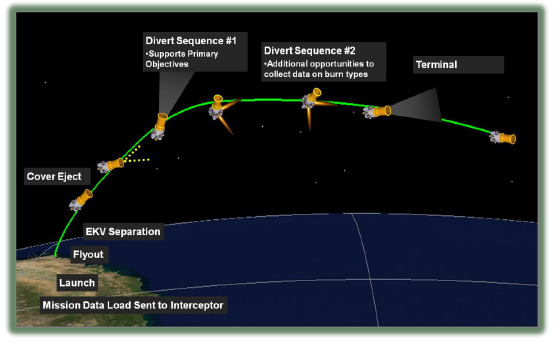
CTV-01figure

CTV-01 Test (Image source: VADM J. D. Syring (Director, Missile Defense Agency), “Ballistic Missile Defense Update,”  Briefing Slides, American Society of Naval Architects, February 22, 2013.

Earlier versions of the GBI interceptor have reportedly been successful on eight out of thirteen intercept attempts.   This includes three out of three for the operationally configured CE-1 version of the GBI (although as has been noted several times in this blog, in one reportedly successful test the interceptor did not achieve a “kill” of its warhead target), which was most recently intercept-tested in December 2008.

Ballistic Missile Defense: What Happened with the Block IA intercept in FTI-01? (What Does a Yellow Check Mark Mean?) (March 6, 2013)

fti01a

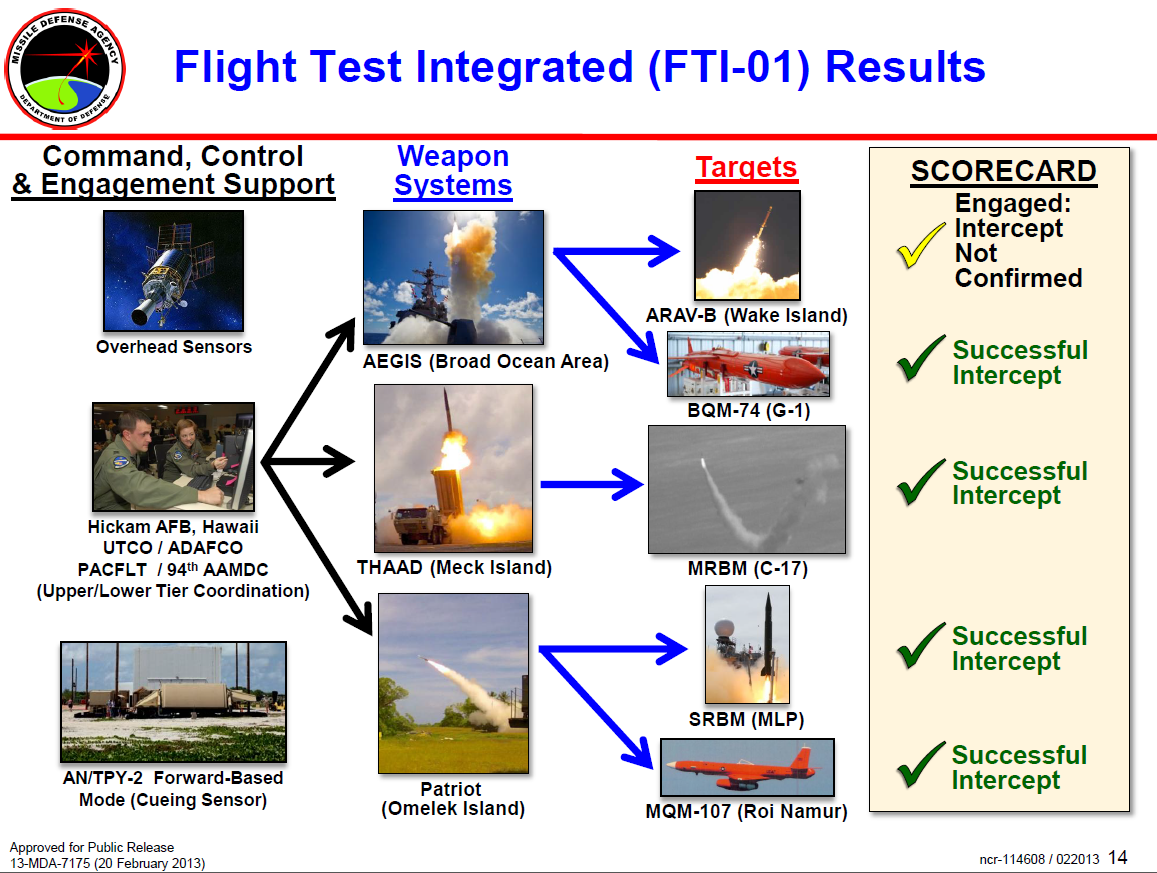
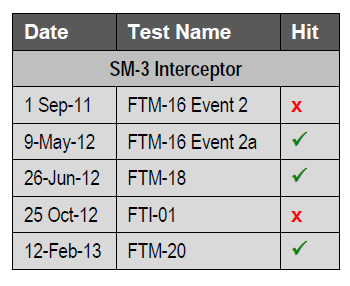
Integrated flight test FTI-01, conducted by the Missile Defense Agency (MDA) on October 25, 2012, involved the near-simultaneous interception of three ballistic missile and two cruise missile targets.  According to a MDA news release issued on the day of the test, four of the intercept attempts were successful.[1]  For the fifth intercept attempt, however, involving an Aegis Block IA interceptor against a short-range ballistic missile (SRBM) target, it was reported that, although the interceptor appeared to fly out normally, “there was no indication of an intercept” of its target.  News reports have since described the intercept attempt as failure.[2] The BMDS section of  DOT&E’s 2012 Annual Report describes the engagement as unsuccessful.  And the MDA’s ongoing intercept test scorecard shows the intercept attempt as a failure, as shown below:

fti01b

(From Missile Defense Agency, “Ballistic Missile Defense Intercept Flight Record,” Fact Sheet, February 13, 2013.)

However, in a February 22 2013 briefing, new MDA Director Vice Admiral James D. Syring presented a slide showing the outcome of the intercept as “Engaged: Intercept Not Confirmed” and scored with a yellow check mark.  The slide is below.

fti01c

(From: VADM J. D. Syring (Director, Missile Defense Agency), “Ballistic Missile Defense Update,”  Briefing Slides, American Society of Naval Architects, February 22, 2013. 

What does this mean?  Does it indicate that, roughly three months after the intercept test, MDA still hasn’t determined if the target was successfully intercepted?  This immediately call to mind the situation with the FTG-02 NMD test, in which the fact that the “successful intercept” did not actually destroy the target was not publicly revealed until more than five years after the test.  However, even that test gets a green check mark in MDA’s intercept test scorecard:

fti01d

So what does the yellow check mark mean?  If they don’t know what happened, why not a question mark?  Maybe as more information comes out, we’ll find out.


[1] Missile Defense Agency, “Ballistic Missile Defense System Engages Five Targets Simultaneously During Largest Missile Defense Flight Test in History,” New Release, October 25, 2012.  Available at: http://www.mda.mil/news/12news0011.html.

[2] For example: “The MDA is studying why Aegis, a ship-based radar program led by Lockheed Martin, and its SM-3 Block 1A missile, manufactured by Raytheon, failed to shoot down its short-range ballistic missile target.” Amy Butler, “Countering the Raid,” Aviation Week and Space Technology, November 5, 2012, p. 37.

Sequestration and U.S. Missile Defense/Space Surveillance Radars (February 25, 2013)

According to the Air Force, if sequestration goes into effect, it would have to make cuts in radar operations that would have the effect of “significantly impacting national missile defense, space situational awareness, and the intelligence community.”[1]  Specifically, radar operations at Cavalier Air Force Station in North Dakota and at Earecksen Air Station, Alaska and operation the Air Force Space Surveillance System (AFSSS) would be reduced from 24 to 8 hours per day.

Would such reductions actually seriously impact U.S. missile defenses?

CobraDaneCoverage2

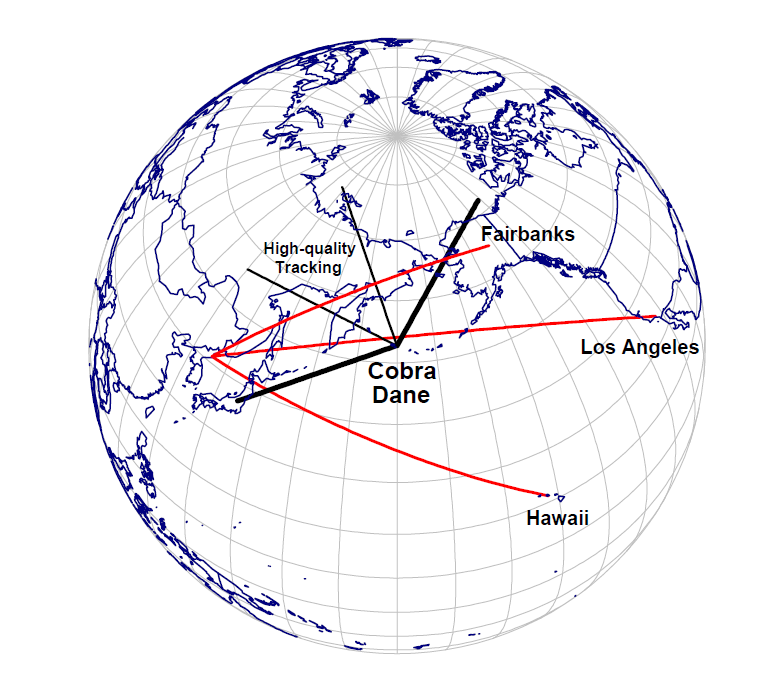
Coverage of the Cobra Dane radar at Earecksen Air Station, Shemya Island, Alaska.  Figure from Union of Concerned Scientists, Technical Realities, p. 37.[2]

The large phased-array PARCS (Perimeter Acquisition Radar Attack Characterization System) radar at Cavalier, which was originally built part of the Safeguard Anti-ballistic Missile System, is now used for missile attack warning and space surveillance.  Earecksen Air Station on Shemya Island at the western end of the Aleutians is the home of the Cobra Dane, a large-phased array L-band radar originally built to gather intelligence on Soviet missile tests, but which is now also used for missile warning, missile  defense and space surveillance.  The AFSSS is a radar “fence” stretching across the southern United States that detects satellites as they pass over it, and is a dedicated component of the U.S. Space Surveillance Network (SSN).

In terms of missile defense, the impact of these temporary (presumably) cutbacks in radar operations seems pretty minimal.  PARCS is not part of the current GMD national missile defense system, and the AFSSS does not have (and cannot be given) any ballistic missile defense capabilities.  While Cobra Dane has been part of the GMD system since the GMD was first declared operational, because of its poor orientation it has never participated in an intercept test.  While Cobra Dane can potentially provide much higher resolution radar data than the Pave Paws radar in California, it can only do so within a narrow region within 22 degrees of its boresite, which a missile from North Korea towards the U.S. west coast would spend little if any of its trajectory within (as shown in figure above). Nor does removing these radars from the early warning network open up any gaps in the coverage provided by the five BMEWS and Pave Paws early warning radars.

The impact on space surveillance seems potentially much more significant.  Cobra Dane can detect and track smaller objects in low earth orbit than any of the SSN’s other sensors (down to as small as about 5 cm, although it only tracks a small fraction of such objects).  It has this small-object capability largely because it operates at a higher frequency (about 1.3 GHz) than other seven large phased-array radars in the SSN, all of which operate in the UHF band at about 440 MHz.  PARCS, although not ideally situated for space surveillance (it is in North Dakota, facing north) is, along with the FPS-85 radar in Florida, one of the two most powerful of the large UHF phased-array radars in the SSN.  The AFSSS, while it cannot detect objects much smaller than about 30 cm in diameter, nevertheless produces thousands of measurements every day on space objects that pass through its radar fence.


[1] Maggie Ybarra, “Air Force Lists Programs that Sequestration Cuts Would Hit Hardest,” Inside Defense SITREP, February 19, 1993.

[2] Lisbeth Gronlund, David C. Wright, George N. Lewis, and Philip E. Coyle, Technical Realities: an Analysis of the 2004 Deployment of a U.S. National Missile Defense System (Cambridge, Mass. Union of Concerned Scientists, 2004).  Available at:  http://www.ucsusa.org/assets/documents/nwgs/technicalrealities_fullreport.pdf.

Ballistic Missile Defense: Location of Second X-band Radar to Japan Announced (February 24, 2013)

The location of the second U.S X-band missile defense radar to be deployed to Japan has been announced.[1]  The TPY-2 radar will be deployed in central Japan at the Kyogamisaki military base near the small city of Kyotango.  The location was described as being selected because it was near the trajectories North Korean missiles fired towards Guam or Hawaii would take.  (This appears to be true for Guam, but not particularly for Hawaii.)  The first TPY-2 to Japan was deployed at the Shariki base in Northern Japan in September 2006, and was the first TPY-2 to be deployed to a foreign country.

JapanMap

(Image from Google Maps)


[1] “U.S. X-band Radar To Be Installed at ASDF Base,” Japan Economic Newswire, February 24, 2013.

Free E-book on Norway and Space Security (February 12, 2013)

Author Bård Wormdal’s book “The Satellite War,” about Norway’s military-related outer space activities is now available for free at http://www.amazon.com.  I’ve only just started to read it.    You can download it at: http://www.amazon.com/The-Satellite-War-ebook/dp/B009J1D1N4.  The last two chapters discuss the Globus-II (formerly HAVE STARE) radar at Vardo.  Wormdal’s message to me today said the book would be free “this week,” so if you are interested you might want to download it soon.

GAO Briefing on Block IIB Alternatives Now Available (February 12, 2013)

The slides for the GAO briefing in the European deployment of the SM-3 Block IIB missile that has been in the news recently are now available at http://www.gao.gov/assets/660/652079.pdf.  The briefing, entitled “Standard Missile-3 Block IIB Analysis of Alternatives” makes three main points:

(1)    Romania is not a good location for defending U.S. territory (not a surprise, since that what the location in Poland is about).

(2)    Defending U.S. territory from the Poland site may require launching the interceptor during the target missile’s boost phase.  (This is perhaps the most interesting finding, given that at least publicly the MDA is maintaining that the parameters of the Block IIB are still being defined).

(3)    The North Sea is better location for defending U.S. territory than Poland.  (From a technical perspective this is not news, but the Russians will undoubtedly find it interesting as confirmation that MDA is at least analyzing this basing option, which would provide more opportunities to intercept Russian ICBMs than the Polish site.

Update on the Cost of GMD Test CTV-01. (February 5, 2013)

According to MDA spokeman Rick Lehner in the February 4 issue  of Space News, the January 26, 2013 CTV-01 non-intercept test of the Ground-Based Midcourse (GMD) national missile defense system cost about S170 million.[1]  This is an increase of about $30 million relative to the estimated $141 million that the GAO reported had been spent as of February 2012, as described in my post of December 28, 2012.  Since there is still analysis of the test to be done, it is possible that this cost will increase further.


[1] Mike Gruss, “Troubled U.S. Missile Defense System Passes Flight Test,” Space News, February 4, 2013, p. 7.

Navy’s Next Destroyer to Increase Radar’s Capability (in terms of S/N) by a Factor of about Thirty. (January 30, 2013)

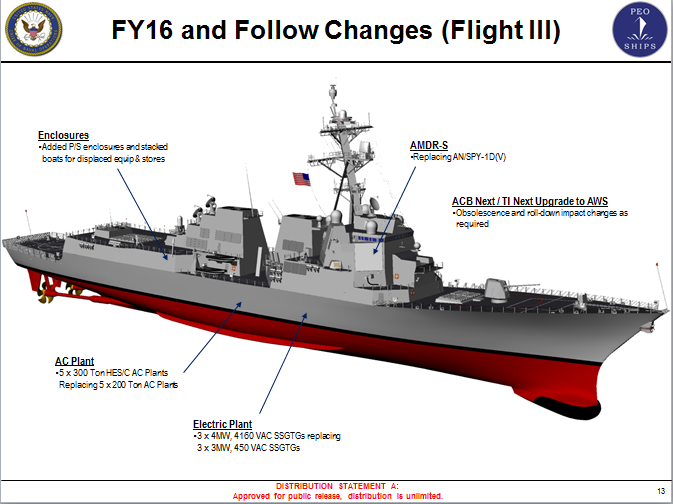
The U.S. Navy has apparently decided that to go with the +15 option (that is, a factor of 32 improvement in signal-to-noise) in the S-band part of the Air and Missile Defense Radar (AMDR) on its planned new Aegis destroyers, according to its DDG-51 Shipbuilding program manager, Navy Captain Mark Vandroff.   Speaking at a Surface Navy Association’s event on January 15, Vandroff stated that “What we’ve locked is the AMDR at SPY [radar] plus 15 decibels” for the new ships.[1]  Under current plans, the first of the new ships, designated DDG-51 Flight IIIs, would be procured in FY 2016 and would achieve an initial operational capability in 2023.

AMDRShip

Figure source:  Capt. Vandroff’s Powerpoint slides, available at:  http://www.navsea.navy.mil/Media/SNA2013/DDG51%20UPDATE%20(CAPT%20Vandroff)%20-%20FINAL.pptx.

(more…)

Missile Defense Agency Conducts First GMD Flight Test in Two Years: Crucial CTV-01 Test Described as a Success. (January 27, 2013)

The Missile Defense Agency announced yesterday that it had conducted the first flight test of a GBI interceptor since its failed FTG-06a intercept test in December 2010.

The test, labeled CTV-01, did not involve a target, and thus no actual intercept was attempted.   Instead the kill vehicle carried out a series of pre-planned maneuvers in order to validate the identification of the problem that caused the failure of the December 2010 test.  MDA officials announced that preliminary indications were that the test had been successful, with all components performing as designed.  If so, the test would represent a crucial step in towards recovering from the FTG-06 and FTG-06a failures, which have delayed the testing program by at least three years.

ctvtest

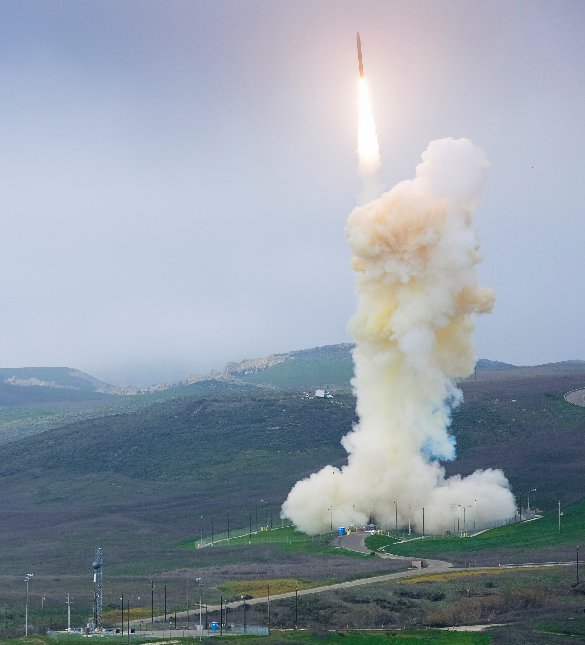
The launch of the GBI Interceptor, January 26, 2012.  (photograph from http://www.mda.mil)

(more…)

How Much Do GMD Tests Cost? (December 28, 2012)

My previous post discussed the low rate of flight and intercept testing of the GMD system.    Since testing of operationally-configured interceptors began in December 2005, MDA has averaged about one flight test per year.  Former MDA director Lt. General Patrick O’Reilly has argued that this pace is the fastest that MDA can sustain while still leaving time for learning between tests.

However, another potential factor is simply the cost of the tests.  As discussed below, the cost of a GMD intercept test could be as great as $300 million or even more.  One such test would then be about 3.75% of a roughly $8 billion annual MDA budget.   This may not seem like a large fraction, but could be a significant issue for an agency under budget pressure.  And it makes it clear that doing two or three intercept tests per year, such as is occurring with Aegis SM-3 testing (which comes out of the same budget, but the cost of each test is much less), would likely eat up a prohibitively large chunk of MDA’s budget.

Here are some cost figures for recent and planned GMD flight tests:

(more…)