Illustration of Radar Imaging of Satellite (May 20, 2012)

Recently published test range images provide an interesting illustration of U.S. capabilities to image satellites.

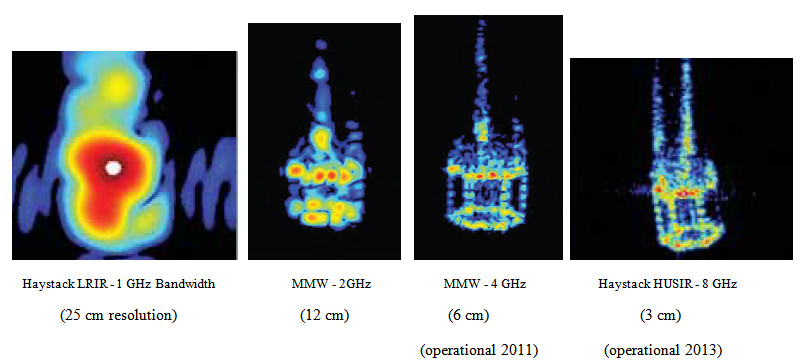
By combining range and Doppler measurements, wide-bandwidth radars can produce photograph-like images of satellites.  The range resolution of a radar is limited to about c/2β, where c is the speed of light and β is the radar’s bandwidth, although for radar processing reasons this limit is not always achieved.  For example, for β = 1 GHz, such as is used by the X-Band Haystack Long-Range Imaging Radar (LRIR)  (and the U.S. X-Band missile defense radars), this formula gives a range resolution of 15 cm, although the Haystack LRIR reportedly only achieves a resolution of 25 cm.  A small cross-range resolution can then achieved by observing a target as it rotates relative to the radar.  This rotational motion can be either due to the satellite’s own spin or simply due its orbital motion relative to the radar.   Typically a rotation of a few degrees is required to get a cross-range resolution equal to the range resolution. 

All U.S. radar images of real satellites are officially classified (although two apparently from HAVE STARE have been published on the internet).

However, the recently published 2011 Lincoln Laboratory Annual Report contains two images of a satellite model at a test range, corresponding to the resolutions of the Millimeter Wave (MMW) radar at Kwajalein before and after its upgrade from 2 GHz bandwidth (12 cm resolution) to 4 GHz Bandwidth (6 cm resolution).  The previous year’s Annual Report contained similar images for the Haystack LRIR at 1 GHz (25 cm resolution) and after its planned upgrade to 8 GHz (~ 3 cm resolution).  I have combined these to give a progression of improving resolution:
 

Here is a picture of the model used for the Haystack measurements (from the 1010 Annual Report):

 

 It is not clear that the same model is used for both the Haystack , as its relative dimensons appear different in the two sets of images (although this could be a viewing angle effect).  Nevertheless it provides an intersting illustration of the rapidly improving U.S. capabilities in this area  (although the last two images don’t look very different to me).
Space Surveillance Sensors: ALCOR Radar (May 17, 2012)

ALCOR

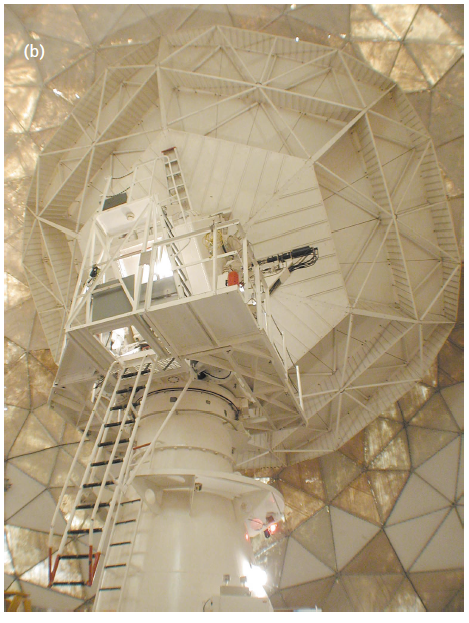
ALCOR (ARPA Lincoln C-Band Observables Radar) was the world’s first high-power long-range wide-band radar.[1]  It played a key role in the development and early implementation of range-Doppler techniques for imaging satellites, producing images with a resolution of 0.5 meters (about 20 inches). ALCOR began operations at Kwajalein in late 1969.  Although it has since been exceeded in both range and resolution capabilities by the Millimeter Wave (MMW) Radar at the same Kwajalein site (and by other wide-band radars at other sites), it remains an important collateral sensor in the Space Surveillance Network.[2]  


 The ALCOR antenna viewed from behind inside its radome at Kwajalein. (Photograph from Camp, et.al.,  Lincoln Laboratory Journal)

Read the full post »

Graph of GMD Tests (May 14, 2012)

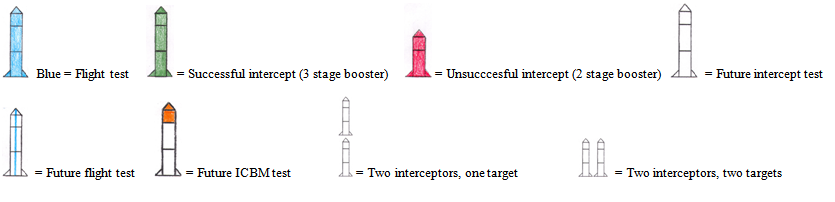
This post is an attempt at  a graphical depiction of the GMD testing schedule.  Information on future tests is as complete as the information I can find, but is certainly incomplete.  I will update this as I get more information.  Click on the images to make them more readable.

Each row of the table shows the tests that have taken place at that time and projected future tests.  The first three rows are for mid-2009, mid-2010, and mid 2011, respectively.  The fourth row is current as of about March 2012.

KEY:

Read the full post »

Space Surveillance Sensors: The ALTAIR Radar (May 11, 2012)

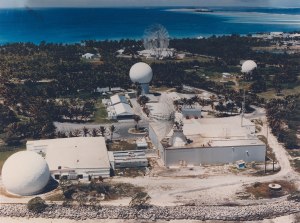
pALTAIR (ARPA Long-Range Tracking and Instrumentation Radar) is a large steerable dish-array radar at the U.S. ballistic missile test range on Kwajalein in the Pacific Ocean.[1]  Operating at both VHF and UHF frequencies, it is an important collateral sensor in the U.S. Space Surveillance Network, particularly for detecting and tracking newly-launched satellites and for tracking objects in deep-space and geosynchronous orbits.  Together with the Millstone Hill and GLOBUS II radars, ALTAIR provides complete coverage of the geosynchronous belt.

Background

The four SSN radars at Kwajalein.  The ALTAIR antenna is the large dish at upper center, viewed partially against the lagoon.  The antenna for TRADEX, which backs up ALTAIR in the Space Surveillance Network (SSN), is the dish antenna on top of the building near the center of the picture.  The antenna for the ALCOR imaging radar is in the dome at lower left, and the antenna for the MMW imaging radar is in the dome in the center of the picture between the ALTAIR and TRADEX antennas.  (Photograph from http://www.orbitaldebris.jsc.nasa.gov/measure/radar.html.)

Read the full post »

GMD Flight Tests of Operationally-Configured Interceptors (May 9, 2012)

GMD Flight Tests of Operationally-Configured Interceptors of the Ground-Based Midcourse Defense (GMD) national missile defense system.

(Update added 12/28/2012: FTG-17, listed below as taking place in FY 2016, has been delayed until 4Q FY 2019.  It will be an intercept test of a two-stage GBI against an ICBM target.  SASC 4/13/2011, p. 244).

The have been seven flight tests (five intercept attempts) of operationally configured GBI interceptors so far.  These are briefly described below, along planned future tests as best as I can figure these out. I will update as I get more information.

FT-1, December 12 2005.  First flight test of operationally-configured GBI, more than a year after the first one was deployed.  It was the first flight of the CE-I version of EKV.  It was not an intercept test; the target was computer-simulated.  Test was reportedly successful.

Read the full post »

Space Surveillance Sensors: The Millstone Hill Radar (May 5, 2012)

The Millstone Hill Radar

The Millstone Hill Radar (MHR) is a large (84 foot diameter) L-Band dish tracking radar located, appropriately enough, on Millstone Hill in Westford MA, a suburb of Boston (42.62˚ N, 71.49˚ W).[1]  It is an important contributing sensor in the Space Surveillance Network (SSN) and is used both for near- and deep-space surveillance.  Two other SSN contributing sensors, the Haystack Radar and the Haystack Auxiliary Radar, which are primarily imaging radars, are located at essentially the same site, and all three are operated by Lincoln Laboratories.  The MHR should not be confused with two other radars at the same site and sometimes also referred to as Millstone Hill radars, one with a 220 foot fixed zenith-pointing antenna and the other with a 150 steerable dish antenna.  Both of these radars operate in the UHF Band and are used almost exclusively for scientific (ionospheric) research, although the steerable dish serves as a backup to MHR for space surveillance purposes.

Read the full post »

When will the GMD national missile defense system finally be tested against ICBMs? 2015? 2020? (May 2, 2012)

When will the GMD national missile defense system finally be tested against ICBMs?   The Missile Defense Agency (MDA) says 2015, but the Government Accountability Office (GAO) says the first test against ICBMs is now scheduled for 2020.  In either case, it will be more than a decade after the system became operational.

Read the full post »

Fourteen claims about GMD Effectiveness (The 13th one is the most accurate) (April 27, 2012)

Fourteen claims about GMD Effectiveness (The 13th one is the most accurate):

(1) April 13, 2011: The posture we have today is one that has us well-protected against the initial ICBMs that might be deployed by states like North Korea and Iran with — that are few in number, relatively slow and lack sophisticated countermeasures.”[1]  Bradley Roberts, Deputy Assistant Secretary of Defense for Nuclear and Missile Defense Policy.

Read the full post »

Telemetry Problems in GMD Tests. When Were They Discovered? Did they Affect the Assessment of FTG-02? (April 24, 2012)

In May 2008, MDA cancelled the planned GMD test FTG-04, which would have been the third intercept test of an operational GBI interceptor.  MDA told GAO that the interceptor telemetry problem that led to this cancellation was discovered in February 2008, but MDA knew about telemetry problems with the interceptor by at least December 2006.  Could the telemetry problem have played a role in the classification of the earlier intercept FTG-02 as a “successful intercept?”

Read the full post »

What does “successful intercept” mean? Maybe not what you think. (April 19, 2012)

What happened with FTG-02?  And what does “successful intercept” mean?

The Missile Defense Agency has long claimed that the first intercept test using the operational version of the Ground-Based Interceptor of its GMD national missile defense system resulted in a “successful intercept.”  But the Pentagon’s own test and evaluation office recently revealed that the interceptor actually failed to kill its target. 

Read the full post »