More on Early Warning Radar to Qatar (August 8, 2013)

In my post of August 7 about the U.S. sale of a large phased-array FPS-132 early warning radar to Qatar, I omitted the detail that the announcement stated that the radar was a Block 5 version of the FPS-132.  I omitted the “Block 5” designation because I has never seen this before and had no idea what it meant.  However, a 36(b)(1) Arms Sale Notification released today provides some additional information.

Specifically, the Notification says:

“The AN/FPS-132 Block 5 supports Missile Defense, Space Situational Awareness, and Missile Warning areas.  The Block 5 system employs 3 electronically steered phased array radar faces to survey 360 degree azimuth.  The Block 5 system is capable of reporting airborne tracks to a maximum range of up to 2,000 km and to a minimum radar cross section (RCS) of 1 m2.”

So:

(1) It is a three-faced array (like the one at Fylingdales).  So its coverage is not solely focused on Iran , but will include the entire region.

(2) The description of it having a maximum range of 2,000 km and a minimum target RCS capability of 1 square meter:

                (a) Vastly understates the radar’s capabilities.  See my post of August 7 for a discussion of the range capabilities of at least the U.S. FPS-132s.

                OR

                (b) Indicates that the radar is a much smaller version  of the U.S. version of the FPS-132 (unlikely)

                OR

                (c) indicates that software restrictions are being installed in the radar to limit its capabilities.

If I had to guess, I’d guess it’s (a).

The 360° nature of the radar would make it even more attractive for space surveillance, assuming (as I am) that the U.S. will have access to its data.  It’s hard to see what the south looking face(s) of the radar would do other than look for space objects.   


Update on TPY-2 Radars. (August 8, 2013)

According to a recent report, the Army may have to “borrow” a TPY-2 X-band radar from a Terminal High-Altitude Area Defense (THAAD) battery for use in future missile defense tests.[1] 

This seems like a good occasion to take another look at where the United States is in building and deploying these radars.  In particular, a more detailed look at the current status of and potential future requirements for these radars indicates that substantially more than the currently planned twelve radars may be needed to meet requirements.

 TPY2-FTI01

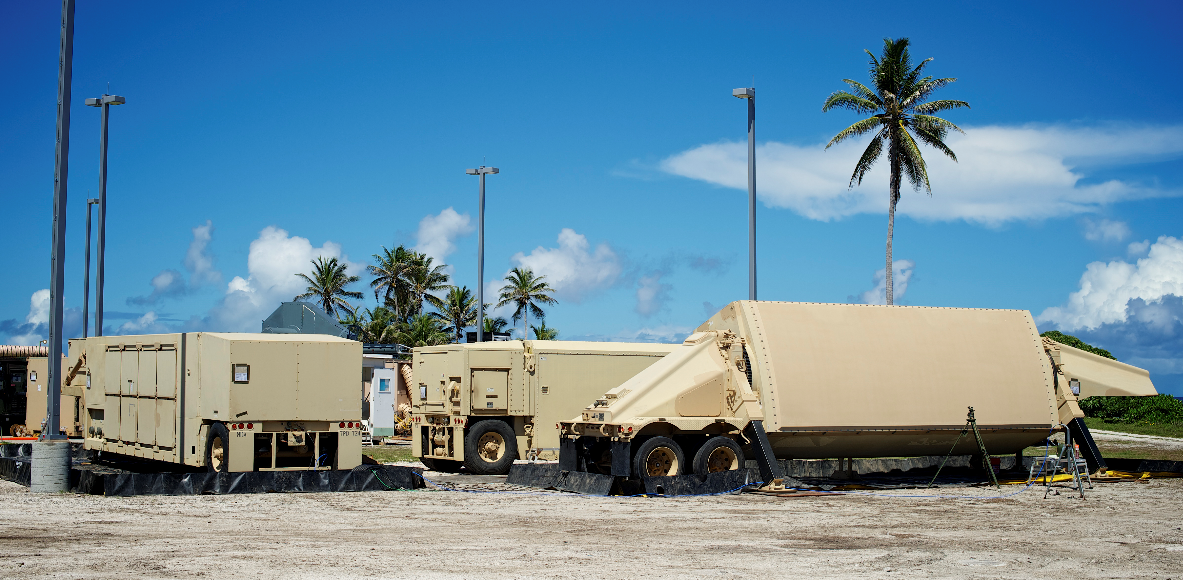
A TPY-2 radar and associated equpment at Kwajalein for the FTI-01 test (image source: http://www.mda.mil).

The TPY-2 radar is an air-transportable radar X-band radar (X-band refers to its operating frequency of about 10 GHz) that can be configured either as a forward-based radar (FBX) for detecting, tracking, and discriminating ballistic missile targets or as a fire control radar for a THAAD  theater missile defense battery.   A TPY-2 radar can be switched between the either configuration in no more than about eight hours.  As a forward deployed radar, a TPY-2 can be used simultaneously both as part of a regional defense system and, in some cases, as an element of the U.S. Ground-Based Midcourse (GMD) national missile defense system.

Prior to 2012, plans called for a total of 14 TPY-2 radars, nine of which were intended for THAAD batteries.  The FY 2013 MDA budget, released in February 2012, reduced the number of planned TPY-2s to eleven (corresponding to a decrease in the planned number of THAAD batteries from nine to six).  In 2013, Congress provided funding for a twelfth TPY-2. 

The U.S. Army has so far accepted delivery of eight TPY-2s.  A TPY-2 takes about 30 months to build under normal circumstances.  In March 2013, it was reported that TPY-2s numbers nine and ten were about halfway completed, and that construction of number eleven was just beginning.  TPY-2 #12 is not yet formally under contract.

Thus, in approximate order of deployment, the current status of the existing and currently planned TPY-2 radars is:

(1) Recently used for testing.  This is the oldest of the TPY-2s.

(2) FBX – Northern Japan

(3) FBX — Israel

(4) FBX — Turkey

(5) THAAD battery – now at Guam

(6) THAAD battery – now at Fort Bliss, TX

(7) FBX – Qatar

(8) THAAD battery #3 (in training) – Fort Bliss

(9) (~mid-2014) THAAD battery #4

(10) (~mid-2014) THAAD battery #5

(11) (~late-2015) THAAD battery #6

(12) (2016, not yet under construction) FBX #6

At present, then, all eight already-completed TPY-2 radars are committed, four as FBXs, three as THAAD radars, and one for use in testing.  At the very least a TPY-2 operating as an FBX will be needed for the FTO-01 integrated system test planned for later in 2013 (another TPY-2 will be used as THAAD fire control radar during this test). 

However, in February 2013 the U.S. announced that a second FBX would be deployed to Japan in the near future.  This commitment was reiterated at the March 15, 2013 Department of Defense Press Conference announcing plans to deploy fourteen additional GBI national missile defense interceptors in silos in Alaska.  Since it appears unlikely that the ninth TPY-2 will be available before mid-2014, once this second radar is deployed to Japan, it thus may become necessary for testing purpose to “borrow” one of the TPY-2s assigned to a THAAD battery.

In the somewhat longer term, it appears that more, and possibly many more, TPY-2s will be needed to meet DoD requirements. Missile Defense Agency (MDA) Director Admiral James Syring recently stated that he was working to find funding for  a seventh and possibly eighth THAAD battery (each of which would require a TPY-2).[2]  At least several additional TPY-2s also seem likely to be deployed as forward-based radars.  In September 2012, the Wall Street Journal reported that in addition to the second FBX to be deployed to Japan, the United States was evaluating potential sites, such as the Philippines, for a third FBX deployment to eastern Asia (see my post of September 27, 2012).  Given the limitations of the Aegis Ashore radars planned for Romania (by 2015) and Poland (by 2018), additional TPY-2s will also likely be needed for deployment in Europe.  The September 2012 National Academy of Science (NAS) Report stated that the MDA has proposed deploying a TPY-2 at both Aegis Ashore sites (although possibly this could be accomplished by deploying a THAAD battery to either or both sites).[3] 

In addition, four TPY-2s have been sold to Qatar and the United Arab Emirates (two each) as part of THAAD batteries.  Production of these radars may not yet begun, as the twelfth U.S. TPY-2 was funded by Congress earlier this year in part to prevent a temporary shutdown of the TPY-2 production line in FY 2014.  

Finally, the September 2012 NAS Report proposed the deployment of five new X-band radars for precision tracking and discrimination.  Each of these proposed radars would be built using two TPY-2 antennas stacked one on top of the other.  Five such stacked TPY-2 radars would thus consume production resources equivalent to ten TPY-2 radars.  A February 2013 MDA report stated that such a stacked TPY-2 radar would take 30 months to develop and produce “assuming that two existing radars were made available for testing and integration.”[4]  If two already existing radars were not made available (which seems unlikely given the short supply of such radars), at least 63 months would be required to build such a stacked TPY-2 radar, “based on current radar production times.”  The report estimated that a stacked TPY-2 would cost “at least $500 million.” While building such a network of stacked TPY-2 radars would clearly have a huge impact on TPY-2 production, they do not currently appear to currently be MDA’s preferred option for adding new radar capabilities, at least based on the MDA’s February 2013 report’s conclusion (presented without any supporting analysis) that “alternative concepts would provide a more robust capability for less cost.”

——————-

[1]Jen Judson, “Army Could Borrow THAAD AN/TPY-2 Radar for Future Missile Tests,” Inside Defense SITREP, July 22, 2013.

[2]Hearing of the Defense Subcommittee of the Senate Appropriations Committee, July 17, 2013.

[3] NAS Report, Page 273, Table E-42, note c.

[4] Missile Defense Agency, “Stacked AN/TPY-2 Array Concept Report to Congress,” February 2013.

U.S. to Sell Large Early Warning Radar to Qatar (August 7, 2013) (corrected February 10, 2014)

On July 29, the U.S. Defense Security Cooperation Agency notified Congress of a potential sale of an FPS-132 early warning radar to Qatar.  This sale of an early warning radar had been announced previously (see my post of November 7, 2012), but the type of radar was not specified at that time.  

 The cost of the radar and associated equipment, training and support was estimated to be $1.1 billion.

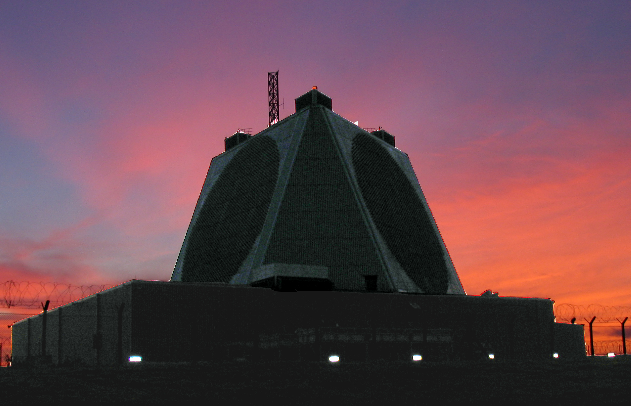
FylingdalesUEWR

The FPS-132 UEWR radar at Fylingdales in Britain.  (Image source: http://www.mda.mil)

 The FPS-132 designation is used for Pave Paws or BMEWS early warning radars that have been upgraded to the Upgraded Early Warning Radar (UEWR) configuration that now forms the core radar infrastructure of the U.S. Ground-based Midcourse Defense (GMD) national missile defense system.  The GMD system currently incorporates three FPS-32s, the Pave Paws radar at Beale Air Force Base in California and the BMEWS radars in Fylingdales,  Britain and Thule, Greenland.   Current plans call for the two remaining Pave Paws radars, at Clear, Alaska and on Cape Cod, to be upgraded to the UEWR configuration by 2017 or later.

The three Pave Paws and two BMEWS radars, all manufactured by Raytheon, are nearly identical except for the somewhat greater size and power the BMEWS radars.  Each phased-array face of a Pave Paws radars has a diameter of 22.1 m compared to 25.6 m for a BMEWS’ radar face.   Each face of a Pave Paws is comprised of 1792 active transmit/receive (T/R) modules, giving an average power per face of about 150 kW.  Each face of a BMEWS includes 2,560 active T/R modules giving an average power of about 255 kW.   Except for the radar at Fylingdales, each of these radars has two faces, each of which covers 120° in azimuth, giving a total azimuthal coverage of 240°.  The Fylingdales radar has three faces, providing 360° coverage.   For descriptions of the Pave Paws and BMEWS radars, see my post of April 12, 2012.

These radars operate between 420-450 MHz, in the UHF radar band.  Because of their limited bandwidth (at most 30 MHZ, probably no more than 10 MHz), the range resolution of these radars is too poor (roughly 25 meters or more) to give them any significant discrimination capability.  However, they can simultaneously track large numbers of targets at large ranges.  MDA’s UEWR fact sheet states that an FPS-132 “detects objects out to 3,000 miles.” In fact, the actual ranges of these radars are likely to be significantly larger.  The original Pave Paws specifications state that it was capable of achieving a S/N = 17.7 dB (= 58.9) against a 10 m2 target (on boresite) at a range of 3,000 nautical miles ( = 5,550 km) with a single 16 ms pulse (the longest pulse it can produce).[1]   (However, because of the curvature of the Earth, ballistic missile targets are unlikely to be observed at ranges much greater than 4,000-4,500 km.) This corresponds to a range of 2,300 km against a 0.1 m2 target with a S/N = 13 dB (=20). The range of the larger BMEWS radars would be about 25% greater.  

The announcement of the sale of the radar to Qatar gives no details of the radar’s configuration, such as the number of antenna faces or how it compares in terms of size and power to the existing U.S. Pave Paws or BMEWS radars.  However, it seems likely that the radar is similar to the large phased-array early warning radar that Raytheon recently completed building for Taiwan (which in photographs such as the one here looks very much like a Pave Paws or BMEWS radar) and which is usually described as having two faces and costing about $1.3 billion (after significant cost overruns).

Qatar has also recently ordered two TPY-2 X-band radars (as part of two THAAD missile defense systems).    In the context of an integrated missile defense system, the FPS-132 UEWR would provide early warning and broad-area surveillance against ballistic missile targets for Qatar (and likely other countries), relieving the TPY-2 radars of this mission so as to enable them to focus on their roles as THAAD fire control and discrimination radars.

In U.S. use, all five of the Pave Paws and BMEWS radars also participate in the U.S. Space Surveillance Network (SSN).   While Qatar probably has little use for space surveillance, data from this radar (if made available) might be quite useful to the U.S. SSN, since it has no large radar in this part of the world.


[1] National Research Council, Radiation Intensity of the PAVE PAWS Radar System, 1979, Table 1.

CBO Estimates Cost of Moving GBR-P X-band Radar to U.S. East Coast (August 6, 2013)

A recent Congressional Budget Office (CBO) cost estimate has estimated the cost of upgrading and moving the Ground-Based Radar – Prototype (GBR-P) radar from Kwajalein to the U.S. East Coast at $510 million.  Such an upgrade and redeployment apparently is one option under consideration for adding an east coast X-band tracking and discrimination radar to the current U.S. Ground-Based Midcourse Defense (GMD) national missile defense system. 

The CBO estimated that upgrading the radar and buying communication equipment would cost $220 million.  The CBO did not indicate the nature of the upgrades that would be made.  The capability of the radar could vary greatly depending on the nature of the upgrades –see my post of June 11, 2013 for a discussion of some potential upgrade options).  The CBO additionally estimated that the preparing the site (assumed to be on an existing military base) and constructing facilities would cost another $290 million, bringing the total to $510 million.  The CBO estimated that the radar could be operational as early as 2017.  It further estimated that operating the radar through 2018 would cost an additional $140 million. 

The Ground Based Radar Prototype (GBR-P) is essentially a smaller version of Ground-Based Radar (GBR) proposed as the tracking and discrimination radar for President Clinton’s proposed3+3 NMD system.   No GBRs were ever built, but a single, similar radar was eventually deployed as the Sea-Based X-band (SBX) radar.  The GBR-P is located on Kwajalein atoll in the Marshall Islands in the Pacific Ocean, where it has been used in the past to observe U.S. ballistic missile tests, although it is not currently in use. Under President George W. Bush’s now-cancelled European Missile Defense plan, the GBR-P would have been moved to the Czech Republic and renamed the European Midcourse Radar.

Construction of the GBR-P on Kwajalein began in October 1996 and it was completed in September 1997.[1]  It first operated at full power in 1998. The GBR-P has an aperture of 123 m2, however only 105 m2 of the antenna is populated with its 16,896 T/R modules.[2]  These modules appear to be are 6 w peak power, 1.2 w average power, first generation T/R modules (see my post of June 4, 2012).  Its stated single-pulse detection range (against an unspecified target radar cross section) is 2,000 km.[3]  The radar sits on a large turntable that can be rotated ± 178° in azimuth and it’s boresite can be mechanically varied between elevations of  0° and 90°.  It has been reported that it can electronically scan its beam up to 25° (±12.5°) in both azimuth and elevation, although its actual electronic scan may be somewhat less.[4]

The GBR-P is designed to be upgradeable by adding more modules and using its entire 123 m2 aperture.  One source states that it can be upgraded to 78,848 modules.[5]  Another source (including authors from the radar’s builder, the Raytheon Company) says “The antenna was designed to be growable to greater than 50,000 elements.[6] 


[1] Jim Bennett, “The Kwajalein Hourglass,” September 26, 2000, pp. 1, 8.

[2] Stanley W. Kandebo, “NMD System Integrates New and Updated Components,” Aviation Week and Space Technology, March 3, 1997,  pp. 47-51.

[3]Michelle L. Kilikaukas, Dirk Brade, Robert M. Gravitz, David H. Hall, Martha L. Hoppus, Ronald L. Ketcham, Robert O. Lewis, and Michael L. Metz,  “Estimating V&V Resource Requirements and Schedule Impact,” Foundations for V&V in the 21st Century Workshop, Johns Hopkins Applied Physics Laboratory, October 22-24, 2002, p. 75;  MDA, “Information Report,” p. 9.

[4] Kilikaukas, et.al., p. 75

[5] Military Electronics Briefing, “BMD X-Band Radars & BMD C4I,” Teal Group Corporation, July, 2007.

[6] J.F. Crawford, R. Reed, J.J. Hines, and D.R. Schmidt, “Ground-Based Radar – Prototype (GBR-P) Antenna,” National Conference on Antennas and Propagation, March 30-April 1, 1999 (IEE Conference Publication No. 461), pp. 249-252.

The Real Reasons for the GMD Testing Delays and Problems (July 15, 2013)

On Friday, four high-ranking Republican members of Congress issued a letter blaming the Obama Administration for the slow pace and poor test record of the Ground-Based Midcourse (GMD) national missile defense system.  This widely-publicized letter (see, for example, Barnini Chakraborty, “GOP lawmakers blame Obama Administration over failed missile test,” FoxNews.com, July 14, 2013) complained that only three GMD intercept tests and two GMD flight tests had been conducted over the last four and a half years.  The letter laid the blame for this situation on the Obama Administration, stating that “is already clear that President Obama’s decision to drastically cut funding for the GMD Program since he came to office … has drained funding available to conduct needed tests of the system.”

Funding for the GMD system has decreased under the Obama Administration.  This is hardly surprising given that the GMD was transitioning from a system under rapid deployment to one whose core was largely deployed.   However, this decrease in funding was not the primary cause of the problems with the GMD test program.  Rather, these problems were the result of a series of mistakes and bad decisions made (mostly) before Obama took office.  Specifically:

(1) Well before Obama took office on January 20 2009, the Missile Defense Agency had begun deploying a new version of Ground-Based Interceptor (GBI) that has a serious but unsuspected design flaw.  In essence, the George W. Bush Administration had left the Obama Administration with a hidden, ticking (albeit slowly) time bomb that would ultimately wreck the GMD testing program.

(2) This defective new version of the GBI was only needed in the first place, because, in its rush to meet a politically motivated deadline established by the George W. Bush Administration, the MDA had deployed GBIs that relied on non-sustainable parts. Moreover, the first operationally-configured interceptor was deployed more than a year before it was first flight tested and more than two years before its first intercept test.

(3) The new version of the GBI also began deployment long before it had even been flight tested, much less intercept tested.

(4) When the first flight and intercept of this new version of the GBI ultimately took place in early 2010, it failed.   However, the MDA simply continued to deploy them as if there were no problem.

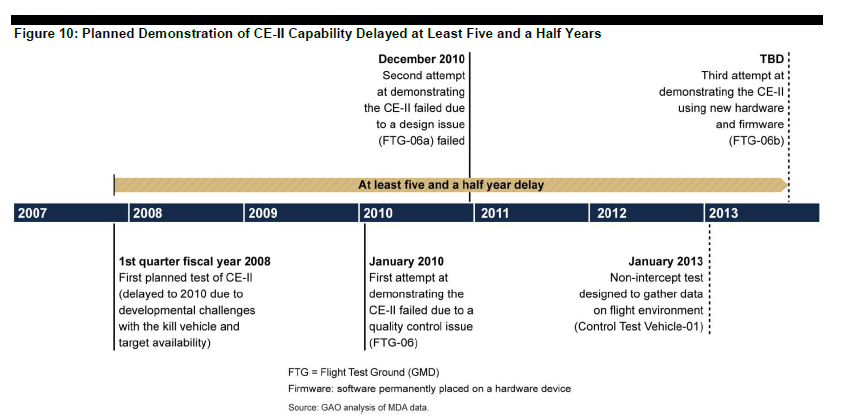
(5) When the design flaw in the new version of the GBI was finally uncovered as a result of a second failed intercept test, its disastrous consequences for the entire GMD program became evident.  It resulted in testing delays of at least five and a half years. It caused planned intercept tests to be cancelled.   It cost over a billion dollars.  To put this cost in perspective, at least four or five intercept tests could have been funded with the money that will ultimately be spent to demonstrate that the CE-II equipped GBI can actually hit a target.  One need not look much further for the cause of GMD test delays and the reason funds have been “drained” from the test program.

(6) Finally, the current slowdown in testing of the GMD system did not begin with the Obama nor did it coincide with large reductions in GMD spending.  The slowdown began in 2007-2008, during the second George W. Bush Administration and at a time when spending on the GMD system was still relatively high.

Some further details and data on each of these six points:

(1) Deployment of GBIs with the new CE-II (Capability Enhancement II) kill vehicle began in October 2008, beginning with the 25th GBI to be deployed.  The 30th GBI was deployed in September 2010.  Thereafter, additional new CE-II GBIs replaced already deployed CE-I versions on a one-for-one basis.  The design flaw in the CE-II, which involved a component(s) not used in the older CE-I kill vehicles, was not discovered until sometime after the failure of the FTG-06a intercept test in December 2010, by which time ten of the new CE-II GBIs were already deployed in silos.

(2) In 2002, President George W. Bush directed the Department of Defense to begin deploying an initial set of national missile defense capabilities by 2004.[1]  Deployment of GBIs began on July 22, 2004 when the first GBI was deployed in a silo at Fort Greely, Alaska.  These interceptors were the first ones built to an operational configuration and were equipped with the original Capability Enhancement-1 (CE-I) version of the kill vehicle.  The first flight test of a CE-I GBI was conducted on December 13, 2005  The first intercept test was FTG-02, conducted on September 1, 2006 (although  reported as highly successful at the time, years afterward it was revealed that the interceptor had only struck the target a “glancing blow.”)  Deployment of the CE-I GBIs continued until the end of Fiscal Year 2007, and a total of 24 were deployed. 

Although the 2004 goal for an operational capability was met, in the rush to deploy, the CE-I GBI interceptors were built with non-sustainable parts.   Thus just a year after the first GBI deployment, MDA began developing a new version of the GBI. 

Then MDA Director Lt. Gen. Patrick O’Reilly told Congress in 2011: “However, we started a second version of the missile kill vehicle in 2005 based on obsolescence reasons; parts, manufacturers and so forth not producing parts anymore that – and the electronic systems that we needed.”[2]  The Government Accountability Office (GAO) states that the decision to develop and deploy the CE-II occurred even earlier, in 2004.[3]

While the development and deployment of this new CE-II version of the kill vehicle is often portrayed as a desirable step for the GMD program, one that improved its capabilities, this is not why it happened. As the GAO reports:  “The CE-II EKV was not originally a reliability upgrade or a performance upgrade program.  Its initial priority was replacing obsolete components.  However, updating certain components is expected to result in increased performance.”[4]  As it turned out, updating one of these components would prove disastrous to the GMD program.

(3) MDA began to deploying the new CE-II equipped GBIs before a CE-II kill vehicle had even been flight tested, much less intercept tested.  The first flight and intercept test for a CE-II equipped kill vehicle was FTG-06, held on January 31, 2010, fifteen months after deployment of CE-II GBIs began in October 2008.  

(4) As noted in the point (3) above, the first flight and intercept test of a CE-II GBI was FTG-06, in January 2010.  It was subsequently discovered that the test failed because a part was omitted during the assembly of the kill vehicle. (There was also a serious failure of the SBX radar during this test.)  However, as discussed in (1) above, deliveries and deployment of CE-II GBIs continued.  Deliveries and deployment of CE-II GBIs were not suspended until after the failure of FTG-06a in December 2010, at which point ten were already deployed in silos.

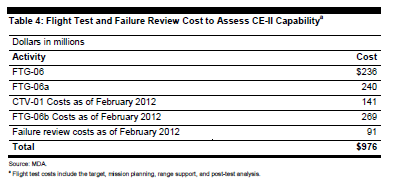
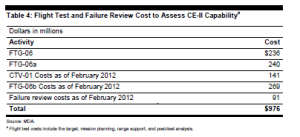
 (5) In 2012, GAO reported that as of February 2012 the cost of the testing the CE-II kill vehicle had reached nearly $1 billion.  These costs are shown in Figure 1 below:[5] 
GAO1

Figure 1.  Cost of establishing the capability of a CE-II interceptor to hit a target as of February 2012.[6]  Click on the figure for a larger image.

Additional costs since then have certainly pushed the total over $1 billion. (For example, as noted in my post of July 12, the cost of conducting the non-intercept CE-II flight CTV-01 had increased by about $29 million from February 2012 until it was actually conducted in January 2013.  This increase alone puts the total over $1 billion.)

Thus well over $1 billion will ultimately be spent demonstrating the basic operation of the CE-II GBI even if the next test, FTG-06b, is completely successful.  To put this in perspective, the most recent test GMD test, FTG-07, held earlier this month, reportedly cost about $214 million (although the costs of investigating its failure will increase this.)  In 2012, MDA told Congress that the planned future tests FTG-11 and FTG-13 would cost $206 and $191 million respectively.  At roughly $200 million each, MDA could have conducted roughly five intercept tests for the over $1 billion it will expend trying to get a CE-II interceptor to hit a target. 

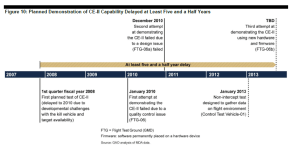
Moreover, as the graphic from the GAO below illustrates, the problems with the CE-II GBIs imposed at least a five and a half year delay in the GMD testing program.
GAO2

Figure 2.  Figure from 2013 GAO Report  showing at least five years of delay in the GMD testing program due to problems with the new CE-II GBIs.[7]  Click on the figure for a larger image.

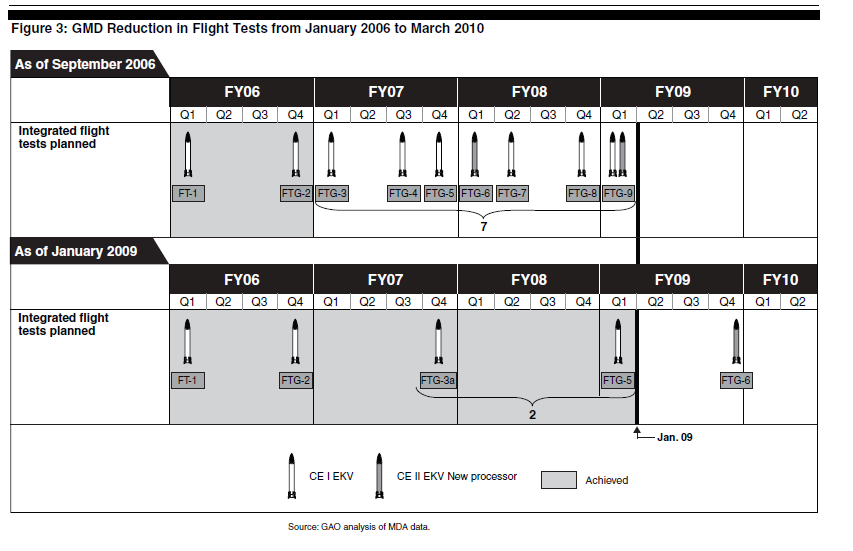
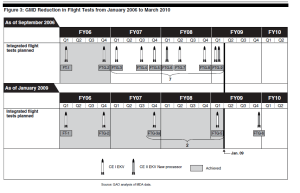
(6) The dramatic slowdown in planned GMD testing occurred in 2007-2008, during the second term of President George W. Bush.  As the top part of the GAO chart below shows, as of September 2006 (following the reportedly successful  FTG-02 test), MDA planned to conduct seven intercept tests (one involving two interceptors) by the end of calendar year 2008.  However, as the lower part of the chart shows, only two tests actually were conducted by the end of 2008.  Moreover, the third test in the lower part of the figure, FTG-06, which is shown as planned for FY2009, did not actually take place until 2Q FY 2010 (and it failed).  Thus the slowdown in GMD testing the letter from the Republican Congressmen complains about was initiated during George W. Bush’s Administration, and at a time during which GMD spending was still relatively high.
GAO3

Figure 3.  GAO chart illustrating the reductions that occurred in 2007-2008 in the number of planned GMD tests through FY2010.[8]  Click on the figure for a larger image.


[1] See, for example, Government Accountability Office, “Defense Acquisitions: Production and Fielding of Missile Defense Components Continue with Less Testing and Validation Than Planned,” GAO-09-338, March 2009, p. 1.  Available at: http://www.gao.gov/products/GAO-09-338.

[2]Strategic Forces Subcommittee, House Armed Services Committee, March 31, 2011.

[3]Government Accountability Office, “Missile Defense: Opportunity Exists to Strengthen Acquisitions by Concurrency,” GAO-12-486, April 2012,  p. 77.  Available at: http://www.gao.gov/products/GAO-12-486.

[4]GAO-12-486, p. 77.

[5] GAO-12-486, p. 75.

[6] GAO-12-486, p. 75.

[7] Government Accountability Office, “Missile Defense: Opportunity to Refocus on Strengthening Acquisition Management,” GAO-13-432, April 2013, p. 96.  Available at: http://www.gao.gov/products/GAO-13-432.
[8] GAO-09-338, p. 29.

How much will GMD Test FTG-06b Cost? More than $300 million? (July 12, 2013)

An article posted on Inside Defense SITREP on Wednesday cites MDA spokesman Richard Lehner as stating that the upcoming FTG-06b test of the Ground-Based Midcourse (GMD) national missile defense system was expected to cost between $229 million and $269 million.[1]  However, publicly available information suggests that the cost could be much higher, to the extent that this could be the first test to top the $300 million mark.

FTG-06b is to be the third intercept attempt for the GMD system using a Ground-Based Interceptor (GBI) equipped with the new CE-II version of the Exo-atmospheric Kill Vehicle.  The first two intercept attempts using the CE-II (FTG-06 and FTG-06a) both failed in 2010, as a result of which production and deliveries of new GBIs was suspended and the ten CE-II GBIs already deployed in silos were taken off operational status.   The MDA has stated that production of new GBIs, which is necessary for the deployment of the planned 14 additional GBIs (scheduled to be completed by 2017), will not start until after the CE-II is successfully demonstrated in an intercept test.  That demonstration is the objective of FTG-06b, currently planned for later this year.  A successful non-intercept test (CTV-01) of a CE-II GBI was conducted in January 2013 as part of the process of validating the cause of the FTG-06a failure.

In April 2012 the Government Accountability Office reported (p. 75) the MDA’s estimate of the cost of FTG-06b “as of February 2012” was already $269 million.  Given the time that has elapsed since then (and that the test is still at least a few months away), this cost has certainly increased.

For example, in the same report, the GAO stated that the cost of the non-intercept test CTV-01 was $141million as of February 2012.  By the time the test was actually conducted in January 2013, this figure had increased to about $170 million, an increase of about 21% (see my post of February 5).  If the cost of FTG-06b increased by the same percentage, its cost would be about $327 million.

It is unclear (to me) precisely what the wording “as of February 2012” in the GAO report means.  However, if it means money actually expended by February 2012, then the costs of FTG-06b could go much higher.  This possibility is suggested by the GAO report’s statement (p. 75) that “In addition to the costs of the actual flight tests, the total cost for determining the root cause [of the FTG-06b failure] and developing the design changes has not been fully developed.”   Moreover, MDA did not even begin building the CE-II kill vehicle to be used in FTG-06b until after the January 2013 non-intercept test (and a CE-II kill vehicle reportedly costs about $39 million).


[1] Jason Sherman, “Top Army General Still Confident in GMD System Despite Intercept Test Failure,” Inside Defense SITREP, July 10, 2013.

“Preliminary Findings” on the Failure of the FTG-07 GMD Missile Defense Intercept Test (July 11, 2013)

The website of the Missile Defense Advocacy Alliance (MDAA) is reporting that the cause of the failure of the July 5 FTG-07 Ground-Based Midcourse (GMD) intercept test was a failure of the booster rocket of the interceptor.  Specifically, according to the MDAA, “preliminary findings” indicate that the final stage of the booster failed to separate.  As the MDAA article discusses, the consequences of this failure will depend heavily on whether the problem was an isolated quality control problem affecting only a single booster or was due to a more systemic problem that could affect the entire fleet of GBI interceptors (or some subset of them).

If the reported reason for the failure is correct, this will also likely mean that virtually no data on the performance of the kill vehicle was collected.  This would be a serious setback,  since as discussed in my post of July 5,  the primary purpose of the test was to check the performance of the refurbished CE-I kill vehicle after it had received “24 to 25” improvements (possibly some of these improvements were to the booster) and possibly also to test the kill vehicle against “countermeasures.”  Thus although the Missile Defense Agency will undoubtedly emphasize that many elements of the system,  such as the radars, worked well, this would mean that, as far as advancing the GMD program is concerned, the test is  essentially a complete loss.


Pentagon Press Secretary on Friday’s Failed GMD Missile Defense Intercept Test (July 10, 2013)

Here’s what Pentagon Press Secretary George Little had to say on Tuesday about Friday’s failed Ground-Based Midcourse (GMD) System test:

Question:  Missile defense.  There was a major missile defense test… 

Little:  Yes. 

Question:  … that didn’t go well on Friday.  A lot of the public is going to say, why are we spending billions on this “turkey,” in quotes?  Can you give the public a sense of if you know what happened and is there a feeling of discomfort within this building that the system using the current warheads — not the new ones — didn’t do so well? 

Little:  The test on Friday was not a success.  And it’s being reviewed as to what went wrong.  And we’re cognizant of the need to get to the bottom of this. 

      But we maintain that we have a robust missile defense system in place to defend the United States and our allies from a range of threats.  And I would repeat what I shared yesterday in my office, Tony, with a number of you and say that you shouldn’t necessarily draw conclusions about our entire missile defense system based on one single test.  We have a range of assets that can support American missile defense, and we are confident that we can defend this country from the missile threat. 

Actually, I think it is considerably more than just “one single test” that has introduced the word “turkey” into this discussion.

I have updated my list of offical claims about GMD effectiveness with Little’s comments


Is the Missile Defense Agency Cutting Back on Public Information? (June 26, 2013)

An article in Inside Missile Defense earlier this month reported that MDA Director Vice Admiral James Syring would not be granting any interviews in the “near term.” (Courtney Albon, “PTSS CAPE Evaluation Submitted to Congress Despite Cancellation,” Inside Missile Defense, June 12, 2013.) The article went on to conclude that “MDA has provided limited information on its programs since last fall, dating back to a scandal involving its previous director.”

[Similarly, in May, Space News reported that MDA Spokeman Richard Lehner told it that MDA was not doing any interviews at that time. (Mike Gruss, “Missile Defense Agency Seeks Universal Kill Vehicle,” Space News, May 6, 2013, p. 7)]

This disturbing conclusion seems consistent with the recent removal of MDA’s “Update” and “Overview” briefing slides from the MDA website.

For at least the last few years, the MDA website’s Downloadable Resources page has included a link to a “Program Overview Briefing.” This briefing was a set of PDF briefing slides from a recent presentation by the MDA Director or other high-ranking MDA official. Older program overview briefings could be found by searching the MDA websitefor “ballistic missile defense overview” or ballistic missile defense update.”

About a week before the March 25, 2013 press conference announcing the deployment of fourteen additional GBI interceptors and the cancellation of Phase IV of the European Phased Adaptive Approach, the link to the Program Briefing Overview was removed and replaced with the statement “Briefing slides coming soon.” Moreover, the older briefing slides are no longer accessible on the MDA website (at least I can’t find them).

At the time the briefing slides were removed, the posted slides were “Ballistic Missile Defense Update,” by then MDA Deputy Director Rear Admiral Randall M. Hendrickson, dated August 14, 2012. A more recent set of briefing slides is “Ballistic Missile Defense Update,” by MDA Director Syring from a talk delivered to the American Society of Naval Architects on February 22, 2013. As far as I know, these slides were never posted on the MDA’s website, but are posted on the Society of Naval Engineers’ website.

Below I have included these two briefings as well as a number of earlier MDA program briefings, dating back to 2007 (not all of these were posted as the “Program Overview Briefing” on the MDA website, nor do they include briefings focused on the EPAA, Aegis BMD, etc…):

MDA Director Vice Admiral James Syring, February 2013:
BMD-Update-Syring-February2013

MDA Deputy Director Rear Admiral Randall M. Hendrickson, August 14, 2012:
BMD-Update-Hendrickson-August 2012

“U.S. Ballistic Missile Defense,” Moscow, May 2012:
US-BMD-Moscow-May2012

MDA Director Lt. General Patrick O’Reilly, March 2012:
BMD-Update-O’Reilly-March 2012

MDA Director Lt. General Patrick O’Reilly, August 2011:
BMD-Overview-O’Reilly-August2011

MDA Director Lt. General Patrick O’Reilly, September 2009:
BMD-Overview-O’Reilly-September2009

MDA Director Lt. General Patrick O’Reilly, May 2009:
BMD-Update-O’Reilly-May 2009

MDA Executive Director Dr. Patricia Sanders, June 2007:
BMD-Overview-Sanders-June2007

MDA Director Lt. General Trey Obering, March 2007:
BMD-Overview-Obering-March 2007

MDA Deputy Director Brigadier General Patrick O’Reilly, January 2007:
BMD-Overview-O’Reilly- January 2007

Presentations on “Ballistic Missile Defense: Technical, Strategic and Arms Control Challenges” (June 19, 2013)

The American Association for the Advancement of Science’s Center for Science, Technology and Security Policy (CSTSP) held an event on “Ballistic Missile Defense: Technical, Strategic and Arms Control Challenges,” on June 6, 2013 in Washington, DC. The speakers were Philip Coyle of the Center for Arms Control and Nonproliferation, George Lewis of the Judith Reppy Institute for Peace and Conflict Studies (and the author of this blog), and Bruce MacDonald of the Federation of American Scientists and Johns Hopkins University/SAIS. The speaker’s PowerPoint presentations are now available at the CSTSP website at: http://www.aaas.org/cstsp/programs/nuclear-security.shtml (under “Selected Events”).