Ballistic Missile Defense: Radars Proposed for Midcourse Discrimination by National Academy of Sciences Report Are Far too Small. (September 20, 2012)

George Lewis and Theodore Postol

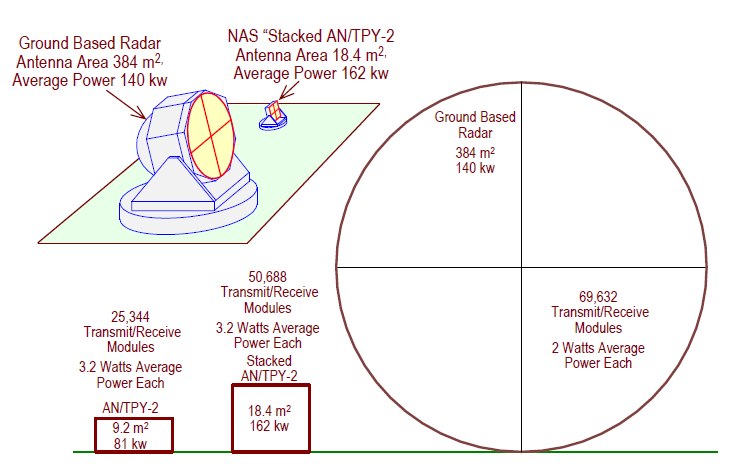
The September 11, 2012 National Academy of Sciences (NAS) Report “Making Sense of Ballistic Missile Defense,” calls for deploying new “stacked” X-band radars alongside four existing early warning radars in order to provide a discrimination capability for the current U.S. Ground-Based Midcourse (GMD) national missile defense (NMD) system.  The report also calls for abandoning plans to mothball the Sea-Based X-band (SBX) radar and to replace the 30 currently deployed Ground-Based Interceptors with fifty new high acceleration interceptors, including some at a site in the northeastern United States.


Figure 1.  The drawings in the upper left of the figure show the relative physical sizes of the Clinton Administration’s proposed GBR x-band discrimination and the stacked x-band radar proposed by the NAS Report.  The lower rectangles compare the physical size and modules of the current TPY-2 X-band radar, the NAS’s proposed stacked X-band radar, Clinton’s proposed GBR.

(more…)

Ballistic Missile Defense: NAS Report: Back to the Clinton Administration’s Approach to Ballistic Missile Defense (September 19, 2012)

Early press coverage of the National Academy of Sciences September 11, 2012 report Making Sense of Ballistic Missile Defense: An Assessment of Concepts and Systems for U.S. Boost-Phase Missile Defense  in Comparison to Other Alternatives has emphasized that the Report calls for scrapping President Obama’s approach to missile defense and returning to the approach of the George W. Bush Administration.   Thus UPI headlines its story “Panel Urges Return to Bush Missile Defense” and the New York Times says “the panel suggested that President Obama shift course by expanding a system he inherited from President George W. Bush and by setting aside the final part of an antimissile strategy he unveiled in 2009.”[1]  In fact, the approach proposed by the NAS panel is a repudiation of the missile defense strategy of the George W.  Bush Administration, and is a return to the missile defense approach of the Clinton Administration.  In particular, it moves away from the Bush Administration’s goal of building a single integrated global missile defense system back to the traditional approach of using separate systems for national and theater defenses.

(more…)

National Academy Of Sciences: Navy Aegis Radars in EPAA Are Just Communications Relays. (September 13, 2011)

Although it is not explicitly spelled out in their report (at least I didn’t see it), the National Academy of Sciences (NAS) Study on “Making Sense of Ballistic Missile Defense” apparently concluded that the only role for the Navy’s Aegis ships in the European Phased Adaptive Approach (EPAA) is to serve as launchers and communication relays for interceptors.

A U.S. Navy Communications Relay System (U.S. Navy Photograph)

In response to a question about the 2011 Defense Science Board (DSB) Report’s conclusion that the Aegis SPY-1 radar was inadequate to support the EPAA, here’s what David Montague, co-chair of the NAS panel had to say at a telephone press conference announcing the NAS Report’s release:[1]

Montague:

“What the DSB said was the SPY-1 radar is not capable enough to do  — support missile intercepts in – in European deployment , which we agree with.

SPY -1 is not used for that purpose in the European deployment.  A — a – subject that has apparently has escaped some people’s read here.

The SPY-1 radar is used only for two things.

One is to communicate with the interceptor, because the X-band radar is used for, what we call and what the MDA calls, engage on remote.  That means all the tracking data and information that is used to launch an interceptor is – comes from the X-band radar.  All the SPY-1 in – in Aegis Ashore does is communicate back and forth with the interceptor.”

Actually, I’m pretty sure the authors of the DSB report understood the concept of engage on remote when they made the following statements:

“The current Aegis shipboard radar is inadequate to support the objective needs of the EPAA mission.” (p. 26)

“Radars of much more substantial operating range than the current radar on the Aegis ships will be necessary for the full realization of a robust regional defense.” (p. 8)

These comments suggest that the DSB sees the inadequate range of the Aegis radars as a problem to be addressed, rather than simply ignored. (In particular, the coverage maps in the DSB report assume a next-generation naval radar, the characteristics of which were not specified in the report.)


[1] “The National Research Council Holds a Teleconference on Missile Defense Report, CQ Transcriptions, September 11, 2012.
NAS Report: One Out of Four Isn’t Bad (September 12, 2012)

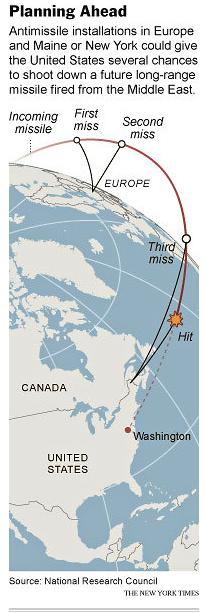
While there will be certainly be much more said on this site about the recent National Academy of Sciences Report on “Making Sense of Ballistic Missile Defense,” here I just want to briefly comment on a somewhat remarkable  figure provided by the NAS via (the National Research Council ) to the New York Times.  The figure, shown below, appears on the Times website here


While I understand the point this figure is trying to make, about the advantage of having multiple intercept opportunities, it nonetheless shows only one of four intercept attempts against an incoming missile succeeding.  The remarkable thing is that, based on the evidence to date, a one-out-of–four success rate is exactly right.  Here are the results of the last eight intercept tests of the U.S. national Missile Defense System, in which the incoming warhead was killed only twice:


Ballistic Missile Defense: The CE-II Interceptors – Beyond High Concurrency (September 4, 2012)

After putting up my previous post (August 31, 2012) about how the interceptors of the Ground-based Midcourse (GMD) national missile defense system were deployed before completing a successful intercept test, I came across two figures in a Government Accountability Office  report that dramatically (I think) illustrate the root cause of the current problems with the interceptors.  


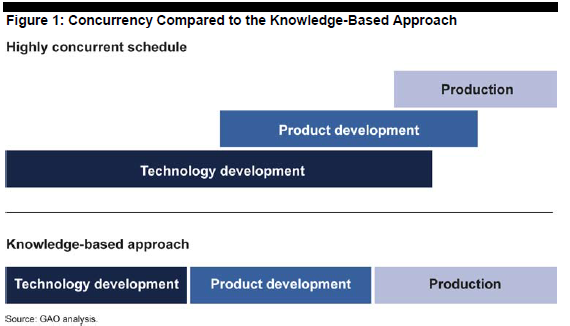
The figure above is from (page 16) the April 12, 2012 GAO report “Missile Defense: Opportunity Exists to Strengthen Acquisition by Reducing Concurrency.”  As the GAO has been doing for a number of years, this report criticizes the Missile Defense Agency for having a high degree of concurrency in some of its programs.  The GAO defines concurrency as “overlap between technology development and product development or between product development and production of a system.” According to the GAO, a high degree of concurrency, as illustrated in the upper half of the above figure “often results in performance shortfalls, unexpected cost increases, schedule delays and test problems.”  On the other hand, the GAO states that “successful programs” follow a “systematic and disciplined knowledge-based approach” as shown in the lower half of the figure.

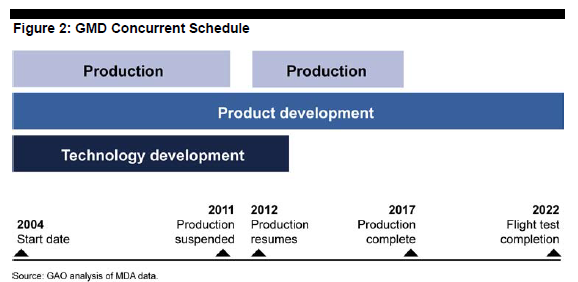
In its Ground-Based Interceptor (GBI) program, however, the MDA has managed to go far far beyond the above figure’s illustration of high concurrency.  The figure below, from the same GAO report (page 17), shows the program schedule for the GBI’s CE-II kill vehicle. (As a reminder, the CE-II is the second version of the kill vehicle used on the GBI interceptor missile.  The CE-II was needed because in the rush to achieve a GMD operational capability before the end of 2004, the original CE-I version of the kill vehicle was built with obsolescent parts.)


As this chart shows, technology development, product development, and production for the CE-II kill vehicle all started simultaneously.  In fact, although not shown on this chart, deployment of GBIs equipped with the CE-II kill vehicle began in 2008, years before the development of its technology was completed, and about 14 years before the currently planned end of its developmental test program.  Predictably, there have been problems.  The CE-II kill vehicle has a design flaw which was not discovered until its second flight test, more than two years after its deployment began (its first test failed for a different reason, before the design flaw could be revealed).   As a result, in early 2011, its production was suspended until it can successfully complete an intercept test (which will be in 2013 at the earliest), after which the ten currently deployed CE-II GBI interceptors will have to be repaired at a cost currently estimated to be about $18 million each. 


Ballistic Missile Defense: Deploy Before You Fly. Were all the GMD interceptors deployed before they had successfully killed a target in an intercept test? (August 31, 2012)

 Were all the GMD interceptors deployed before they had successfully killed a target in an intercept test? 

At a glance, this might seem impossible.  After all, the deployment of the 30th GBI interceptor did not occur until mid-2009, and the MDA states that it had conducted three successful intercept tests by the end of 2008.  However, a closer examination, taking into account that there are currently two different types of GBIs deployed and a recent revelation about the GBI test program, indicates this may actually have happened.  The publicly available information indicates that, at best, a few of the CE-I versions of the GBI interceptor may have been deployed one or two days after it first successfully killed a target in a test.


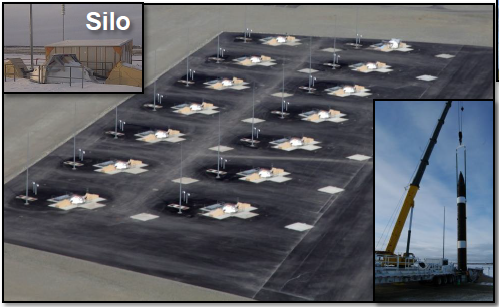
Figure 1: GBI Silo Field 2 at Fort Greely, Alaska.  The lower inset shows a GBI being loaded into a silo.

(more…)

Ballistic Missile Defense: Why the Current GMD System’s Radars Can’t Discriminate (August 28, 2012)

My previous missile defense post (August 24) compared the three-phase national missile defense (NMD) system plan developed by the Ballistic Missile Defense Organization (BMDO) during the Clinton Administration with the current GMD system.  One of the most striking differences in this comparison was the lack of long-range radar discrimination in the current GMD system.  While the BMDO plan would have ultimately deployed eight or nine very large X-band Ground-Based Radars (GBRs), the current GMD has only one such radar, the Sea-Based X-band (SBX) radar.  Moreover, the SBX, which is somewhat smaller than the GBRs envisioned under the BMDO plan, is scheduled to be semi-mothballed in FY 2013 by cutting its budget by more than 90% and putting it in a “limited test and operations” status.

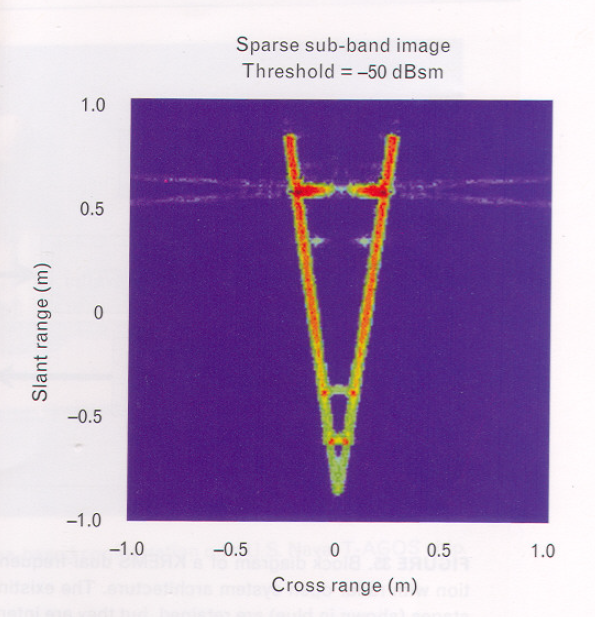
This post explains why the absence of these large X-band GBR radars leaves the current GMD vulnerable to defeat by the simplest of countermeasures, even unintentional ones.  The fundamental problem is that the core radar infrastructure of the GMD consists of Upgraded Early Warning Radars, which have essentially no discrimination capability.


Figure 1.  Simulated two-dimensional image of a warhead by a radar with a bandwidth of about 6 GHz, corresponding to a range resolution of about 5 cm.[1]

(more…)

Ballistic Missile Defense: Comparing the Current GMD National Missile Defense (NMD) System to the Clinton Adminstration’s Proposed NMD System (August 24, 2012)(Typo corrected November8, 2015)

In September 2000 President Clinton announced his decision not to start deploying the national missile defense (NMD) system his Administration then had under development.  In effect, Clinton deferred the deployment decision to the next president.  As a presidential candidate, George W. Bush made clear both his belief that the Clinton system was too small and his intention, if elected, to proceed with a larger and more effective system.  After his election, President Bush soon withdrew the United States from the Anti-Ballistic Missile (ABM) Treaty and began deployment of what is now known as the Ground-Based Midcourse (GMD) national missile defense system.

After ten years of deployment (the U.S. withdrawal from the ABM Treaty went into effect on June 13, 2002) it is interesting and informative to ask how the current GMD system compares with the NMD system plan developed during the Clinton Administration.  In almost all important respects (number of interceptors, radar capabilities), the current GMD national defense system fall far short of what the Clinton plan called for.

The table below summarizes the systems.  More detailed descriptions and an element-by-element comparison follows.


Table 1.  Comparison of the current GMD national missile defense system with the initial (C-1) and final (C-3) phases of President Clinton’s proposed NMD system.

(more…)

Ballistic Missile Defense: The Aegis SPY-1 Radar (August 3, 2012)

The Aegis SPY-1 Radar

The Aegis SPY-1 radar is part of the Aegis combat system deployed on U.S. Navy cruisers and destroyers as well as on a number of foreign ships.  Originally designed as an air defense system, the Aegis system on many U.S. Navy ships has been or is being upgraded to include a ballistic missile defense (BMD) capability.   

The U.S. Navy currently operates 22 Aegis cruisers (CG-47 or Ticonderoga class), although it currently plans to retire seven of these in FY2013 and FY 2014.[1]  Five of the cruisers have so far received BMD upgrades (although one of these is among ones scheduled for retirement).  

By the end of 2012, all 62 Aegis destroyers (DDG-51 or Arleigh Burke class) procured through 2005 will have been delivered, with 24 of these having received the BMD upgrades.  In 2010, procurement of an additional ten Aegis destroyers began, with first scheduled to be operational in 2016.  These ships will be delivered with a BMD capability built-in.  The number of BMD-capable Aegis ships (both cruisers and destroyers) is projected to reach at least 39 by 2020.  Beginning in 2016, the Navy plans on beginning procurement of a new type of destroyer (the Aegis Flight III) with a more capable (and not yet completely defined) radar, with the first ship scheduled to be operational in 2023.     

Aegis Cruiser (CG 72, Vella Gulf).    Two of the Aegis antenna array faces are visible on the rear deckhouse. The other two antenna faces are on the forward deckhouse but are not visible here. (Picture source: U.S. Navy)

Aegis Radar Versions

Four different versions of the Aegis SPY-1 radar are currently deployed on U.S. ships.  The SPY-1 was a test version of the radar that was never deployed. 

(more…)

Ballistic Missile Defense: How Much Does a GBI Interceptor Cost? (July 24, 2012)

The standard answer is about $70 million each, but the actual cost is more like $90+ million.  And the GBI unit acquisition cost, which includes development costs, is well in excess of $400 million each.

.A GBI being deployed into a silo at Fort Greely, February 2012 (Photograph source: www.mda.mil/global/images/system/gmd/DSC_5160.jpg).

(more…)