North Korean Rocket “No Problem” for U.S. Defenses (and fourteen other claims about the GMD national missile defense system’s effectiveness). (December 14, 2012) (March 8, 2013: Updated with 16th Claim)

Claims by U.S. government officials about the effectiveness of the U.S. Ground-Based Midcourse (GMD) national missile defense system.

(1) March 7, 2013: “I can tell you that the United States is fully capable of defending against any North Korean ballistic missile attack.  And our recent success in returning to testing of the upgraded version of the so-called GBI, or the CE2 missile, will keep us on a good trajectory to improve our defense capability against limited ballistic missile threats such as those from North Korea.  But let’s be clear, we are fully capable of dealing with that threat.”  White House Press Secretary Jay Carney, in response to a question at White House Daily Press Briefing, March 7, 2013.[1]

(2) December 12, 2012: “I’m very confident that American defense capabilities are able, no problem, to block a rocket like this one.”  U.S. Secretary of Defense Leon Panetta, in response to a question from CNN on the capability of U.S missile defenses, December 12, 2012.[2]

(3) April 13, 2011: “The posture we have today is one that has us well-protected against the initial ICBMs that might be deployed by states like North Korea and Iran with — that are few in number, relatively slow and lack sophisticated countermeasures.”[3]  Bradley Roberts, Deputy Assistant Secretary of Defense for Nuclear and Missile Defense Policy.

(4) December 1, 2010: “…the probability will be well in the high 90s today of the GMD system being able to intercept that today.” MDA Director Patrick O’Reilly in response to a question from Representative Trent Franks about countering “one ICBM coming from Tehran to New York.”[4]

(5) April 21, 2010: “It is the belief of the — of the leaders of this department that we have the capability to defend the United States against the — against an ICBM threat from a rogue nation such as Iran or North Korea.  We are confident in the system we have at this point.[5]  Geoff Morrell, Pentagon Press Secretary.

(6) July 28, 2009: “Well, we have a very proven missile system in the area of missiles coming out of North Korea.[6]  MDA Director Lt. Gen. Patrick O’Reilly.

(7) June 16, 2009: Confidence that a North Korean missile could be shot down is: “ninety percent plus.”[7]  MDA Director Lt. Gen. Patrick O’Reilly.

(8) June 9, 2009: “I think that the judgement and advice I got was that the 30 silos we have now, or are under construction, are fully adequate to protect us against a North Korean threat for a number of years.[8] And “I have confidence that if North Korea launched a long-range missile in the direction of the United States, that we would have a high probability of being able to defend ourselves against it.”  Secretary of Defense Robert M. Gates.

(9) March 27, 2009: “And Senator, I’ll tell you, if we felt the North Koreans were going to shoot a ballistic missile at us today, I am comfortable that we would have an effective system able to meet that threat.”[9]  General Victor Renaurt, Commander U.S. Northern Command, U.S. Africa Command and U.S. Transportation Command.

(10) November 2, 2008: “I have very high confidence we could defend the United States against that threat.[10] MDA Director Lt. Gen. Henry Obering, about one or two missiles launched from North Korea.

(11) October 2, 2007: “ – does the system work? The answer to that is yes. Is it going to work against more complex threats in the future?  We believe it will.”  MDA Director Lt. Gen. Henry Obering.[11]

(12) September 1, 2006: “I would say that if we had to use the system in an operational mode, it would be very capable.[12] MDA Director Lt. Gen. Henry Obering.

(13) June 2006: “(From) what I have seen and what I know about the system and its capabilities I am very confident.[13]  MDA Director Lt. Gen. Henry Obering.

(14) March 14, 2006: “When the president declares limited defensive operational capability, we are prepared as the shooter, if you will, to execute the mission to defend our country.  And I’m very confident in the efficacy of that system.[14]  Admiral Timothy Keating, Commander of U.S. Northern Command.

(15) March 18, 2003:  “Effectiveness is in the 90% range.[15]   Edward Aldridge, Undersecretary of Defense for Acquisition, Technology and Logistics.

(16) March 23, 2003: “There are a lot of things that go into [determining] effectiveness.  Everybody can be right.[16] MDA Director Ronald Kadish, in response to a question about Aldridge’s statement.


[1]The White House, “Press Briefing by Press Secretary Jay Carney,” March 7, 2013.  Available at: http://www.whitehouse.gov/the-press-office/2013/03/07/press-briefing-press-secretary-jay-carney-372013

[2] Bradley Clapper, “U.S. Hesitant in Condemning North Korean Launch,” The Associated Press, December 13, 2012.

[3] “Now what does that mean?  The posture we have today is one that has us well-protected against the initial ICBMs that might be deployed by states like North Korea and Iran with — that are few in number, relatively slow and lack sophisticated countermeasures.  And against this threat, we have the current posture of 30 GBIs and the expected enhancements to come in the defense of the homeland with the future deployment in 2020 time frame of SM-3 2B.”  Opening statement of Bradley Roberts, Deputy Assistant Defense Secretary for Nuclear and Missile Defense Policy, Hearing of the Strategic Forces Subcommittee of the Senate Armed Services Committee, April 13, 2011.

[4] Strategic Forces Subcommittee of the House Armed Services Committee, December 1, 2010.

[5] “DOD News Briefing with Geoff Morrell from the Pentagon,” News Transcript, U.S. Department of Defense, Office of the Assistant Secretary of Defense (Public Affairs), April 21, 2010.  Available at:  http://www.defense.gov/transcripts/transcript.aspx?transcriptid=4612.   Morrell is the Pentagon Press Secretary.

[6] Gen O’ Reilly: ‘Well, we have a very proven missile system in the area of missiles coming out of North Korea.  The testing we have done to date, we have a lot of testing still to do against all our capability in all scenarios, but in the scenarios out of North Korea, we have intercepted three times out of Fort Greely, Alaska.  The missiles, we actually test them out of Vandenberg, but they’re up at Fort Greely. And then for Hawaii, we have multiple systems (inaudible).  A theater high-altitude-area defense system, its an Army mobile system, and then we have the Navy Aegis system.  And we also have the…”    Margaret Brennan, “US Missile Defense Director Patrick O’Reilly on Bloomberg TV,” Bloomberg TV, July 28, 2009.

[7] SEN Bayh: I’ve bumped up against my time limits here, but there was one final question.  You’re briefing the President of the United States.  He asks you based on — you know,  he’s got to take into consideration what you’re doing in terms of facing these threats.  He asks you if there is a rogue launch, what are the percentages that we’re going to be able to hit it and bring it down, what would you tell him?

GEN. O’Reilly: Ninety percent plus.

SEN. Bayh: Ninety percent plus confidence that we could  — if there’s a rogue launch from North Korea, let’s say, we could intercept that target and bring it down?

Gen. O’Reilly: Yes. Sir.

Hearing of the Senate Armed Services Committee, June 16, 2009.

[8] “I think that the judgement and advice I got was that the 30 silos we have now, or are under construction, are fully adequate to protect us against a North Korean threat for a number of years.”

“I was just in Fort Greely last week, and its an immensly capable system.”  And one of the things that I think is important to remember is, it is still a developmental system.  It has real capabilities, and I have confidence that if North Korea launched a long-range missile in the direction of the United States, that we would have a high probability of being able to defend ourselves against it.”

Secretary of Defense Robert M. Gates, Hearing of the Defense Subcommittee of the Senate Appropriations Committee, June 9, 2009.

[9] Senate Armed Services Committee,  March 17, 2009.

[10] “Obama To Be Told U.S. Missile Defense Capable, General Says,” CNN.com, November 2, 2008.

[11] “DoD News Briefing with Gen. Renuart and Lt. Gen. Obering from the Pentagon, Arlington, Va.”, October 2, 2007.

[12] Pentagon Briefing, September 1, 2006.

[13] Robert Burns, “Missile Defense Chief Confident in Ability To Hit Missile,” The Associated Press State and Local Wire, June 23, 2006.

[14] Jason Sherman, “Experts Question U.S. System’s Ability To Intercept North Korean Missile,” Inside Missile Defense, June 21, 2006.

[15] BAYH: Let me withdraw the question and move on. I think you see where I was heading.

Let me ask you Mr. — Secretary Aldridge, about the effectiveness of the system that’s to be deployed in 2004 and 2005 in protecting against this developing North Korean threat — the 10 land-based missiles proposed for the end of fiscal year 2004 — how effective would they be against the North Korean missile if it were, in fact, launched against our country?

ALDRIDGE: Well, we think that it would be effective. Probably shouldn’t go into a lot of details of…

BAYH: Well, how do you define effective — 90 percent success rate — 75 — 50?

ALDRIDGE: Yes, sir — you would — and you — the way you could achieve these rates is you don’t have to fire just one interceptor per target, you could fire two, as we do in PAC-3.

BAYH: Of course.

ALDRIDGE: And so the effectiveness is in the 90 percent range. Of course, we want the effectiveness to be high enough that we never have to use these things. I mean, that’s the ultimate effectiveness is that they’re never used.

BAYH: There are — there are — there are — there are 10 going online in 2004 — 10 in 2005. The radar is not going to be available — when will that go into place — 2006?

ALDRIDGE: Well, General Kadish has probably got the specific dates for all of those. Let him…

KADISH: We’ll have radars online to handle the early warning and usefulness of the system in ’04, when we put the missiles on alert if everything works out all right. We’ll add the sea-based X-band (ph) if it proves out by — the following year — it’s currently scheduled by September of ’05.

BAYH: So, Secretary Aldridge, your testimony is that with the 10 interceptors going in at the end of fiscal year ’04 and the radar that will be online at that time, we would have a 90 percent effectiveness in shooting down a NATO (ph) Dong II?

ALDRIDGE: Well, it depends on — a lot depends on the continuation of the — of the test and the effective — this precise effectiveness numbers. But I would put — you know, as of today, the projected effectiveness would be in the 90 percent range.
Senate Armed Services Committee, March 18, 2003.

[16] Randy Barrett. “Lawmakers Question Effectiveness of Missile Defense System.” Space News, March 24, 2003, p. 6.

 

Ballistic Missile Defense: How Much Would it Cost for Norway to Give its Aegis Ships Ballistic Missile Defense Capabilities? (December 7, 2012)

While in Norway recently, I was asked a question about how much it would cost to give Norway’s five existing Aegis-equipped frigates ballistic missile defense capabilities.  This was raised as one hypothetical way the Norway might be able to contribute to the larger NATO missile defense program (and not as something that was expected to happen).  At the time, I just said I didn’t know but guessed that it would be hundreds of millions of dollars.  After returning, I came across a recent report about the cost of Spain similarly upgrading its Aegis ships.  The numbers in this story suggest that the costs would be at least $300-$400 million.

NorwegianFrigate

The Norwegian Frigate Fridtjof Nansen (photograph source: Norway Ministry of Defense)

(more…)

Ballistic Missile Defense: Iron Dome Description (December 5, 2012)

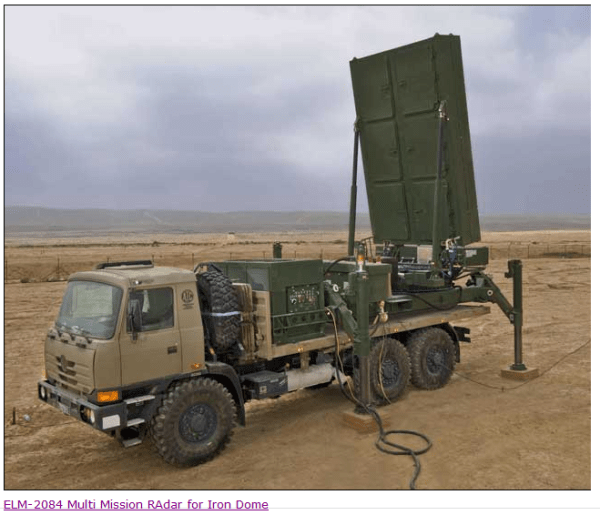
This post collects what information I have been able to find on the characteristics of the Iron Dome system.   Some of the details are of uncertain reliability.  Previous posts (November 29, July 19) discussed what is known about Iron Dome’s effectiveness.

An Iron Dome Battery consists of a radar, a fire control center, and several, typically three or more, launchers.  Each launcher is capable of holding up to 20 Tamir interceptor missiles.  Each battery reportedly costs about $50 million.

irondome radar

The Iron Dome Radar. (Photograph from : http://www.iai.co.il/34380-en/CompanyInfo-Gallery-Radars.aspx)

(more…)

Ballistic Missile Defense: How Did Iron Dome Perform in the Recent Attacks? How Does this Compare to Previous Uses? (November 29, 2012)

About an hour and half after the cease fire at 9:00 pm on November 21 2012, the Israeli Defense Forces (IDF) released an announcement with some details on the rocket attacks from the Gaza Strip and on the effectiveness of the Iron Dome system in countering them.[1]  Here are figures from that announcement, which start with the beginning of the attacks on November 14 and goes up to the time of the cease fire:

(more…)

November 8, 2012: The Mystery of the Cost of the NAS Report’s Proposed GMD-E National Missile Defense System, Part II: What Do the NAS GMD-E System Costs Include?

As discussed in Part I (November 4, 2012) of this post, Figure 4-1 of the National Academy of Sciences Report summarizes its conclusions about the cost of the various ballistic missile defense alternatives the Report considers. In particular, Figure 4-1 purports to show that NAS Report’s proposed new GMD-E national missile defense (NMD) system could be developed, procured and operated for 20 years for billions of dollars less than simply completing and operating the current Ground-Based Midcourse (GMD) NMD system. Part I of this post showed that the NAS overestimates the cost for the current GMD system by about $2.5 billion because it double counts operation and sustainment (O&S) costs. Even corrected for this error, however, the NAS Report’s Figure 4-1 would still show that its proposed GMD-E system is less expensive than simply completing the current GMD system.

This post (Part II) focuses on showing two things:

(1) That the costs shown in NAS Report’s Figure 4-1 are only for the east coast site of its proposed GMD-E system, not the complete system;

and

(2) When the costs of the full GMD-E system and the time required to build it are taken into account, deploying and operating the NAS Report’s proposed GMD-E system will actually cost much more than simply completing and operating the current GMD system.

(more…)

Ballistic Missile Defense: 2 X-Band Radars, Early Warning Radar to Qatar. (November 7, 2012)

The U.S. Defense Security Cooperation Agency has announced on Monday the possible sale of two complete Terminal High Altitude Area Defense (THAAD) batteries, including two TPY-2 X-band missile defense radars, to Qatar for a total of $6.5 billion.  The two THAAD batteries would include eight launchers and 150 interceptor missiles. 

The announcement also stated that the sale would include “1 Early Warning Radar (EWR)” although no further details about this radar were provided.

Given the sale announced at the beginning of 2012 of two THAAD batteries to the UAE (including two TPY-2 radars), and recently announced plans to deploy a U.S. TPY-2 radar to Qatar, this brings the total planned number of TPY-2 radars for this small part of the Middle East to five.


November 4, 2012: The Mystery of the Cost of the NAS Report’s Proposed GMD-E National Missile Defense System, Part I: Double Counting Sustainment Costs

Perhaps the most significant recommendation in the recent National Academy of Sciences’ Report on ballistic missile defense is its Major Recommendation Five.[1]  In part, this recommendation calls for replacing the currently deployed Ground-Based Interceptors (GBIs) of the Ground-Based Midcourse (GMD) national missile defense system with new short-burn time interceptors, which it refers to as GMD-E interceptors (the “E” stands for “evolved”). Initially 30 of these GMD-E interceptors would be deployed in silos at a new site in the North East United States.  Subsequently 30 additional new GMD-E interceptors would replace the existing 30 GBIs (26 in Alaska and 4 in California) on the West Coast. In order to carry out testing and sustainment for this deployed force of 60 GMD-E interceptors, a total of 100 new interceptors would be procured.[2] This new “CONUS-Based Evolved GMD” system, as the NAS Report refers to it, would also involve the deployment of 5 new X-Band radars (referred to as GBX radars) alongside existing early warning radars. Here we simply refer to the “CONUS-Based Evolved GMD” system as the GMD-E system.

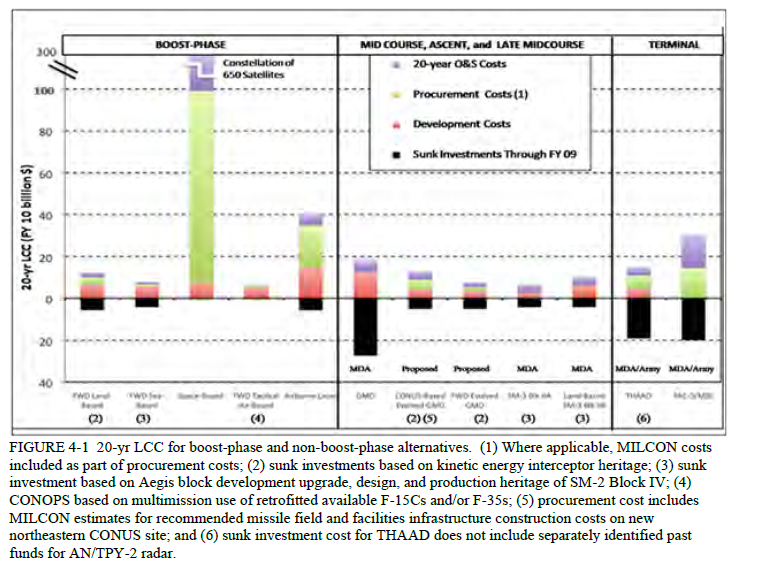
The NAS Report summarizes the cost for a range of alternatives in Figure 4-1 on page 4-2 (This figure also appears in the Report Summary as Figure S-2). This figure is reproduced below as Figure 1.

[Note: In this post I use the NAS cost figures, which are based on numbers for FY 2010.  I do not attempt to account for things which have happened since then.  For example, since 2010 test failures have led to both an increase in the total buy of GBI interceptors from 52 to 57 and increased testing costs. Thus future GMD costs will be higher than in the budgets shown here. However, such costs increases are likely more than offset by the fact that two or three years of spending that the NAS Report counts as future costs are now “sunk” costs.]


Figure 1.  Figure 4-1 from NAS study.

As the caption states, Figure 4-1 shows the 20 year lifecycle costs (LCCs) for various missile defense alternatives considered in the NAS report. The 20 year LCCs start in FY 2010 and are given in FY 2010 dollars.  The first section of the figure shows the NAS costs for five boost-phase systems, the middle section shows midcourse defense systems, including both the GMD and the proposed GMD-E systems, and the last section shows costs for two terminal defenses, Patriot PAC-3 and THAAD.

The first two columns of the middle, midcourse section compare the cost of completing and operating for 20 years the current GMD system to the cost of developing, procuring and operating their proposed new GMD-E system, also for 20 years. 

Surprisingly, the NAS Report’s Figure 4-1 purports to show that this new GMD-E system can be developed, procured and operated for 20 years at a lower cost than completing the current GMD system and operating it for 20 years. 

Why is this surprising?  Because the GMD system is nearly complete. Only the last 12 GBI interceptors remain to be bought.  Yet according to the NAS Report, the development and procurement costs associated with deploying these last 12 interceptor are billions of dollars greater than the cost of developing and deploying a much larger number of their proposed new, more capable GMD-E interceptors. How is this possible?

In this and the next several posts, I will attempt to assess and explain this NAS Report finding. It is a complicated subject, and so I will break it up into several posts. In this first part, I focus on only two things:

(1) Showing how the NAS Panel obtained their projected cost figures for the GMD system, as shown in their Figure 4-1;

and

 (2) Showing that they double count Operations and Sustainment (O&S) costs for the GMD system, leading to an error of about two and a half billion dollars.

  (more…)

Ballistic Missile Defense: A Significant Advance in Missile Defense Criticism Evasion Technology (October 18, 2012)

In my post of April 19: What does “Successful Intercept” Mean: Maybe Not What You Think, I pointed out that the statement to the Strategic Forces Subcommittee of the House Armed Services Committee on March 6, 2012 by the Pentagon’s Director of Operational Test and Evaluation (DOT&E) J. Michael Gilmore that the interceptor in the September 2006 FTG-02 test of the Ground-Based Midcourse did not “kill” its target seemed inconsistent with the Missile Defense Agency (MDA)’s claim that the test was a “successful intercept.”  However, at the time Dr. Gilmore’s statement did not make clear precisely what had happened. 

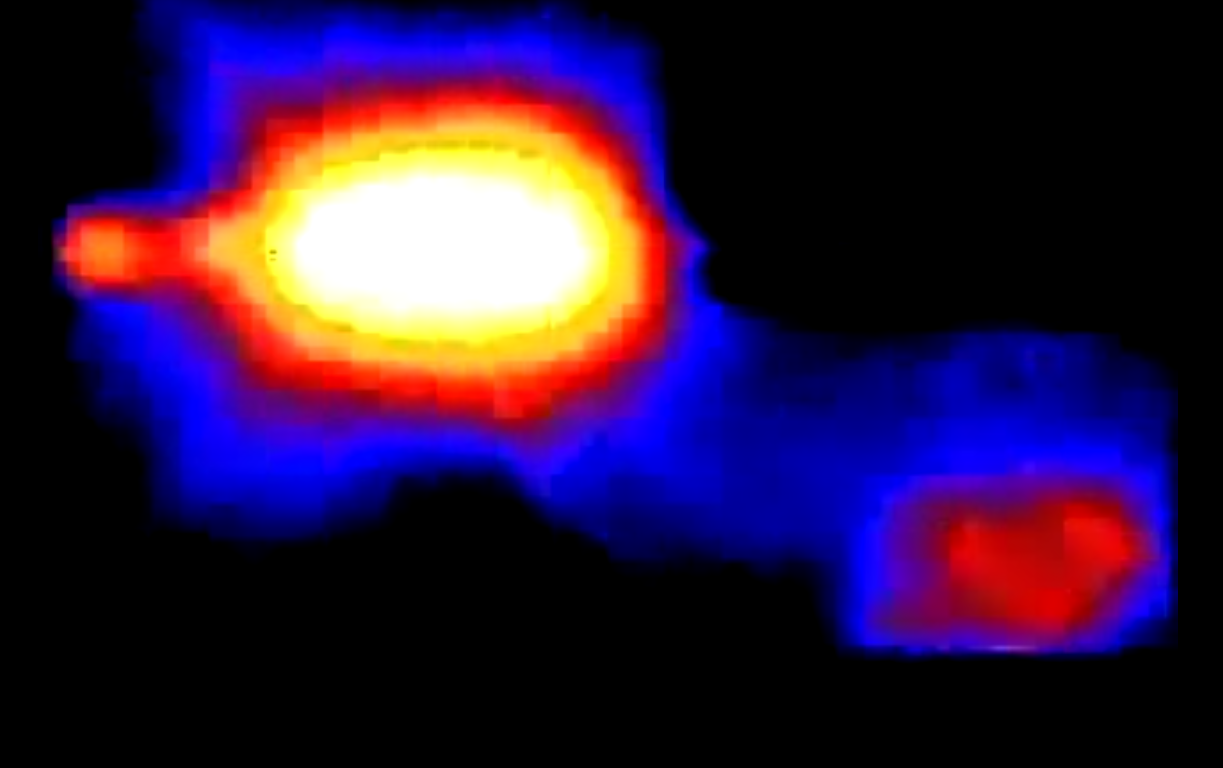
FTG-02: A “glancing blow.” (screen capture from MDA video)

The official transcript of the hearing, with follow-up questions and answers, is now available, and this sheds some new light on the issue.

In particular, in response to a written question from Rep. Loretta  Sanchez, Dr. Gilmore explains that in FTG-02, the kill vehicle struck a “glancing blow” to the target re-entry vehicle and that subsequent analysis showed would this would not have destroyed the re-entry vehicle. 

Here is the question and answer:

Ms. SANCHEZ.  For GMD testing, is a hit considered a kill?  Does this introduce any risk in reliability assumptions for the GBIs? 

Dr. GILMORE. A hit on the threat re-entry vehicle (RV) by the exo-atmospheric kill vehicle (EKV) is not automatically considered a kill.  Ground-testing (using rocket-propelled sleds) as well as modeling and simulation demonstrate the EKV can strike the RV in a location that does not result in a kill.  This was the case in Flight Test Ground-Based Interceptor (GBI)-02 (FTG-02).  Although the flight test objectives excluded actually killing the incoming RV, the EKV achieved a “glancing blow” on the RV. Subsequent analysis indicated that the “glancing blow” would not have resulted in a kill.  I score the FTG-02 flight test a hit, but not a kill.

In principle, an intercept hit that does not result in a kill could have a number of causes some of which are not related to reliability.  The result of FTG-02, in which an RV kill was not planned (and was not achieved) is not a reliability issue.

[Note that, as discussed in the post of April 19, hitting the target, while not the primary objective of the test, was indeed a secondary objective, and MDA has stated that all of the secondary objectives of the test were achieved]

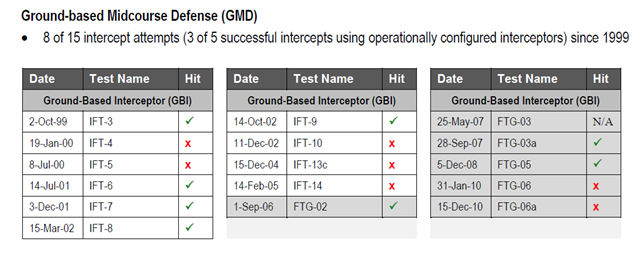
Thus it is now clear, seven years after the test, that the despite repeated claims by the MDA that the test was a “successful intercept,” that it did not actually destroy its target.  Moreover, the MDA still claims that the test resulted in a “successful intercept”.  Here is a table from a fact sheet on the MDA’s website that I downloaded today (the date on the fact sheet is July 10, 2012), showing FTG-02 as a “successful intercept.”  (The tests of operationally configured interceptors are the last six, whose names begin with “FTG”).

This appears to represent a significant advance in missile defense criticism evasion technology.  As I noted in the April 19 post, following the 1991 Gulf War, the U.S. Army specifically argued that the word “intercept” did not mean the target was destroyed.  Now it seems we have advanced to the point that even a “successful intercept” does not mean the target was destroyed.

Ballistic Missile Defense: More on X-Band Radar Locations (September 27, 2012)

The recent National Academy of Sciences (NAS) Report Making Sense of Ballistic Missile Defense indicates that in addition to deploying Aegis Ashore sites in Romania and Poland, the Missile Defense Agency would like to deploy a TPY-2 X-band radar at each site.  Specifically the report states (in its appendix on System Cost Methodology) that: “As part of the Phased Adaptive Approach for the European missile defense system, MDA has proposed that each interceptor site location include a forward-based (FBM) AN/TPY-2 X-band radar system.”[1]  If true, this statement has several interesting possible implications about the MDA’s radar plans.


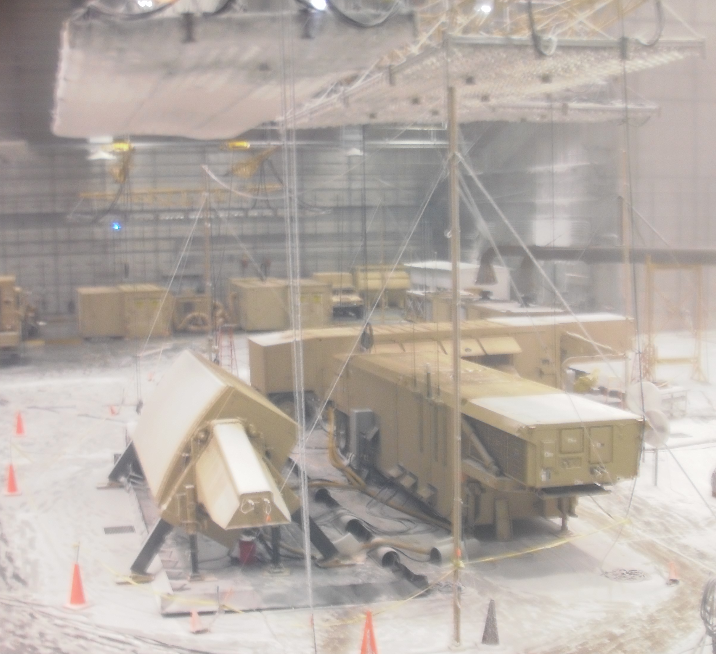
A TPY-2 radar undergoing environment  testing. (Picture source: Missile Defense Agency)

  (more…)

Ballistic Missile Defense: Radar Range Calculations for the AN/TPY-2 X-Band and NAS Proposed GBX Radars (September 21, 2012)

By George Lewis and Theodore Postol

While the recent National Academy of Sciences (NAS) Report, “Making Sense of Ballistic Missile Defense,” doesn’t cite any specific numbers for radar ranges, their figure 5-8, shown below, shows ranges of about 1,500 km for the current AN/TPY-2 X-band radars and 3,000 km for their proposed stacked TPY-2 radars (which they refer to as GBXs).  However, we believe that these ranges are much too large, particularly for discrimination, which is what the proposed GBX radars are for.  To provide a basis for discussion, here we provide our own estimates for the ranges of these radars, with all our parameters and assumptions spelled out.

Figure 5-8 from NAS Report, showing ranges of TPY-2 radars in Turkey and Japan and of stacked TPY-2 (GBX) radars in Britain, Greenland, North Dakota and Cape Cod. This figure shows ranges of about 1,500 km for the TPY-2 radars and 3,000 km for the stacked TPY-2 radars.

(more…)