Estimating the Composition of the 44 Deployed GBIs in 2017 (May 5, 2015)

Under current plans, the total number of deployed Ground-based Interceptors (GBIs) of the U.S. Ground-Based Midcourse Defense (GMD) system will reach a total of 44 by the end of 2017.  Three different types (and likely several sub-types) of Exo-Atmospheric Kill Vehicles (EKVs) will be deployed on these GBIs.  These are the original Capability Enhancement-1 (CE-I) version, deployed between 2004 and 2007, the follow-on CE-II version deployed between 2008 and 2015, and the new CE-II Block 1, which will be deployed starting in 2017.  The differences between these types of EKVs are described in my post of April 26, 2015.

In this post I try to estimate the composition of the deployed GBI force when the 44th GBI is deployed in 2017.

It seems clear that ten of the deployed GBIs will be the new CE-II Block 1 version. This assumes that the first flight and intercept test of a CE-II Block 1, currently scheduled for the third quarter of calendar year 2016, is successful. The MDA currently plans to deliver eleven CE-II Block 1s by the end of 2017, one of which will be expended in the intercept test  — FTG-15.

According to the Department of Defense’s Inspector General, through 2015, the U.S. has bought a total of 33 CE-I and 24 CE-II EKVs, for a total of 57.[1]  This numbers appears to be the final totals for each of these EKV versions, because by 2016 production will have switched over to the CE-II Block 1.  Under current test plans, by the end of 2017, seven CE-Is and six CE-IIs EKVs will have been expended in test flights.[2]  These tests will reduce the number of remaining EKVs to at most 27 CE-I and 18 CE-IIs.

According to the 2015 prepared statement of MDA Director Admiral Syring for Congressional committees, “Four previously fielded CE-II GBIs will be used for flight and Stockpile Reliability testing.”  Removing these four GBIs  leaves 16 deployable CE-II GBIs, since two of the CE-IIs (CTV-02+ and FTG-11) to be withdrawn for testing were already subtracted out of our count in the previous paragraph.

A total of 16 deployed CE-IIs is consistent with Admiral Syring’s statement in his 2015 prepared testimony that eight new CE-IIs would be deployed in 2015 and that eight currently fielded CE-IIs would be upgraded in FY 2016.

With sixteen CE-IIs deployed, the breakdown at the end of 2017 would be:

10 CE-II Block-1s

16 CE-IIs

18 CE-Is

Thus at that point less than half of the deployed GBIs would be CE-Is.

An alternate method of attempting to count the number of deployed CE-II GBIs is included at the end of this post.


Continuing out past 2017:

The further out one goes in time, the more speculative attempts to estimate the EKV stockpile become. However, several general points can be made:

(1) MDA budgetary materials suggest that few if any new GBIs will be deployed using funding from its RDT&E account from 2017 to 2020.[3]  All the currently deployed GBIs as well as those planned for deployment through 2017 have been bought through the MDA’s RDT&E account.  GBIs usually require several years from initial procurement to deployment, and there are no indications in the RDT&E budget materials of plans to procure additional GBIs for deployment in the near future.

Specifically, in the Ground Based Interceptor Manufacturing budget element for FY 2016, MDA cites only three projects:

— Completing the planned deliveries of CE-II equipped GBIs.

— Continuing the manufacturing of the eleven CE-II Block 1 GBIs planned for deployment (and use in a test) by the end of 2017.

— Beginning acquisition of two new GBI boosters.  These are likely the two boosters that will be used in the flight and intercept tests of the new Redesigned Kill Vehicle (RKV) planned for FY 2018 and FY 2019.

(2) Beginning in FY 2018, MDA will begin procuring two GBIs per year under its Procurement account.  These GBIs are needed to provide additional GBIs to support flight testing, stockpile reliability, and spares requirements associated with the increase from 30 to 44 deployed GBIs.  Under previously announced plans, a total of ten GBIs will be bought over five years for these purposes.  Initially, these GBIs will likely be equipped with CE-II Block 1 EKVs and be deployed to free up older deployed GBIs for testing.  Thus by about 2019-2020, the numbers of deployed CE-1s will likely to begin declining in favor of CE-II Block 1s.  It is possible that starting in 2020, these GBIs will start to be equipped with RKVs — if not, then it seems that both CE-II Block 1 EKVs and RKVs would have to be in production at the same time.

(3) Under current plans, MDA plans to begin deploying RKV-equipped GBIs in 2020.  There has been no public indication of how rapidly such new GBIs might be deployed.  One possible factor might be that the EKV-equipped GBIs are said to have a twenty-year lifetime, and the last CE-I equipped-GBIs were deployed in 2007.  Replacing all of the deployed CE-Is by 2027 would only require an RKV deployment rate of somewhat over two per year.  Of course, if it was decided to establish an East Coast interceptor site, the rate of RVK production would have to increase very significantly.

An alternate attempt estimate of the number of CE-II GBIs at the end of 2017:

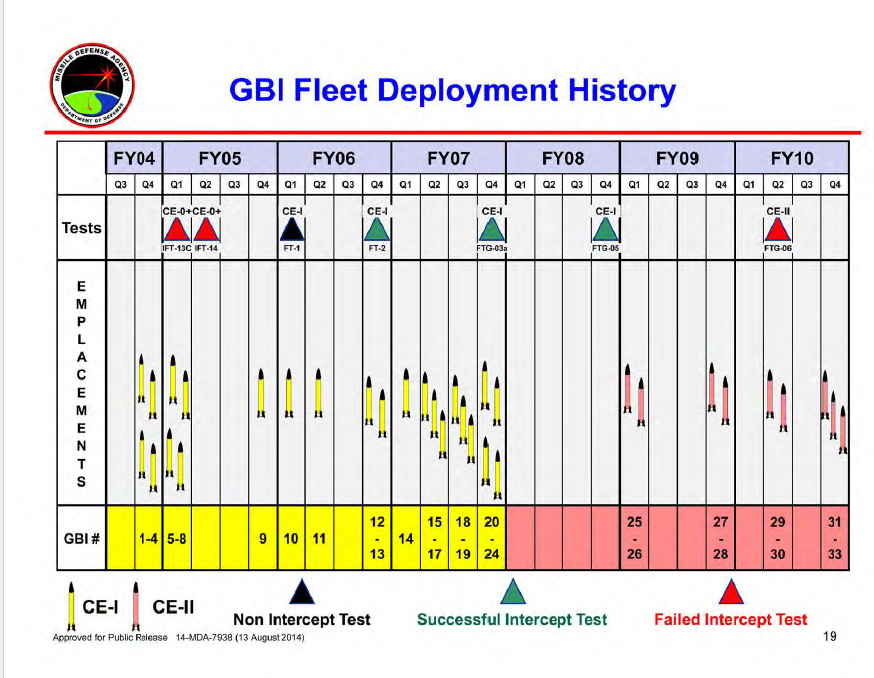
Another way to try to estimate the number of deployed CE-IIs is by the numbers assigned to individual GBIs in MDA budget documents.  These numbers are the same as those used in the slide entitled “GBI Fleet Deployment History,” in Admiral Syring’s 2015 SMDC Conference presentation, as shown below (click on image for larger version).  As Admiral Syring’s slide shows, the first twenty four deployed GBIs were CE-1s that were deployed before the end of September 2007.  These GBIs were designated GBI 1 through GB 24.  The slide makes clear that at that time only GBIs intended for deployment are included in this numbering scheme.
GBIDeployments

Deployment of GBIs resumed with the first CE-II GBI — GBI 25 – in October 2008.  The first six CE-II GBIs – GBI 25 through GBI 30 – were deployed into empty silos, bringing the total number of deployed GBIs to the objective total of thirty.  Admiral Syring’s slide shows three additional CE-II GBIs (GBI 31 to GBI 33) were deployed by the end of FY 2010.  These three GBIs replaced existing deployed CE-I GBIs.  Thus at the end of FY 2010, there would have been twenty one deployed CE-I GBIs and nine deployed CE-II GBIs.

In addition to the nine deployed CE-IIs, by the end of 2010 there appear to be two or three CE-II EKVs that were outside of this numbering scheme.  These are the EKVs used in intercept test FTG-06, which took place in January 2010, and one or both of the EKVs intended for intercept test FTG-09, which was a salvo test (two interceptors against one target) scheduled for FY 2011.  Following the failure of FTG-06, FTG-09 was cancelled in order to conduct FTG-06a, which also failed.

Following the failure of FTG-06a, deliveries of CE-II EKVs were suspended.  MDA budget documents show that the first of the suspended deliveries was GBI 34.  Thus at the time of this suspension, there would have been nine deployed CE-II GBIs (GBI 25 – GBI 33) and two CE-IIs expended in intercept tests.  However, the GAO has stated that, at the time of the suspension, twelve CE-II GBIs had been delivered and ten of these had been deployed.  The reason for this discrepancy is unclear (to me).  One possible, although speculative, resolution to this discrepancy would be that the both of the interceptors for the planned FTG-09 salvo test were CE-II GBIs (as opposed to what is now planned as the first salvo test, FTG-11 in FY 2017, which will use one CE-I and one CE-II).  Both of these CE-II GBIs would be outside the GBI numbering scheme, and the EKV not expended in FTG-06a could have been subsequently deployed, bringing the total number of deployed CE-II GBIs up to ten.

In 2013 and 2014, two CE-II EKVs were expended in the flight test CTV-01 and the intercept test FTG-06b.  According to MDA budget documents, both of these CE-II EKVs were pulled from the ones that had already been deployed, bringing the number of deployed CE-IIs down to seven or eight.

Following the successful intercept test FTG-06b in 2014, MDA once again began accepting deliveries of CE-II-equipped GBIs.  According to MDA budget documents, the next batch of eleven CE-II GBIs (GBI 34 to GBI 44) will be delivered before the end of FY 2016, bringing the total to eighteen or nineteen deployed.  Taking into account the four deployed CE-II GBIs that in 2015 MDA Director Syring said would be withdrawn from deployment, the total number of deployed CE-II GBIs would then be fourteen of fifteen.

This counting scheme only totals twenty three CE-II EKVs.  Given that the DoD Inspector General reports total of twenty four CE-IIs were delivered, and the conclusion above that sixteen CE-IIs will be deployed by 2017, it appears likely that there is one more CE-II GBI that is for some reason outside the GBI numbering system. (In addition, there is no reference to GBIs 45, 46 and 47 in the MDA budget documents.)

Production and delivery of GBIs will subsequently continue with eleven CE-II Block 1 GBIs (GBIs 48-58).  This Block 1 numbering of GBIs appears to differ from the previous GBI numbering scheme in that it includes GBIs both for deployment and testing, and in particular it includes the GBI for the FTG-15 intercept test, scheduled for 2016. This would leave ten CE-II Block 1s for deployment by the end of 2017.

[1] Inspector General, U.S. Department of Defense, “Exoatmospheric Kill Vehicle Quality Assurance and Reliability Assessment – Part A,” DODIG-2014-111, September 8, 2014, p. 7. Available at: http://www.dodig.mil/pubs/documents/DODIG-2014-111.pdf.

[2] For the CE-Is, these are FT-1 (2005), FTG-2 (2006), FTG-3a (2007), FTG-5 (2008), BVT-1 (2010), FTG-07 (2013), and FTG-11 (2017). For the CE-IIs, These are FTG-6 (2010), FTG-6a (2010), CTV-01 (2013), FTG-06b (2014), CTV-02+ (2015) and FTG-11 (2017).

[3] By budgetary materials, I primarily mean the annual MDA RDT&E Budget Justification Books available on the Department of Defense’s Comptroller’s website. For example, the FY 2016 materials are at: http://comptroller.defense.gov/Portals/45/Documents/defbudget/fy2016/budget_justification/pdfs/03_RDT_and_E/MDA_RDTE_MasterJustificationBook_Missile_Defense_Agency_PB_2016_1.pdf.
EKVs, RKVs, CKVs, MOKVs and More. (April 26, 2015)

There have been at least as many acronyms and designations assigned to current, past and future kill vehicles of the Ground-based Midcourse Defense (GMD) national missile defense system as there have been successful intercept tests of such kill vehicles.  Below I summarize the most important of these kill vehicle designations.

EKV CE-0: This designation covers the kill vehicles used in the first seven GMD intercept tests, from 1999 to 2002, as well as the IFT-1a and IFT-2 fly-by tests in 1998-99.  The first, and so far only, place I have seen this designation is on the slides used by MDA Director Admiral Syring during his August 13 presentation at the 2014 Space and Missile Defense Conference.  (These slides were obtained via FOIA by Laura Grego of the Union of Concerned Scientists.)  These kill vehicles are sometimes referred to as “prototypes” although this term is sometimes also used for the later CE-I and CE-II kill vehicles as well.  The “CE” stands for Capability Enhancement, so the CE-0 designation seems to be both a retroactive designation as well as a catch-all for all the early GMD kill vehicles, as indicated by its use for both the fly-by tests, which used two completely different competing kill vehicle designs.

(more…)

The Long Range Discrimination Radar at S-Band? (April 20, 2015)

It appears likely that the Ground-Based Midcourse (GMD) Defense’s new Long Range Discrimination Radar (LRDR) will operate at S-band instead of at X-band. This raises the question of whether the better range resolution that would have been available at X-band is being sacrificed in order to keep the initial cost of the LRDR down to about $1 billion. Or is there some other reason?

Although the current Ground-Based Midcourse (GMD) national missile defense system nominally provides coverage of all 50 states from limited intercontinental ballistic missile attack, it is well known that the system is severely lacking in its discrimination capabilities. In particular, the primary sensor infrastructure (aside from the infrared seekers on interceptor kill vehicles) for the GMD system consists of five radars — seven within a few years — in the United States, Greenland and Britain that were originally built for ballistic missile early warning purposes.[1] These radars date to the 1970s-1980s, but have subsequently received (or will soon receive) relatively minor upgrades that allow them to detect and track incoming missiles as part of the GMD system.[2] However, the relatively low operating frequency of these radars (about 440 MHz, corresponding to a wavelength of about 0.68 m) limits their bandwidth, resulting in a minimum range resolution of no less than about 5 meters.[3] This low resolution limits these radars to at best being able to only classify objects as potentially threatening (warheads, decoys, booster stages, etc…) or non-threatening (small pieces of debris).[4]

(more…)

Update on Future Ground-Based Midcourse (GMD) Flight Tests (April 12, 2015)

An updated description of planned GMD flight tests (last update was post of April 17, 2013) as best as I can figure them out:

FY 2016: GM CTV-02+ (1Q FY 2016). This test replaces FTG-09, which was previously planned as an intercept test with a CE-II kill vehicle. The “+” indicates that the kill vehicle has the fix to the vibration problem that was demonstrated in the June 2014 FTG-06b test.[1] One purpose of the test is to “demonstrate the performance of alternate divert thrusters” that might be used in future kill vehicles.[2] One reason for developing the new thrusters is to reduce further the vibration problem involved in the failure of test FTG-06a in December 2010. The test is also intended to demonstrate “the end-to-end discrimination of a complex target scene including countermeasures.”[3] Although officially not an intercept test, the presence of a target raises the prospect that the interceptor might actually hit the target, as happened in FTG-02 in 2006, without running the risk of failing an intercept test.

(more…)

The Track Gate Anomaly: Does it also Affect CE-I Kill Vehicles? (August 15, 2014, revised 8/18/2014)

On Wednesday August 13, at the Space and Missile Defense Symposium, MDA Director Vice Admiral James Syring was one of the featured speakers. As Admiral Syring started to go through his slides, Aviation Week reporter Amy Butler began to photograph the slides. Even though the the slides were clearly marked “Approved for Public Release,” meeting organizers quickly stopped her, saying photographing of the slides was not permitted. However, before she was stopped she managed to photograph twelve of the slides and subsequently posted them on twitter (she tweets as @ABAviationweek). You can read her account about the slides and her (sucessful) attempt to ask Admiral Syring a question here:

The twelve slides that were posted are actually more detailed and interesting then those in your typical MDA briefing. Hopefully they will all soon be publicly available.

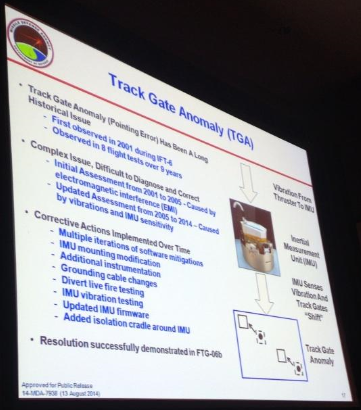
The slide that struck me as the most interesting was one titled “Track Gate Anomaly (TGA)” shown below:

TrackGateAnomaly

(more…)

“Informational Handouts” from MDA Environmental Impact Meetings Posted. (August 9, 2014)

The Missile Defense Agency (MDA) has begun holding a series of required public meetings as part of the Environmental Impact Review process for the proposed eastern U.S. Ground Based Midcourse (GMD) defense system interceptor site. The first meeting was held on Tuesday (August 5) in Ravenna Ohio. Apparently it was sparsely attended. You can read a description of the meeting here.

A number of other meetings will be held through August. The full list is here.

The MDA has posted its informational handout from the meeting here,

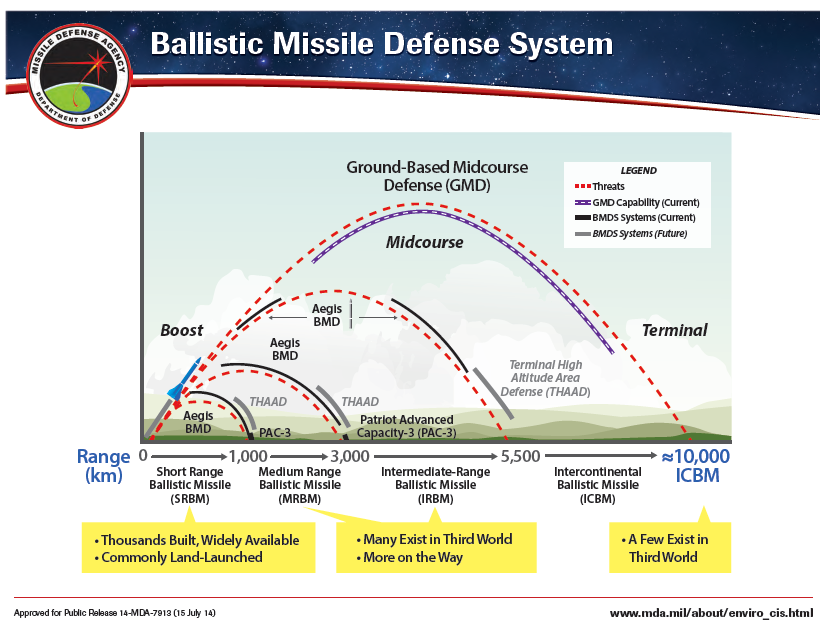
Two points from the handout struck me as noteworthy. First as the slide below suggests, MDA apparently believes that a few 10,000 km ICBMs now exist in the third world.

MDAMissileRanges

Second, the sites are being sized for up to 60 interceptors per site (3 x 20 launch silos). Given calls for expanding missile field 1 at Fort Greely Alaska from six to twenty silos, (which would bring the total in Alaska and California to 58 launch silos silos), this could indicate that we are headed for a total deployment of roughly 120 GBI interceptors in the not-too-distant future.

Lying Down on the Ground. It’s Almost as Effective as Iron Dome. And a Lot Cheaper. (July 24, 2014)

According to the Israeli Government, Iron Dome has been 85% effective (or perhaps a bit more) in destroying threatening rockets fired at its territory. However, each Iron Dome interceptor costs roughly $50,000-100,000, which adds up fast when there are a lot of rockets coming in. Moreover, a recent article in the Bulletin of Atomic Scientists by Theodore Postol challenges this claim, arguing that the evidence indicates that Iron Dome’s success rate in destroying the rockets is actually quite low.

On Sunday (July 20), another perspective on the threat posed by these rockets came out in the course of a hearing before the Israeli Supreme Court. The Court was ruling on a petition from several Bedouin and human rights organizations requesting that the Israeli government provide mobile bomb shelters to Bedouin villages in the Negev Desert. The court rejected the request, saying that the number of mobile bomb shelters was limited and that the government had prioritize where these were deployed.

A key argument made by the Israeli state attorney at the hearing was: “Bomb shelters are a last resort from a security perspective. Lying on the ground reduces danger by 80%.”

Imagine how effective an actual shelter would be.

(Actually, it is not clear how much either bomb shelters or lying down on the ground would actually help the Bedouins, since the warning sirens telling people to seek shelter apparently cannot be heard in many of the Bedouin villages.)

A Closer Look at the CBO’s Ground-Based Midcourse Defense (GMD) System Cost Figures (July 23, 2014)

The Congressional Budget Office has just released a very short report on the Missile Defense Agency’s future spending plans for its Ground-Based Midcourse (GMD) national missile defense system.[1] This Report, titled “Historical and Planned Future Budgets for the Missile Defense Agency’s Ground-Based Midcourse Defense Program” was released as a letter to Senator Jeff Sessions and is based on MDA’s budget request projections out through fiscal year 2019. It compares these GMD budget projections with actual GMD spending going back to FY 2008.

The main conclusions people seem likely to draw from the Report are that spending on the GMD system is expected to decline by more than a factor of two from its 2008 level and that by FY 2019 it will fall below $1 billion.[2] Specifically, the Report shows that GMD Research, Development, Test, and Evaluation (RDT&E) and GMD Procurement spending will total $789 million in FY 2019. Another $169 million for Operations and Maintenance (O&M) will bring the total FY 2019 GMD spending to $958 million. For comparison, the Report shows that in FY 2008 the total GMD spending was $2,093 million. (None of the $ figures in the Report have been adjusted for inflation.)

Several points should be made:

First the GMD budget falling below $1 billion is not a particularly significant benchmark (nor does the CBO Report say it is). According to the Report’s figures, actual FY 2013 spending on the GMD system was only $923 million.

Second, the actual planned spending on the GMD system will be significantly higher than shown in the CBO Report.[3] To illustrate this, I will focus on the planned GMD spending for FY 2019, the last year considered by the Report. As noted above, the Report says the currently planned GMD spending for FY 2019 is $958 million. However, if we look in more detail at the MDA’s planned budget we see that there are some significant omissions in what the CBO includes. For example, neither the Sea-Based X-Band (SBX) Radar ($63.0 million in FY 2019) nor the Long Range Discrimination Radar (LRDR) ($189 million in FY 2019) is included.[4] The FY 2019 GMD Test line item (Project MT08) included in the CBO cost figure is only $61.6 million.[5] Since each GMD test now costs $200 million or more, this suggests that roughly another $100-150 million for GMD testing should be included in the CBO’s FY 2019 GMD cost estimate figure.[6] A number of other projects that are intended to at least partially to contribute to the GMD system, such as the Common Kill Vehicle Technology Project ($54.3 million in FY 2019) are also not accounted for in the CBO figures.  Taken together, these omissions suggest MDA’s total planned spending for FY 2019 is much closer to $1.5 billion than the $958 million in the CBO Report.

Third, the numbers in the CBO Report are based on MDA plans that do not include a third interceptor site in the eastern United States. If this third site is not built, then by FY 2019, if everything proceeds according to plan, the GMD system would be nearly complete. All 44 planned GBI interceptors would be deployed, the Clear and Cape Cod radars would have been upgraded and incorporated into the system, and the LRDR would be nearly complete (with about $910 million spent on it through FY 2019). While there would certainly be significant ongoing costs, such as for operations, for testing (including buying new interceptors for this purpose) and for technology development and upgrades, one would certainly expect the GMD annual funding to be significantly less that it was FY 2008, when the system was in the midst of being built.

On the other hand, if a decision was made to proceed with a third interceptor site, the future GMD spending situation could look quite different.  The environmental impact statement for the proposed third site location will assess the deployment of between twenty and sixty interceptors at potential sites. If each interceptor cost the same as a current GBI interceptor, about $75 million, then the total cost just for the additional interceptors would be about $1.5-4.5 billion, which would require a large increase in GMD funding over current plans.

[1] Congressional Budget Office, “Historical and Planned Future Budgets for the Missile Defense Agency’s Ground-Based Midcourse Defense Program, letter to Senator Jeff Sessions, July 12, 2014. Available at: http://www.cbo.gov/sites/default/files/cbofiles/attachments/45546-GMD_Program.pdf.

[2] See for example, Jason Sherman, “CBO Traces Decline in GMD Spending From FY-08 To FY-19,” Inside Defense SITREP, July 23, 2014.

[3] The CBO Report (footnote a) states that the Report only includes funding in the Midcourse Defense program element and does not include “funding for other support activities that are contained in other program elements.”

[4] MDA’s planned budget can be found on pages 2a-xxi to 2a-xxiv of http://comptroller.defense.gov/Portals/45/Documents/defbudget/fy2015/budget_justification/pdfs/03_RDT_and_E/2_RDTE_MasterJustificationBook_Missile_Defense_Agency_PB_2015_Vol_2.pdf.

[5] This is not just an FY 2019 budget anomaly, as the FY 2015-2019 five year average for the GMD Test line item is $67.4 million.

[6] Most of this other GMD testing funding is likely in the Ballistic Missile Defense Test ($413 million in FY 2019) and the Ballistic Missile Defense Targets ($429.8 in FY 2019) program elements, which are not included in the CBO GMD cost figures.

Next Ground-Based Missile Defense (GMD) Intercept Test Could Be as soon as June 22. (June 6, 2014)

It appears that the next intercept test for the Ground-Based Midcourse national missile defense system is planned for Sunday, June 22 between 9:00 am and 1:00 pm U.S. east coast time. The target will be launched from Kwajalein in the Marshall Islands and the interceptor from Vandenberg Air Force Base in California

On Wednesday (June 4), Reuters cited two anonymous sources that the test, designated FTG-06b, would be held on June 22.[1]

However, today (June 6), the Pacific Islands News Association reported that, according to a warning issued by the U.S. Army, the planned test time was Monday June 23 between 4:00 am and 8:00 pm. The backup dates are June 24 and 25.

These two announced dates are not inconsistent because the of the 19 hour time difference between California and Kwajalein. Thus 4:00 am to 8:00 am on the 23rd at Kwajalein corresponds to 9:00 am to 1:00 pm on the 22nd in California. MDA usually specifies the date and time of a test using the time zone of the interceptor launch location. On the other hand, the U.S. Army warning was presumably intended for the local population near the target launch location, and thus likely uses Kwajalein time.

Thus from a U.S east coast perspective, the planned interceptor launch time is Sunday June 22 between 9:00 am and 1:00 pm.

This test is the third intercept test of the new CE-II version of the GBI interceptor’s kill vehicle. The previous two CE-II intercept tests failed, although a successful flight test not using a target was successfully conducted about a year ago.

If this upcoming test is successful, MDA will likely be able to almost immediately resume production of the 14 additional GBI interceptors it plans to deploy in Alaska by the end of 2017. A failure, depending on its cause, would likely impose significant delays on any future deployments of CE-II interceptors and may make the end of 2017 deadline impossible to achieve. It is now over 41 months since the most recent CE-II intercept test attempt, which failed.

[1] Andrea Shalal, “U.S. Missile Defense Test Could Shift Timing to Add Interceptors,” Reuters.Com, June 4, 2014

First Test Launch for Aegis Ashore (May 21, 2014)

The Missile Defense Agency announced today that it had conducted its first test launch of an Aegis SM-3 missile defense interceptor from an Aegis Ashore facility similar to the one planned to be operational in Romania by the end of next year. The test, using an SM-3 Block IB version of the interceptor, was conducted at the newly completed Aegis Ashore test facility in Hawaii and was described as successful. No target missile was used, and thus there was no intercept attempt.